Scottish Kilt Tartan Sett Drafting & Pleating Guide 2026
The Renaissance of Bespoke Highland Dress in 2026
The traditional Scottish kilt remains one of the most iconic and technically demanding garments in European folk dress. Unlike tailored trousers or standard skirts, a true kilt is an exercise in geometric precision, textile manipulation, and historical reverence. As we move through 2026, there has been a massive resurgence in artisanal kilt making, driven by a new generation of makers who value slow fashion, heritage crafts, and the mathematical beauty of traditional construction patterns. Whether you are drafting a historic clan sett or engineering a modern knife-pleated silhouette, mastering the foundational techniques of kilt construction is essential.
This comprehensive guide explores the intricate construction patterns and techniques required to build a traditional 8-yard Scottish kilt, from decoding the tartan sett to executing the invisible fell stitch.
Decoding the Tartan Sett: The Foundation of the Pattern
The 'sett' is the specific repeating pattern of colors and thread counts that make up a tartan. In kilt making, the sett is not merely a decorative print; it is the structural blueprint that dictates how the fabric will be pleated and aligned. According to the Scottish Register of Tartans, there are thousands of registered setts, each with a unique thread count sequence (e.g., K4 R24 K24 Y4).
When drafting a kilt, the maker must decide between two primary pleating techniques:
- Pleating to the Sett: The most common and traditional method. Each pleat is folded so that the pattern on the outside of the pleat perfectly matches the pattern of the unpleated apron. This creates a seamless, continuous geometric design across the back of the kilt.
- Pleating to the Stripe: Often used for military or band kilts. The maker selects one dominant vertical stripe in the sett and aligns the edge of every pleat to that exact stripe, creating striking vertical lines down the back of the garment.
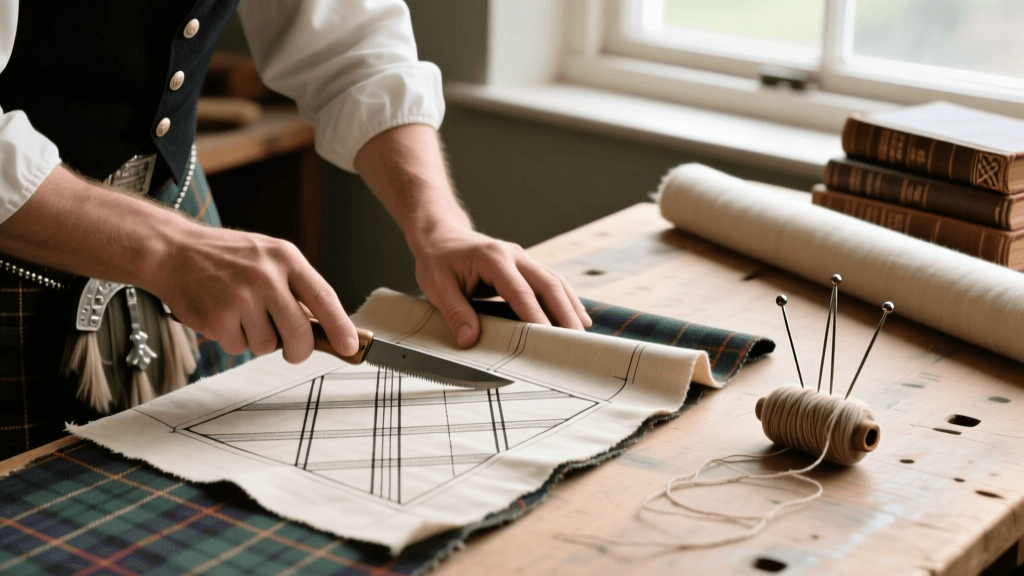
In 2026, while digital weaving software can visualize how a sett will pleat, traditional makers still rely on graph paper and physical fabric samples to calculate the exact width of each pleat based on the wearer's hip measurement and the physical size of the sett repeat.
Essential Measurements and Fabric Calculations
A standard traditional kilt requires approximately 8 yards (7.3 meters) of double-width (54-60 inches) worsted wool tartan. Precision in measuring is critical, as the kilt sits higher on the waist than modern trousers and must accommodate the natural movement of the body without gaping.
| Measurement Point | Description & Technique | Standard Allowance / Note |
|---|---|---|
| Upper Waist | Measured at the natural waistline, typically just above the navel. | Add 1-2 inches for comfort and breathing room. |
| Lower Waist / Hips | Measured across the widest part of the hips and buttocks. | This dictates the total width of the pleated section. |
| Fell Length | Distance from the upper waist to the widest part of the hips. | Usually 5 to 7 inches; determines where pleats are stitched down. |
| Total Length | Measured from the upper waist to the middle of the knee cap. | Kilt should hit mid-knee when the wearer is kneeling. |
Calculating the pleat depth requires dividing the hip measurement by the desired number of pleats (typically 25 to 30 for an 8-yard kilt). Each pleat must consume one full sett repeat plus an additional overlap (the under-pleat) to ensure opacity and structural integrity.
The Art of the Knife Pleat: Drafting and Pressing
The traditional Scottish kilt utilizes knife pleats, where all folds face the same direction. The construction process is labor-intensive and requires an understanding of textile behavior, particularly with heavy 16oz worsted wool.
Step 1: Marking and Basting
Using tailor's chalk and a specialized pleating board, the maker marks the exact sett alignment points on the wrong side of the fabric. Because the tartan pattern is woven, the maker must follow the exact warp and weft threads rather than relying on printed lines. The pleats are then folded and temporarily secured with long basting stitches along the fell line.
Step 2: The Clapper and Steam Technique
Pressing a wool kilt is an art form. Modern steam irons are insufficient for setting the deep, crisp edges required for a traditional kilt. Makers use a heavy wooden tool called a 'clapper'. After applying steam to the wool, the clapper is pressed firmly onto the damp fabric. The wood traps the heat and forces the steam deep into the wool fibers, permanently setting the pleat edge as it cools. As noted in the Victoria and Albert Museum's textile archives, this method of heat and moisture manipulation has been central to Highland dress tailoring for centuries.
Inner Construction: Canvas, Linings, and Fell Stitching
The true mark of a master kilt maker lies in the inner construction, which is entirely hidden from the outside world. A kilt is not merely pleated fabric; it is a structured garment engineered to support its own weight and maintain its shape over decades of wear.
Hair Canvas and Stiffeners
The inner waistband and the fell area (the section where pleats are stitched down before flaring out) are reinforced with heavy hair canvas or traditional linen stiffener. This interfacing prevents the pleats from sagging and provides a sturdy foundation for the heavy silver or brass kilt pins and sporran chains.
The Invisible Fell Stitch
Once the canvas is basted to the inner pleats, the maker uses a technique called 'fell stitching' to secure the edges of the pleats to the canvas and lining. Using a fine, strong linen thread, the maker takes microscopic stitches that catch only a single thread of the tartan wool on the right side, rendering the stitching completely invisible from the outside. This process alone can take 20 to 30 hours of hand-sewing for a single garment.
2026 Material Sourcing and Cost Guide
Sourcing authentic materials is crucial for historical accuracy and garment longevity. In 2026, the market for heritage textiles has stabilized, though premium artisanal wools command a higher price due to sustainable farming practices and specialized milling in the Scottish Borders.
- 16oz Heavyweight Worsted Wool: The gold standard for traditional kilts. In 2026, expect to pay between £85 and £130 per meter from premier mills like Lochcarron or Marton Mills. An 8-yard kilt requires roughly £700 to £1,000 in fabric alone.
- 13oz Mediumweight Wool: A popular alternative for warmer climates or active Highland dancing. Priced around £70 to £95 per meter.
- Linen Lining and Hair Canvas: Essential for the inner structure. High-quality Irish linen lining costs approximately £25 per meter.
- Leather Straps and Brass Buckles: Sourced from specialized Highland outfitters, a full set of three straps and solid cast brass buckles will cost around £80 to £120 in 2026.
Preserving a Living Heritage
Constructing a traditional Scottish kilt is a profound engagement with European folk dress history. It requires the maker to act as both a mathematician and an artisan, balancing the rigid geometry of the tartan sett with the organic curves of the human body. By mastering the techniques of precise pleating, traditional pressing, and invisible fell stitching, modern makers ensure that this iconic garment continues to be a living, breathing testament to Highland culture for generations to come.
For those looking to deepen their understanding of historical Highland dress construction, the National Museums Scotland offers extensive digital archives detailing the evolution of the kilt from the 16th-century 'feileadh mòr' (great kilt) to the tailored, pleated masterpiece we recognize today.