Authentic Chiton & Roman Stola Draping Guide for 2026
The Resurgence of Classical Antiquity Dress in 2026
The year 2026 has marked a significant turning point for historical reenactment, classical theater, and heritage fashion enthusiasts. Across Europe and the globe, there is a growing movement away from synthetic, mass-produced costumes toward meticulously researched, historically accurate garments. Whether you are preparing for a Hellenic revival festival, participating in a Nova Roman convention, or simply studying the evolution of European folk dress, understanding the foundational garments of the ancient Mediterranean is essential. The chiton and the Roman stola are not merely relics of the past; they are masterclasses in zero-waste pattern making, textile draping, and functional elegance.
Unlike modern tailored clothing, ancient Greek and Roman garments were primarily draped rather than cut and sewn. This means the beauty and fit of the garment rely entirely on the quality of the textile, the precision of the folds, and the strategic placement of pins and belts. In this comprehensive guide, we will break down the construction, draping techniques, and modern sourcing strategies for the Doric chiton, the Ionic chiton, and the Roman stola, ensuring your 2026 wardrobe is both authentic and breathtaking.
Mastering the Doric Chiton (The Peplos)
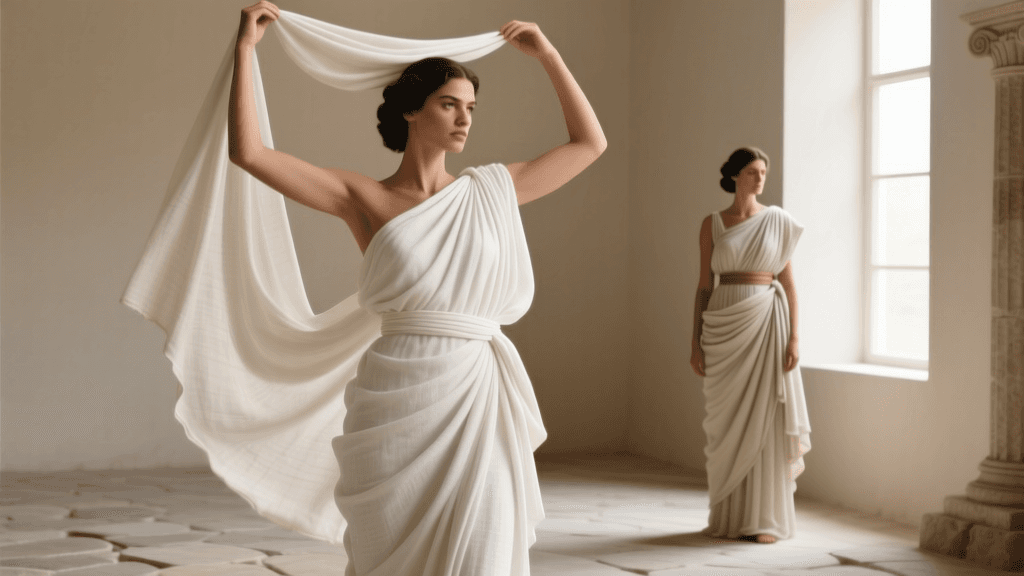
The Doric chiton, often referred to as a peplos, is the quintessential garment of ancient Greek women, characterized by its heavy woolen fabric and distinctive fold-over flap known as the apoptygma. This garment relies on the natural weight of the wool to create beautiful, columnar drapes that resemble the fluting of Doric architecture.
Measurements and Fabric Requirements
To create a Doric chiton, you need a single rectangular piece of wool. The width should be approximately twice the circumference of your body, allowing for deep, elegant folds. The height of the fabric must equal your desired length (from shoulder to ankle) plus the depth of the apoptygma (usually 12 to 18 inches, reaching anywhere from the hips to the mid-thigh).
Draping Steps
- Step 1: Fold the top edge of the fabric down to create the apoptygma.
- Step 2: Wrap the fabric around your body, ensuring the fold-over flap rests on the outside.
- Step 3: Pin the top edges together at both shoulders using reproduction bow fibulae or straight pins. The pins should catch both the front and back layers, as well as the folded flap.
- Step 4: Tie a woven wool or leather belt around the waist, either over or under the apoptygma, to blouse the fabric and adjust the hemline.
According to the Perseus Digital Library at Tufts University, the Doric chiton was heavily associated with the austere, martial, and traditional ideals of early Greek society, making the choice of a heavier, un-dyed or saffron-tinted wool historically appropriate for reenactors portraying classical antiquity.
The Ionic Chiton: Linen, Sleeves, and Elegance
As trade expanded and lighter textiles became available, the Ionic chiton emerged. Unlike the heavy wool peplos, the Ionic chiton was typically made from finely woven linen or even imported silk for the ultra-wealthy. Its defining feature is the creation of multiple sleeves through a series of pins or small sewn tacks along the upper arms.
The Art of Crinkling
One of the most striking visual elements of the Ionic chiton seen in ancient marble statues is the dense, vertical crinkling of the fabric. In 2026, textile artisans and reenactors achieve this historical effect through a meticulous wet-pleating process. The linen is tightly twisted, bound with string, and left to dry completely. When untied, the fabric retains a permanent, accordion-like texture that catches the light beautifully and allows the garment to stretch and move with the body.
Draping the Sleeves
Instead of a single pin at the shoulder, the top edge of the Ionic chiton is gathered and pinned at regular intervals (usually 3 to 5 inches apart) from the front shoulder, across the upper arm, to the back shoulder. This creates a series of elegant, flowing sleeves that leave the side of the torso open or loosely draped, often secured with a secondary belt beneath the bust.
Roman Garments: Layering the Tunica and Stola
While Greek dress focused on the single, draped garment, Roman women's fashion was defined by structured layering. The foundation of a respectable Roman matron's wardrobe in the Imperial era consisted of the tunica interior, the stola, and the palla (mantle).
The Tunica Interior
This was the base layer, essentially a simple, T-shaped or rectangular linen shift worn against the skin. It was usually knee-length and featured short sleeves or was sleeveless. In 2026, sourcing high-quality, breathable tabby-weave linen is crucial for this layer, as it provides comfort and absorbs moisture beneath the heavier stola.
The Stola and the Instita
The stola was the ultimate symbol of the Roman matron. Worn over the tunica, it was a long, sleeveless dress suspended from the shoulders by straps (institae) or small brooches. The most critical identifying feature of the stola was the instita—a distinct, often contrasting woven band or flounce sewn to the bottom hem. As noted by the British Museum's classical antiquities archives, the stola was strictly reserved for married, citizen women, serving as a visual marker of social status and modesty.
Draping the Palla
No Roman woman would step outside without her palla. This large rectangular woolen mantle was draped over the left shoulder, wrapped across the back, and brought over the right shoulder or pulled up over the head as a veil. Mastering the palla requires practice; the fabric must be heavy enough to stay in place without constant adjustment, yet soft enough to drape gracefully over the head and shoulders.
Sourcing Historically Accurate Textiles in 2026
The success of any ancient Mediterranean garment relies entirely on the textile. Modern synthetic blends, with their stiff drape and plastic sheen, will instantly ruin the historical illusion. In 2026, the historical costuming community has unprecedented access to heritage mills across Europe that produce historically accurate weaves.
When shopping for your chiton or stola, pay close attention to the weave structure. Ancient looms produced tabby (plain) weaves and simple twills. Avoid modern satin weaves, heavy damasks, or printed patterns, as these did not exist in classical antiquity. Instead, look for yarn-dyed stripes, simple geometric borders, and natural, unbleached, or plant-dyed colors (such as madder red, weld yellow, and woad blue).
2026 Fabric Comparison Chart
| Textile Type | Historical Era/Use | Weave Structure | 2026 Avg Cost (per yard) | Drape Quality |
|---|---|---|---|---|
| Lightweight Tabby Linen | Ionic Chiton, Tunica Interior | Plain Weave (High Thread Count) | $28 - $45 | Fluid, airy, requires crinkling |
| Medium-Weight Wool Flannel | Doric Chiton, Palla | Plain Weave (Fulled) | $35 - $60 | Heavy, columnar, excellent structure |
| Crinkled Linen | Ionic Chiton (Pre-pleated) | Plain Weave (Textured) | $40 - $55 | Stretchy, form-fitting, elegant |
| Heavy Wool Twill | Winter Stola, Cloaks | 2/2 Twill | $50 - $85 | Warm, stiff, highly durable |
For visual analysis of surviving marble drapery and textile fragments to guide your fabric choices, the Metropolitan Museum of Art's Greek and Roman Art Collection provides invaluable, high-resolution reference points for understanding how ancient fabrics behaved in motion.
Essential Accessories: Fibulae and Belts
You cannot securely drape a chiton or stola without the proper hardware. The fibula (brooch) was the safety pin of the ancient world. For a Doric chiton, large, ornate bow fibulae or simple straight pins with decorative heads are historically accurate. For the Ionic chiton, smaller, delicate rosette or disc fibulae are preferred to manage the multiple shoulder points without tearing the fine linen.
In 2026, several specialized artisan smiths across Europe and North America offer museum-quality reproduction fibulae cast in bronze, brass, or silver. Avoid cheap, zinc-alloy costume jewelry, as the pins are often too dull to pierce woven wool and will bend under the weight of the fabric.
Belts (zona) were equally important. Woven tablet-weave bands, braided wool cords, and simple leather straps with bronze buckles were used to blouse the chiton and stola. The placement of the belt dramatically changes the silhouette: a high belt beneath the bust creates an empire-waist look common in Hellenistic art, while a low belt on the hips creates the traditional, bloused kolpos effect of the classical era.
Garment Care and Maintenance
Caring for historically accurate wool and linen requires a departure from modern laundry habits. Ancient garments were rarely washed with harsh soaps; instead, wool was cleaned using fuller's earth or lanolin-rich treatments, while linen was beaten and bleached in the sun. In 2026, you should hand-wash your woolen chitons in cool water with a specialized wool wash to preserve the lanolin and prevent felting. Linen stolas can be machine-washed on gentle cycles but should always be line-dried to maintain the integrity of the fibers. Store your garments rolled rather than folded to prevent permanent crease lines that would disrupt the natural drape.
Conclusion
Embracing the chiton and the Roman stola is an exercise in connecting with the ancient world through the tactile experience of cloth. By understanding the distinct differences between the heavy, folded Doric peplos, the delicate, sleeved Ionic chiton, and the layered, status-driven Roman stola, you can create a wardrobe that is not only visually stunning but deeply authentic. As the historical costuming community continues to elevate its standards in 2026, investing in heritage textiles, mastering the art of the drape, and utilizing proper bronze fibulae will ensure your ancient Mediterranean garments stand the test of time, both on the reenactment field and in the annals of classical revival.