Master 8-Yard Scottish Kilt Pleating & Sett Alignment in 2026
The Resurgence of Bespoke Highland Dress in 2026
The art of kiltmaking is experiencing a profound renaissance in 2026. As global interest in sustainable, slow-fashion heritage garments grows, the traditional 8-yard Scottish kilt has emerged as a pinnacle of bespoke tailoring. Unlike machine-made alternatives, a hand-stitched kilt requires an intimate understanding of geometry, textile behavior, and historical construction patterns. For artisans and enthusiasts looking to master European folk dress construction, the Scottish kilt offers a masterclass in precision. According to the Scottish Tartans Authority, the demand for authentic, hand-pleated kilts woven in heritage Scottish mills has reached a decade-high this year, driven by a renewed appreciation for ancestral craftsmanship and garment longevity.
Decoding the Tartan Sett: The Blueprint of the Kilt
Before cutting a single thread, a kiltmaker must understand the 'sett'—the repeating geometric pattern of the tartan. The sett is the foundational blueprint of the garment. Tartans can be symmetrical (where the pattern reverses at the pivot points) or asymmetrical (where the pattern repeats in one continuous direction). Aligning the sett across the pleats is what separates a master kiltmaker from an amateur.
In 2026, digital fabric mapping tools are sometimes used to visualize the sett, but traditional hand-measuring remains the gold standard for bespoke garments. The kiltmaker must identify the dominant color stripes to serve as the visible edge of each pleat. When the wearer stands still, the pleated back of the kilt should perfectly mirror the unpleated apron, creating a continuous, unbroken tartan pattern around the body. This optical illusion requires meticulous calculation, as the fabric hidden inside the folds must be accounted for without disrupting the visible exterior alignment.
Essential Materials and Tools for the Modern Artisan
Constructing an 8-yard kilt requires specific, heavy-duty materials capable of withstanding decades of wear. The industry standard in 2026 remains 16oz worsted wool, prized for its ability to hold a razor-sharp crease. For warmer climates or active dancing, 13oz wool is occasionally utilized, though it requires more aggressive steaming to set the pleats.
To execute the construction, you will need the following specialized tools:
- Kiltmaker's Chalk: A sharp, clay-based chalk for marking precise lines on heavy wool without leaving permanent residue.
- Basting Thread: High-visibility, easily breakable cotton thread used to temporarily hold pleats before the final pressing.
- Wooden Clapper: An essential hardwood block used to trap steam and force the wool fibers to accept the pleat's shape.
- Heavy-Duty Needles: Sharps or betweens capable of piercing multiple layers of 16oz wool and canvas interlining.
- Linen Canvas Interlining: Used to stiffen the fell (the upper, flat portion of the pleats) and provide structural support for the leather straps.
The Mathematics of the 8-Yard Kilt
The term '8-yard kilt' refers to the total length of the double-width fabric (typically 54 to 60 inches wide) used before pleating. However, the actual construction relies on a strict division of this fabric. A standard allocation divides the 288 inches (8 yards) into three primary sections: the outer apron, the under-apron, and the pleated section. The pleated section alone consumes roughly 6 yards of fabric, which is compressed into approximately 25 to 30 individual pleats, depending on the wearer's waist measurement and the size of the tartan sett.
Comparing Traditional Pleating Techniques
| Pleating Style | Visual Effect | Fabric Allocation | Best Suited For |
|---|---|---|---|
| Knife Pleats to the Sett | Continuous tartan pattern; most common. | 6+ yards compressed into deep folds. | Ceremonial wear, pipe bands, formal Highland dress. |
| Knife Pleats to the Stripe | Vertical stripes dominate the back; tartan breaks. | Similar to sett pleating, aligned to a single color. | Military regiments, dancers requiring sharp visual lines. |
| Box Pleats | Geometric, squared-off folds; bulky but structured. | Requires precise, equal-width fabric folding. | Historical reenactment, specific regional clan variations. |
Step-by-Step Hand-Pleating and Sett Alignment
The actual construction of the kilt is a labor-intensive process that typically takes 20 to 30 hours of focused work. Below is the definitive guide to the hand-pleating process as practiced by master tailors in 2026.
Step 1: Measuring and Marking the Fell
The 'fell' is the upper portion of the kilt that sits flat against the wearer's lower back and hips, extending from the waist down to the hipline (usually 9 to 11 inches). The pleats are stitched down completely through this section. Using the kiltmaker's chalk, mark the exact width of each pleat on the wrong side of the fabric. The visible edge of each pleat must align perfectly with the dominant stripe of the sett. You must calculate the 'under-fold'—the fabric hidden behind the visible edge. A standard pleat might show 4 inches of tartan but hide 8 to 12 inches of fabric inside the fold to provide the necessary swing and weight.
Step 2: Basting and Pressing
Once marked, fold the fabric along the chalk lines and secure it with long basting stitches. This is where the wooden clapper becomes vital. Wool is a natural fiber that responds to heat and moisture. Apply a damp press cloth over the folded edge, hit it with a high-steam iron, and immediately press the wooden clapper down hard onto the fold. The clapper traps the steam, forcing the wool fibers to cool rapidly in the compressed position. This technique ensures the pleat will remain razor-sharp even after years of wear and dry cleaning.
Step 3: Tapering the Pleats
The human body is not a cylinder; the hips are wider than the waist. If the pleats are folded with uniform width from top to bottom, the kilt will flare out awkwardly at the waist. To achieve a custom fit, the kiltmaker must taper the pleats. This is done by taking small, calculated darts out of the hidden under-fold of the pleat within the fell area. By narrowing the top of the hidden fold while maintaining the exact width of the visible sett stripe, the kilt naturally curves inward to hug the wearer's waist without distorting the exterior tartan pattern.
Step 4: Fell Stitching
With the pleats pressed and tapered, they must be permanently secured. Artisans use a 'fell stitch'—a nearly invisible hand stitch that catches only a single thread of the top layer of the pleat and passes through the underlying layer. This stitch must be tight enough to hold the heavy wool but loose enough to prevent puckering. In 2026, synthetic core-spun threads are often favored for their immense tensile strength, ensuring the structural integrity of the garment outlasts the wool itself. For deeper historical context on the evolution of these stitching methods, the Victoria and Albert Museum maintains an extensive archive of 19th-century Highland dress construction that continues to inform modern bespoke techniques.
Constructing the Apron and Waistband
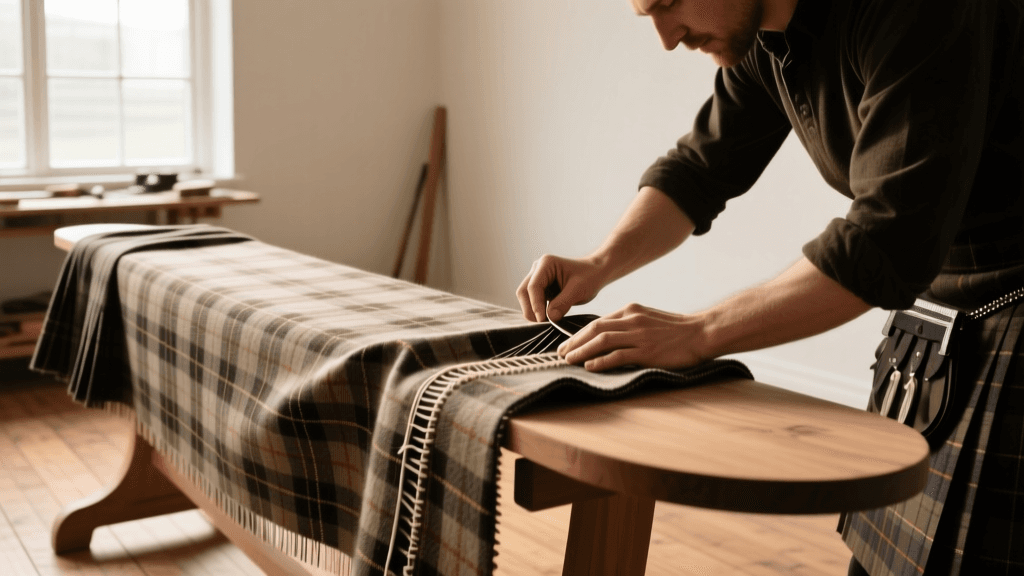
The aprons are the flat, unpleated panels that wrap around the front of the wearer. The under-apon is hemmed and finished simply, while the outer apron requires meticulous fringe work. The fringe is created by unraveling the weft threads of the wool at the edge of the fabric and twisting them into tight, uniform cords. This fringe is then sewn to the opposite edge of the outer apron, providing a decorative and functional border.
Behind the aprons and the fell, a layer of heavy linen canvas is pad-stitched by hand. This interlining provides the rigidity required to support the weight of the 8 yards of wool and the leather straps. The waistband is applied last, encasing the top edge of the canvas and wool, and finished with a soft cotton or satin lining to ensure comfort against the skin.
Final Fitting and 2026 Styling Trends
The final stage of kilt construction involves attaching the leather straps and buckles. Modern bespoke kilts in 2026 often feature three straps on the right side and one on the left, allowing for micro-adjustments in fit. As noted by heritage tailoring experts at Houston Kiltmakers, contemporary clients are increasingly requesting subtle modernizations, such as hidden interior pockets for modern devices or lightweight, breathable linings, while strictly maintaining the exterior historical accuracy of the 8-yard silhouette.
Mastering the construction patterns of the Scottish kilt is a journey into the heart of European textile heritage. It demands patience, mathematical precision, and a deep respect for the raw materials. Whether you are an aspiring kiltmaker or a cultural historian, understanding the intricate geometry of sett alignment and the physical labor of hand-pleating reveals why the 8-yard kilt remains one of the most sophisticated and enduring examples of traditional folk dress in the world today.