Authentic Norwegian Bunad 2026: Regional Styles Guide
The Cultural Renaissance of the Norwegian Bunad in 2026
In the landscape of European folk dress, few garments command the reverence, strict adherence to tradition, and widespread contemporary use as the Norwegian bunad. As of 2026, the bunad is far more than a historical costume relegated to museum displays; it is a living, breathing symbol of regional identity and national pride. Over 70 percent of Norwegian women and a rapidly growing demographic of men own at least one bunad, wearing them for Constitution Day (May 17th), weddings, christenings, and milestone anniversaries. Unlike many European folk traditions that faded during the industrial revolution, the bunad has experienced a continuous cultural renaissance, evolving into a highly regulated and deeply cherished textile art form.
It is crucial to distinguish between a folkedrakt (the historical, everyday peasant clothing worn by rural Norwegians up until the 19th century) and the bunad (the modern revival and reconstruction of these garments). The modern bunad movement is heavily overseen by the Bunad- og folkedraktrådet (The National Council for Folk Costumes). This authoritative body ensures that contemporary manufacturers and artisans adhere strictly to historical patterns, traditional materials, and authentic color palettes, preventing the commercialization and dilution of regional heritage.
The Historical Roots: From 1905 to 2026
The genesis of the modern bunad movement is inextricably linked to the Norwegian national romanticism of the late 19th and early 20th centuries, culminating in the dissolution of the union with Sweden in 1905. As Norway sought to establish a distinct national identity, cultural pioneers looked to the isolated valleys and fjords where traditional weaving, embroidery, and silversmithing had survived untouched by continental fashion trends. Today, in 2026, this ethos remains intact. The demand for historically accurate, locally sourced materials—such as hand-woven vadmel (woolen cloth) and hand-spun linen—has never been higher, driven by a new generation of consumers prioritizing sustainability, slow fashion, and deep cultural roots over mass-produced alternatives.
Major Regional Variations: A County-by-County Breakdown
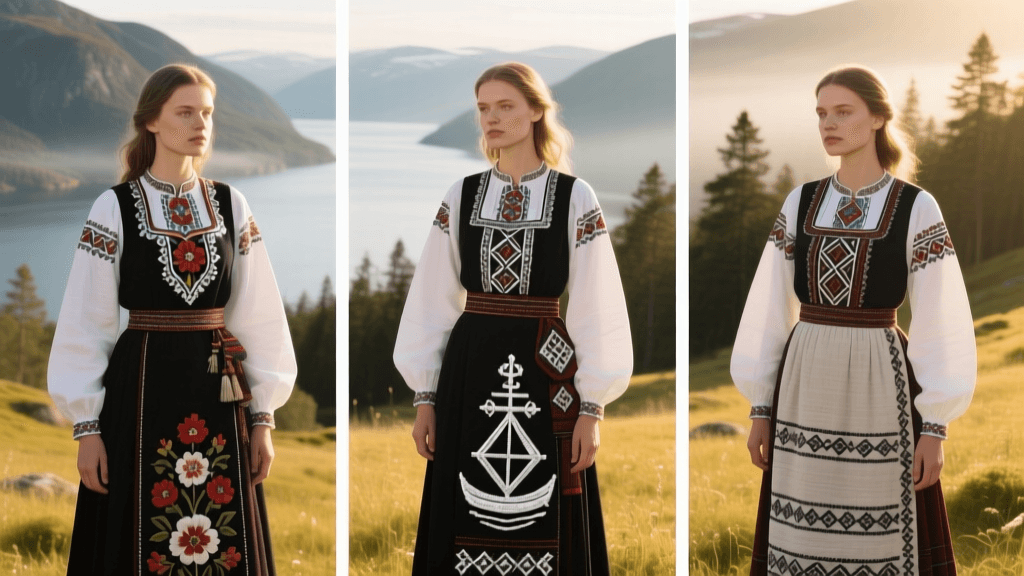
Norway boasts over 450 distinct bunad variations, each tied to a specific valley, municipality, or county. The geographical isolation of Norway's dramatic landscape allowed highly localized textile traditions to flourish. Below is an exploration of some of the most prominent regional styles.
The Hardangerbunad (Vestland)
Often referred to as the 'first bunad,' the Hardangerbunad originates from the breathtaking Hardangerfjord region in Vestland. It was championed in the early 1900s as the quintessential Norwegian national dress. The women's garment is characterized by a dark blue or black wool skirt and bodice, paired with a white linen apron featuring intricate korssting (cross-stitch) embroidery in vibrant reds, yellows, and greens. The men's version features a striking red or black wool vest with elaborate floral embroidery, silver buttons, and a high-collared linen shirt. In 2026, the Hardangerbunad remains the most recognizable Norwegian folk dress internationally, though local artisans continue to fiercely protect its specific geometric pattern copyrights.
The Telemarksbunad (Telemark)
The Telemark region is celebrated for its rich folk art, particularly rosemaling (decorative wood painting), and this aesthetic translates directly into its bunads. The East Telemark bunad is widely considered one of the most exquisite and complex garments in the Norwegian repertoire. It features asymmetrical, flowing wool embroidery (rosesaum) that mimics the curling acanthus leaves and floral motifs of traditional rosemaling. The color palette is remarkably diverse, utilizing deep reds, blues, and golds against a dark wool base. Sourcing the specific, historically accurate hand-dyed yarns for Telemark embroidery remains a specialized skill in 2026, with master embroiderers often maintaining waiting lists of over a year for custom commissions.
The Nordlandsbunad (Nordland)
Representing the rugged beauty of Northern Norway, the Nordlandsbunad was developed in the mid-20th century based on a 17th-century church textile from the region. It is instantly recognizable by its deep, midnight-blue wool base adorned with exquisite silk embroidery depicting local Arctic flora, including the cloudberry, forget-me-not, and campanula. The women's bunad features a distinctive silk apron and a velvet bodice, while the men's includes a striking blue wool coat with silver clasps. The Nordlandsbunad is a source of immense pride in Northern Norway, symbolizing the resilience and unique cultural heritage of the Arctic communities.
The Valdresbunad (Innlandet)
Hailing from the inland valleys of Innlandet, the Valdresbunad is based on garments from the late 18th century. It is renowned for its elegant, pleated wool skirt and a velvet bodice trimmed with delicate, metallic-thread floral embroidery. The Valdres region has a strong tradition of textile preservation, and the local bunad committees in 2026 have recently approved the reconstruction of several rare 18th-century outerwear pieces, including the brudekappe (bridal cape), allowing modern brides to incorporate even deeper historical layers into their wedding attire.
Comparative Guide to Regional Bunads (2026 Edition)
| Regional Style | Origin County | Primary Embroidery Technique | Approx. 2026 Complete Set Price (USD) |
|---|---|---|---|
| Hardangerbunad | Vestland | Cross-stitch (Korssting) | $4,200 - $5,500 |
| East Telemark | Telemark | Wool Floral (Rosesaum) | $5,500 - $7,500 |
| Nordlandsbunad | Nordland | Silk Botanical | $4,800 - $6,200 |
| Valdresbunad | Innlandet | Metallic Thread Floral | $4,500 - $6,000 |
Note: Prices reflect complete sets including hand-woven textiles, custom tailoring, and basic silver accessories, based on 2026 market rates from authorized Norwegian retailers.
Sourcing, Pricing, and Authenticity in 2026
Acquiring an authentic bunad is a significant financial and temporal investment. In 2026, the global supply chain for specialized heritage textiles remains tight, and the scarcity of master artisans capable of executing historical embroidery techniques has driven prices upward. A complete, custom-tailored women's bunad from an authorized dealer typically ranges from $4,500 to over $7,500 USD, depending on the complexity of the embroidery and the amount of silver required.
To ensure authenticity and support the local heritage economy, buyers are strongly advised to purchase through authorized member organizations such as Norges Husflidslag (The Norwegian Folk Art and Craft Association). Husfliden boutiques across Norway offer certified materials, authorized embroidery kits, and professional tailoring services. Beware of mass-produced 'costume' imitations sold online; these garments often feature machine-embroidered synthetic fabrics that violate the strict guidelines set by the National Council for Folk Costumes and are widely frowned upon in Norwegian cultural circles.
Essential Accessories: The Role of Bunadsølv
A bunad is incomplete without its accompanying bunadsølv (bunad silver). Historically, silver was a form of portable wealth for Norwegian farmers, and the amount of silver worn on a bunad indicated a family's social and economic standing. Today, the silver remains a vital component, often passed down through generations as heirlooms.
A standard women's silver set includes a brystknapp (breastplate or brooch), a veskelås (ornate purse clasp), cufflinks, and a belt buckle. The silver is typically oxidized to highlight the intricate filigree and sølje (dangling spoon-like pendants) designs. According to archival records preserved at the Norsk Folkemuseum (Norwegian Museum of Cultural History), the tradition of hoarding and displaying silver on folk garments dates back to the 16th century. In 2026, a complete set of hand-forged, oxidized sterling silver accessories can easily add $1,500 to $3,000 to the total cost of the garment.
Undergarments and Outerwear: Completing the Silhouette
The visual impact of a bunad relies heavily on the layers worn beneath and over the main wool garments. The foundational layer is the serk or skjorte, a shift or shirt made from pure, unbleached linen. These shirts often feature intricate white-on-white embroidery, drawn-thread work (hardangersaum), or delicate lace cuffs and collars. Linen is essential not only for historical accuracy but also for temperature regulation, keeping the wearer comfortable beneath the heavy wool during long summer celebrations.
Outerwear is equally regulated. Depending on the region, this may include a hand-woven wool shawl, a silk scarf pinned with a specific silver brooch, or a tailored wool cape lined with linen. Headwear is also strictly dictated by regional customs and marital status; for example, in many traditional bunads, married women must wear a specific linen cap or veil, while unmarried women wear their hair uncovered or adorned with a simple ribbon or silver crown.
Practical Advice: Ordering, Fitting, and Garment Care
If you are planning to commission a bunad for a specific event in 2026, such as a May 17th celebration or a summer wedding, you must begin the process at least 12 to 18 months in advance. The initial consultation involves selecting the specific regional variant based on your family's ancestral origins or your current place of residence. Following this, precise measurements are taken by a certified tailor.
A unique and practical feature of authentic bunad tailoring is the inclusion of generous seam allowances—often up to two inches of extra fabric hidden inside the seams. This historical design choice allows the garment to be let out or taken in, accommodating natural weight fluctuations over a lifetime of wear, ensuring the bunad remains a lifelong companion rather than a temporary purchase.
Caring for a bunad requires strict adherence to traditional methods. Dry cleaning is absolutely forbidden, as the harsh chemicals will strip the natural lanolin from the vadmel wool and tarnish the metallic embroidery threads. Instead, garments should be aired out in a cool, dry environment after wearing. Minor stains on the wool should be gently spot-cleaned with a damp cloth and mild wool soap. When not in use, the bunad must be stored in a breathable, unbleached cotton garment bag to protect it from light and dust; plastic covers must never be used, as they trap moisture and invite moth damage. Silver accessories should be removed before storage and polished gently with a specialized silver cloth to maintain their oxidized patinas.
Conclusion
The Norwegian bunad stands as a testament to the enduring power of regional identity in an increasingly homogenized world. By strictly preserving historical techniques, supporting local artisans, and wearing these garments with pride, Norwegians ensure that their textile heritage remains a vibrant, living tradition well into the future. Whether you are tracing your Scandinavian ancestry or simply studying the pinnacle of European folk dress, the regional bunads of Norway offer an unparalleled masterclass in cultural preservation, craftsmanship, and sartorial elegance.