Authentic Bavarian Tracht for Schuhplattler Dance Festivals 2026
The Intersection of Heritage and Kinetics
When discussing European folk dress, few garments are as globally recognized—or as fundamentally misunderstood—as the Bavarian and Austrian Tracht. While often reduced to seasonal tourist souvenirs, authentic traditional dress is a highly engineered, deeply symbolic, and remarkably functional wardrobe. Nowhere is this functionality more apparent than in the Schuhplattler, the iconic Alpine folk dance characterized by rhythmic stomping, thigh-slapping, and acrobatic leaps. As the 2026 festival circuit and the prestigious Gaufest competitions approach, dance troupes and cultural preservationists are placing a renewed emphasis on historically accurate, kinetically optimized costumes.
The Schuhplattler is not merely a visual performance; it is a percussive art form where the dancer’s body and their garments act as the instruments. The sharp crack of leather against skin, the flare of a heavily pleated skirt during a rapid spin, and the resonant thud of hobnailed shoes on a wooden stage all contribute to the auditory and visual spectacle. According to the Bavarian National Museum, the evolution of Alpine Tracht has always been intrinsically linked to the physical demands of rural life and communal celebration, a tradition that modern dance troupes rigorously maintain today.
Lederhosen: The Percussive Canvas
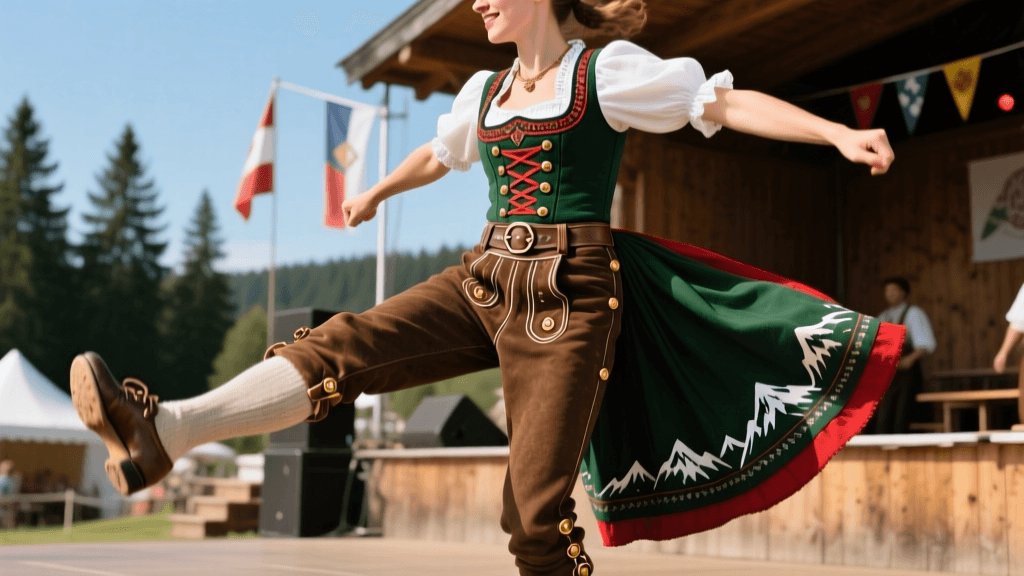
For the male dancer, the Lederhosen (leather breeches) are the centerpiece of the performance. However, not all Lederhosen are created equal. A pair designed for casual beer garden wear will fail catastrophically during a rigorous Schuhplattler routine. The secret lies in the leather selection and the tanning process.
The Supremacy of Hirschleder (Deer Leather)
Authentic dance troupes in 2026 exclusively favor Hirschleder (deer leather) or, less commonly, Gamsleder (chamois). Deer leather is prized for its unique combination of durability, softness, and acoustic properties. When a dancer executes the Watschn (the signature slapping of the thighs and calves), deer leather produces a sharp, resonant crack that echoes through festival halls. Cow leather (Rindsleder) is too thick and stiff, resulting in a dull thud, while goat leather (Ziegenleder) can be too thin and prone to tearing under the friction of repetitive slapping.
In 2026, master Säckler (traditional leatherworkers) have perfected vegetable-tanning techniques that yield a supple yet resilient hide. The leather must be 'sämisch' (oil-tanned) to allow it to breathe and move with the dancer. A well-made pair of dance Lederhosen will mold to the dancer's musculature, providing a second-skin fit that prevents the fabric from bunching during high kicks and jumps.
Structural Integrity: Suspenders and Seams
The Hosenträger (suspenders) are critical for maintaining the garment's position during acrobatic moves like the Fensterln (where dancers form human pyramids). Dance-specific Lederhosen feature wide, H-style suspenders with reinforced cross-pieces and heavy-duty metal clips or traditional horn buttons. The seams are stitched with heavy waxed linen thread, often featuring the iconic Federkielstickerei (quill embroidery) in vibrant greens and reds, which not only denotes regional origin but also reinforces the stress points of the garment.
The Dirndl in Motion: Engineering the Spin
While the male dancers provide the percussive rhythm, the female dancers provide the visual melody through the Dirndl. In the context of the Schuhplattler, the Dirndl is a marvel of aerodynamic tailoring. The female role in the dance involves continuous, rapid spinning (Drehen) while holding the skirt, creating a mesmerizing bell-like silhouette.
The Faltenrock (Pleated Skirt)
A standard fashion Dirndl features gathered fabric, but a traditional dance Dirndl utilizes a Faltenrock—a meticulously knife-pleated or cartridge-pleated skirt. These precise pleats ensure that when the dancer spins, the skirt flares out perfectly symmetrically, creating a uniform circle of color. In 2026, troupes often commission skirts made from lightweight, high-thread-count cotton or fine wool blends that hold a sharp pleat even after hours of vigorous movement and stage lighting heat.
The Mieder (Bodice) and Support
The bodice must offer substantial support without restricting the dancer's breathing or arm movements. Traditional dance bodices are structured with internal boning and feature a deep, square or round neckline. They are laced tightly but ergonomically, distributing pressure evenly across the torso. The Stecker (the decorative bib or stomacher inserted into the bodice) is often secured with hidden snaps to prevent it from shifting during lifts and partner-swapping choreography.
The Schürze (Apron)
The apron is tied securely at the front. Beyond its aesthetic role, the apron's fabric weight is carefully chosen to complement the skirt. A silk apron provides a beautiful sheen and fluid movement, while a fine cotton apron offers a more matte, traditional rural aesthetic. The tying of the bow remains a strict indicator of marital status, a cultural code that preservation societies monitor closely during competitions.
Footwear: The Foundation of the Rhythm
The Schuhplattler requires footwear that can withstand immense impact while providing grip and ankle support.
- Haferlschuhe (Men): These traditional Bavarian shoes feature a distinctive side-lacing system and a sturdy, often double-layered leather sole. For stage performances in 2026, many dancers add discreet rubber heel taps or specialized hobnails to amplify the stomping sequences (Stampfen) without damaging historic wooden stages.
- Dirndlschuhe (Women): Female dancers wear sturdy, low-heeled shoes with an ankle strap. Stilettos or high-fashion pumps are strictly forbidden in traditional troupes due to the danger they pose during rapid spins and the jarring visual dissonance they create. The ideal shoe has a reinforced shank to support the arch during continuous pivoting.
2026 Material and Acoustic Comparison
Choosing the right leather is paramount for the acoustic success of a Schuhplattler performance. Below is a comparison of materials utilized by dance troupes in the current festival season.
| Leather Type | Best Application | Acoustic 'Slap' Quality | 2026 Avg. Price (EUR) | Break-in Time |
|---|---|---|---|---|
| Hirschleder (Deer) | Professional Dance Troupes | Exceptional (Sharp, loud crack) | €850 - €1,400 | 2-3 weeks of active wear |
| Gamsleder (Chamois) | Historical Reenactment | Very Good (Slightly softer) | €900 - €1,500 | 3-4 weeks of active wear |
| Ziegenleder (Goat) | Casual / Youth Troupes | Fair (Higher pitch, less resonance) | €450 - €700 | 1 week |
| Rindsleder (Cow) | Workwear / Fashion | Poor (Dull thud) | €250 - €500 | Months (Often too stiff for dance) |
Accessories: Completing the Stage Presence
No Tracht ensemble is complete without its regional accessories, which add vital splashes of color and texture to the stage.
Hats and the Gamsbart
Male dancers typically wear a wool felt hat adorned with a Gamsbart (a tuft of chamois or deer hair). The size and quality of the Gamsbart denote the wearer's status and the formality of the event. During the Schuhplattler, the hat must be secured with a hidden chin strap or hat pin to prevent it from flying off during the energetic leaping sequences.
Loferer and Calf Warmers
The lower legs are wrapped in Loferer (thick, ribbed calf warmers) or pulled-up wool socks. These serve a dual purpose: they protect the shins and calves from the intense friction and impact of the slapping, and they provide a uniform visual line that emphasizes the synchronization of the troupe's footwork. According to the Tyrolean Folk Art Museum, the specific knitting patterns and colors of these socks are often strictly regulated by local heritage committees to ensure regional accuracy.
Sourcing and Caring for Dance Tracht in 2026
Acquiring authentic, dance-ready Tracht requires bypassing mass-market souvenir shops and connecting directly with master artisans. In 2026, the demand for bespoke, sustainably sourced Tracht has led to longer waiting lists at renowned Säckler workshops in Upper Bavaria, Salzburg, and Tyrol. Dancers are advised to commission their Lederhosen at least six months before the festival season to allow for multiple fittings and the essential break-in period.
Maintenance is equally crucial. Leather must be regularly treated with natural lanolin-based conditioners to prevent it from drying out and cracking under stage lights. Dirndl skirts require professional steaming after every performance to reset the knife pleats, and bodices must be aired out and spot-cleaned to preserve the integrity of the internal boning and delicate embroidery.
Conclusion
The preservation of the Schuhplattler and its accompanying Tracht is a testament to the living, breathing nature of European folk dress. As recognized by the UNESCO Intangible Cultural Heritage frameworks that protect Alpine traditions, these garments are not static museum pieces. They are dynamic, engineered costumes that bridge the gap between historical identity and physical expression. For the dancers taking the stage in 2026, wearing authentic, properly crafted Tracht is the ultimate sign of respect for their ancestors, their art form, and the enduring rhythm of the Alps.