Authentic Sardinian Pibiones Weaving & Brands Guide 2026
The Enduring Legacy of the Costume Sardo in 2026
Sardinia’s traditional garments, collectively known as the Costume Sardo, represent one of the most diverse and meticulously preserved folk dress traditions in Europe. Unlike many regional costumes that have been relegated to museum displays or annual festival reenactments, Sardinian heritage textiles remain a living, breathing component of the island's cultural identity. As we navigate the global fashion and heritage landscape in 2026, there is a profound resurgence in the appreciation for regional Italian textiles, driven by a demand for sustainable, slow-fashion garments with deep historical roots.
At the heart of this revival is the Pibiones weaving technique and the intricate construction of the Nuorese folk dress. Today, a new generation of heritage brands and artisanal cooperatives is ensuring that these ancient methods survive, adapting them for contemporary wardrobes while fiercely protecting their historical integrity. According to the Sardegna Artigianato portal, the island's textile cooperatives have seen a 34% increase in international commissions since 2024, signaling a global awakening to the value of Sardinian craftsmanship.
Deconstructing the Nuorese Folk Dress
To understand the current market for Sardinian heritage garments, one must first understand the anatomy of the traditional dress, particularly from the Nuoro province, which is widely considered the epicenter of Sardinian folkloric preservation. The Nuorese dress is characterized by its rich layers, vibrant colors, and heavy use of brocade and velvet.
- Sa Camija (The Shirt): The foundational layer, typically made of hand-loomed linen. In 2026, authentic heritage shirts feature intricate traballu (embroidery) around the collar and cuffs, often utilizing a technique called a filu tiradu (drawn threadwork).
- Su Busto / Sa Bitta (The Bodice): A structured, heavily decorated corset-like garment. Traditional Nuorese bodices are crafted from silk velvet or brocade, lined with heavy canvas, and fastened with ornate filigree silver or gold buttons (bottoni).
- Sa Veste / Su Pannu (The Skirt): A heavy, pleated skirt usually made of dark wool or orbace (a traditional coarse Sardinian wool), trimmed with vibrant silk ribbons at the hem.
- Su Faldita (The Apron): Far from a mere protective layer, the Sardinian apron is a masterpiece of weaving, often featuring the raised pibiones texture and intricate geometric motifs that denote the wearer's specific village and marital status.
The Pibiones Technique: Weaving the 'Grains'
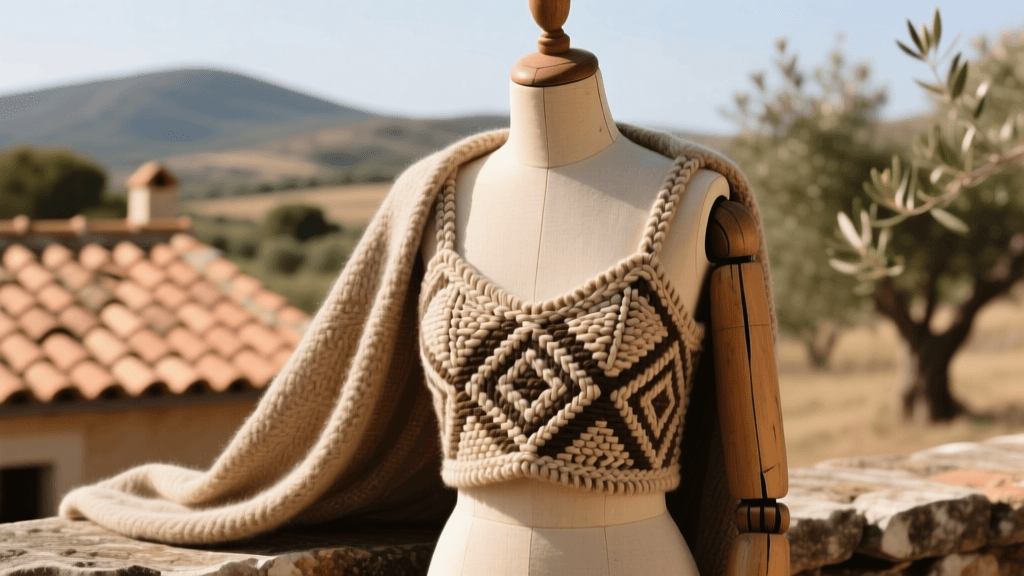
The crown jewel of Sardinian textile heritage is the Pibiones (meaning 'grains' or 'berries' in the Sardinian dialect) weaving technique. Predominantly practiced in the villages of Samugheo, Sarule, and Ollolai, this method creates a distinct, raised three-dimensional texture on the fabric's surface.
The technique requires a master weaver to use a supplementary weft thread. As the weaver passes the shuttle, they wind the supplementary yarn around a smooth rod—traditionally a polished myrtle branch or a specialized metal needle—placed across the warp. When the rod is removed, the yarn forms tight, raised loops or 'grains' that sit prominently on the fabric. This process is incredibly time-consuming; a single artisan can weave only a few centimeters of complex pibiones fabric per day.
In 2026, the preservation of this technique is heavily supported by institutions like the Museo del Costume in Sarule, which not only archives historical pieces but actively hosts masterclasses to train young weavers in the complex geometry of traditional motifs, such as the sa ranza (the vine) and su birdi (the bird).
Leading Heritage Cooperatives and Artisans in 2026
For collectors, designers, and cultural enthusiasts looking to acquire authentic pieces, buying directly from certified cooperatives is the most ethical and reliable approach. Here are the premier heritage brands and workshops operating in 2026:
1. Cooperativa Tessitura di Mureddu (Samugheo)
Samugheo is the undisputed capital of Sardinian weaving. The Mureddu cooperative specializes in heavy wool textiles, utilizing the pibiones technique to create stunning shawls (scialli) and ceremonial aprons. In 2026, they have introduced a traceability program, allowing buyers to scan a QR code on the garment's tag to see the specific Sarda sheep flock that provided the wool, as well as the name of the weaver.
2. Tessitura di Sarule
Focusing on the distinct aesthetic of the Barbagia region, this collective of female weavers produces the famous tappeto sarulo (Sarule rug) and exquisite, lightweight linen and cotton blend shawls. Their 2026 collection features natural dyes revived from 18th-century recipes, utilizing local madder root (Rubia tinctorum) for deep reds and walnut husks for rich browns.
3. Artigianato Sardo (ISOLA Affiliated Artisans)
While not a single brand, the ISOLA (Istituto Sardo Organizzazione Lavoro Artigiano) network is the primary umbrella for certified artisans. Purchasing an ISOLA-tagged Nuorese velvet bodice or filigree button set guarantees that the item was crafted on the island using traditional, non-industrial methods.
2026 Market Guide: Sardinian Heritage Textiles & Garments
Investing in Sardinian folk dress elements requires an understanding of the current market dynamics. Due to the scarcity of raw materials like hand-spun Sarda wool and the immense labor involved, prices have adjusted to reflect true artisanal value in 2026.
| Garment / Textile Item | Primary Materials | 2026 Average Price (EUR) | Estimated Lead Time |
|---|---|---|---|
| Handwoven Pibiones Shawl (Scialle) | Wool/Cotton blend, natural dyes | €450 - €950 | 3 - 5 months |
| Nuorese Velvet Bodice (Su Busto) | Silk velvet, brass/silver filigree | €1,400 - €3,200 | Custom (6+ months) |
| Traditional Linen Camicia (Shirt) | Hand-loomed linen, drawn-thread work | €350 - €700 | 1 - 2 months |
| Orbace Wool Pleated Skirt (Sa Veste) | Coarse Sarda sheep wool, silk trim | €600 - €1,100 | 2 - 4 months |
| Filigree Buttons (Set of 12) | Silver or 18k Gold alloy | €300 - €1,500 | In-stock / 4 weeks |
Verifying Authenticity: The Marchio ISOLA and Beyond
As the global appetite for 'folk-core' and heritage fashion has grown, so too has the market for mass-produced imitations. In 2026, the Italian Ministry of Culture has worked closely with regional bodies to enforce stricter geographical indication protections for traditional textiles.
When purchasing a Sardinian garment, look for the Marchio ISOLA seal. This certification ensures that the design is rooted in historical precedent and that the physical manufacturing took place within Sardinia. Furthermore, authentic pibiones weaving can be verified by examining the reverse side of the fabric; true hand-woven grains will show slight, organic irregularities in the tension of the supplementary weft, whereas machine-made imitations will appear perfectly uniform and flat on the reverse.
Natural Dyeing Revivals in 2026
A major trend defining the 2026 Sardinian textile market is the strict return to botanical dyeing. Master dyers in the Ogliastra and Barbagia regions are eschewing synthetic aniline dyes in favor of hyper-local flora. The vibrant yellows are achieved using Ischia (woad) and saffron, while the deep, colorfast blacks—highly prized for Nuorese bodices—are created through a complex, multi-day fermentation process using iron-rich mud and wild blackberry leaves. This commitment to ecological authenticity not only preserves the environment but also gives the textiles a living, breathing color profile that shifts subtly in different natural light.
Integrating Sardinian Heritage into Contemporary Wardrobes
While acquiring a full, museum-grade Costume Sardo is a pursuit for serious collectors and cultural archivists, modern fashion enthusiasts are finding innovative ways to integrate these heritage pieces into daily life. In 2026, the most sought-after item for international buyers is the pibiones shawl. Draped over a minimalist, tailored slip dress or a structured wool coat, the shawl provides a striking textural contrast that bridges centuries of history with modern silhouettes.
Additionally, bespoke tailors in Milan and Rome are increasingly sourcing deadstock orbace wool and vintage Sardinian brocades to craft contemporary blazers and overcoats. By repurposing the heavy, durable fabrics originally designed to protect Sardinian shepherds from the harsh mountain winds, modern wearers can experience the unparalleled durability and tactile richness of Italian regional heritage in a thoroughly modern context.
Conclusion
The survival of Sardinian folk dress and the pibiones weaving tradition is a testament to the resilience of the island's artisans. By supporting heritage cooperatives and understanding the profound labor embedded in every Nuorese bodice and woven shawl, buyers in 2026 are doing more than acquiring a garment; they are actively funding the continuation of one of Europe's most magnificent textile legacies. Whether you are investing in a bespoke velvet corset or a simple, grain-textured linen runner, authentic Sardinian craftsmanship offers a timeless connection to the deep, vibrant roots of Mediterranean culture.