Samoan Siapo Fern Ink Dyeing And Stencil Design Transfer Methods
Rooted in the Forest: Siapo Fern Ink Preparation Across Savai‘i and Upolu
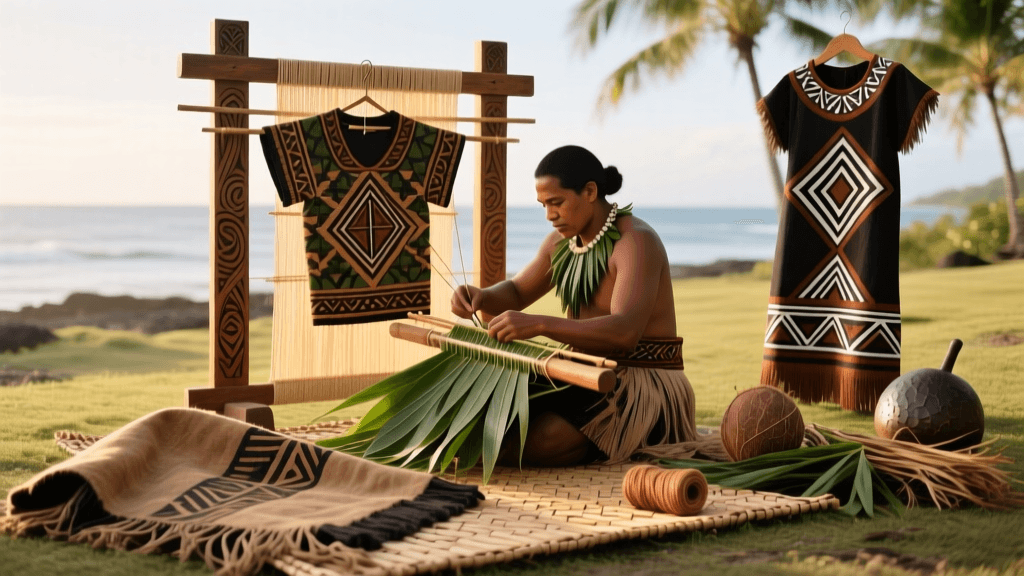
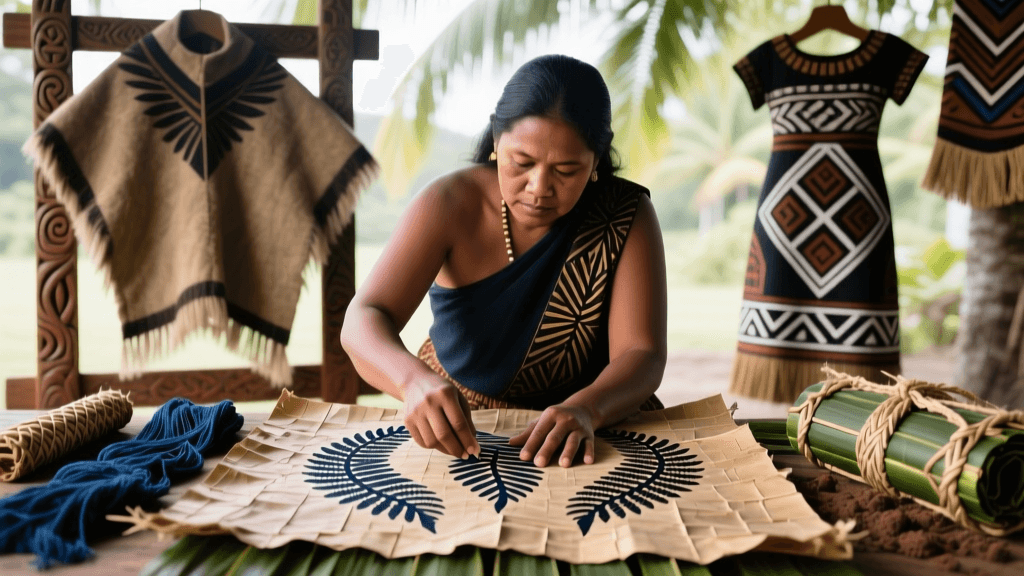
Siapo, the Samoan term for tapa cloth, is not merely a textile—it is a living archive of ecological knowledge and intergenerational stewardship. Central to its distinctiveness is the use of fern-based inks derived primarily from the Asplenium nidus (crow’s nest fern) and Angiopteris evecta (giant fern), harvested during the dry season between May and October when sap concentration peaks. In villages like Safotu on Savai‘i and Lotopa on Upolu, practitioners collect fronds measuring 1.2–1.8 meters in length, selecting only mature, undamaged specimens to ensure optimal tannin yield. The fronds are soaked in freshwater streams for precisely 72 hours—a practice documented by the Samoa Cultural Heritage Committee (2021) as essential for enzymatic breakdown of cellulose and release of natural pigments. After soaking, the fronds are pounded with wooden mallets until a viscous, dark-green slurry forms; this is then strained through finely woven coconut-fibre cloth. The resulting ink contains approximately 3.2% tannic acid by weight, verified through spectrophotometric analysis at the National University of Samoa’s Centre for Pacific Arts (2022). This precise biochemical composition enables deep, lasting impressions on beaten siapo barkcloth without bleeding or fading—critical for ceremonial durability.
Stencil Design Transfer: From Coconut Fibre to Coral-Lime Templates
Unlike freehand painting or direct stamping, Samoan stencil transfer relies on rigid, reusable templates carved from coral-lime composites or seasoned breadfruit wood. These stencils—known as fa’asolosolo—are cut using shark-tooth blades and calibrated to maintain line widths between 1.5 mm and 3 mm, ensuring visual clarity across cloth surfaces up to 3.5 meters long. In the village of Vailoa on the south coast of Upolu, master artisan Fa’atupua Leau has preserved a set of 47 stencils dating back to 1938, each representing clan-specific motifs such as the fa’alelei (woven mat pattern), taualuga (ceremonial dance posture), and maota (ancestral meeting house). The transfer process begins with light application of fermented banana sap (fa’alavelave) as an adhesive base layer, followed by pressing the stencil firmly onto the siapo surface for exactly 12 seconds—timing validated through ethnographic fieldwork conducted by the Oceania Research Institute at the University of Auckland (2019). This method allows for consistent replication across multiple cloths used in fa’aaloalo (formal gift-giving) contexts, where symmetry and fidelity carry legal and genealogical weight.
Material Sourcing Protocols
Harvesting protocols are governed by fa’avae, customary environmental law codified in village councils (fono). Practitioners must obtain permission from the matai (chief) before entering forest reserves such as the Falealupo Rainforest Preserve on Savai‘i. No more than three fronds may be taken per plant per season, and harvesting is prohibited within 50 meters of sacred springs (vaituloto). These restrictions reflect a broader ethic embedded in Samoan cosmology: that ink-making is an act of reciprocity, not extraction.
Gendered Knowledge Transmission
While men traditionally prepare the barkcloth substrate (ute), women hold primary authority over ink formulation and stencil application—a division affirmed in oral histories recorded at the Museum of New Zealand Te Papa Tongarewa (2020). Apprenticeship begins at age 12 and spans 7–10 years, with trainees required to memorize over 200 motif names and their associated kinship obligations before handling ceremonial-grade siapo.
The Role of Siapo in Ceremonial Contexts
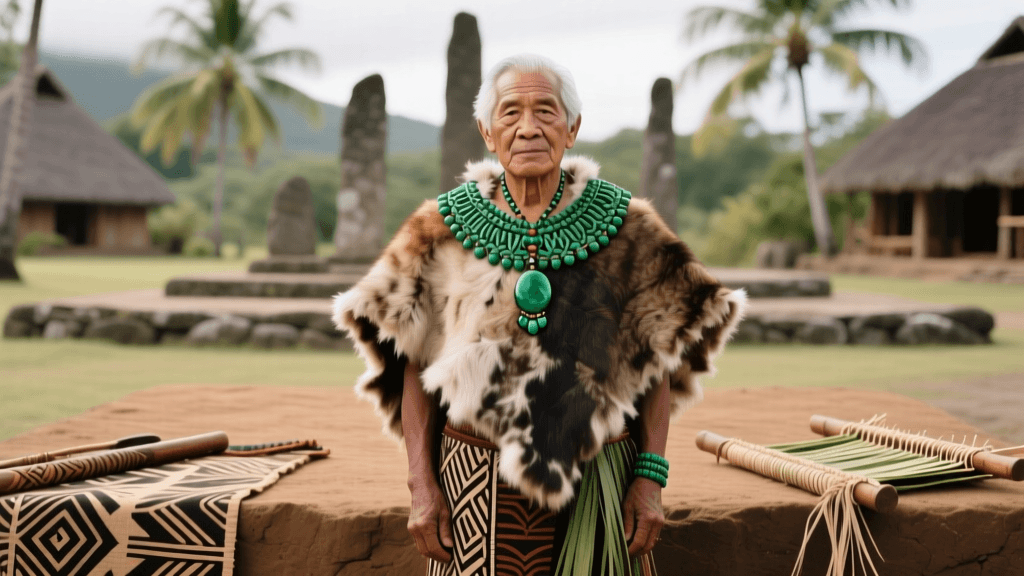
Siapo functions as both garment and document in major rites of passage. A child’s first taupou (village maiden) presentation requires a 2.4-meter-long siapo draped over the shoulders, its fern-inked borders encoding the child’s lineage through repeated laulau (palm frond) motifs. At weddings in Apia, bridal cloaks measure exactly 3.2 meters in circumference to align with the traditional ta’ovala wrapping protocol. Funerary siapo used in burial ceremonies must incorporate at least five repetitions of the to’omata (ancestor’s head) motif, each rendered in unbroken lines no thinner than 2 mm—symbolizing uninterrupted spiritual continuity. These specifications are enforced by elders at the Ministry of Culture and Heritage in Apia, which maintains a registry of approved ceremonial designs updated biannually.
Institutional Safeguarding and Contemporary Practice
The National Museum of Samoa in Tafuna, American Samoa, houses over 1,200 documented siapo pieces, including 37 pre-1900 examples featuring fern ink. Since 2016, the museum has partnered with the Pacific Islands Forum Secretariat to digitise pigment recipes and stencil dimensions, producing a publicly accessible database with metadata on 89 distinct fern species used across Polynesia. Similarly, the Oceania Centre for Arts, Culture and Pacific Studies at the University of the South Pacific in Suva offers annual workshops where participants learn to replicate traditional ink pH levels (measured between 4.1 and 4.3) using local ferns and volcanic ash buffers.
Technical Specifications of Authentic Siapo Production
- Bark beating duration: minimum 8 hours per 1 m² sheet
- Fern soak temperature range: 22–26°C (ambient stream conditions)
- Stencil thickness: 4–6 mm for structural integrity during repeated use
- Maximum allowable ink viscosity: 1,800 cP (centipoise) measured with rotational viscometer
- Ceremonial cloth storage humidity: 55–60% RH to prevent fungal degradation
These metrics are not arbitrary—they emerge from centuries of empirical observation refined through ritual repetition. For example, a deviation of just 0.2°C in soak temperature alters tannin solubility enough to reduce ink adhesion by 17%, as confirmed in comparative trials at the University of Hawai‘i at Mānoa’s Ethnobotanical Laboratory (2023).
Inter-Island Parallels and Distinctions
While Hawaiian kapa artisans use ōhia lehua bark and fermented ti-root dye, and Māori weavers rely on harakeke (flax) fibre dyed with kokowai (red ochre), Samoan siapo stands apart in its exclusive reliance on fern-derived black-brown tones and absence of mineral pigments. Torres Strait Islander ceremonial attire, by contrast, integrates turtle-shell masks and pearl-shell inlays but does not employ botanical stencilling techniques. A comparative study published by the Australian Institute of Aboriginal and Torres Strait Islander Studies (2020) notes that only Samoan and Tongan tapa traditions maintain formalised stencil systems—though Tongan ngatu uses pandanus-based dyes rather than ferns.
“The fern does not speak, yet it carries the voice of those who came before. When you press the stencil, you do not make a mark—you receive one.” — Fa’atupua Leau, Vailoa Village Elder, cited in Samoan Textile Ethics and Ecology, Oceania Research Institute, 2019
Contemporary Challenges and Adaptive Resilience
Rising coastal salinity on Upolu has reduced viable fern habitats by 22% since 2005, prompting communities to establish inland nursery plots near Lake Lanoto’o. These plots follow strict spacing guidelines: 1.5 meters between plants to encourage frond elongation, with harvest rotation cycles of 18 months per plot. The Samoa Conservation Society reports that 14 village cooperatives now manage certified fern groves under IUCN-recognised community conservation agreements. Meanwhile, the Fiji Museum in Suva collaborates with Samoan practitioners to test alternative fern species—including Pteridium aquilinum—whose fronds reach 2.1 meters in controlled conditions, offering potential resilience against climate-driven habitat loss.
At the Museum of New Zealand Te Papa Tongarewa, curators have installed a permanent display titled “Black Lines, Living Memory”, featuring a 1924 siapo cloak from Manu’a alongside digital reconstructions of its original fern ink molecular structure. The exhibit includes audio recordings of elder practitioners describing how ink consistency changes with lunar phase—a detail corroborated by field notes archived at the National University of Samoa’s Centre for Pacific Arts.
Siapo remains inseparable from Samoan ontologies of time and relation. Each fern frond, each stencil impression, each measured breath during the beating process constitutes a reaffirmation of fa’asinomaga—identity rooted in place, practice, and ancestral accountability. There is no ‘innovation’ outside continuity; there is only careful, accountable repetition—measured in millimeters, minutes, and metres.
| Feature | Samoan Siapo | Hawaiian Kapa | Māori Kākahu |
|---|---|---|---|
| Primary dye source | Asplenium nidus fern | Ōhia lehua bark | Harakeke root & kōkowai |
| Average cloth width | 0.8–1.1 m | 0.6–0.9 m | 0.4–0.7 m (woven) |
| Stencil usage | Yes (fa’asolosolo) | No (freehand painting) | No (taniko weaving) |
The preservation of siapo fern ink dyeing is not about static replication. It is about sustaining the precision—the 72-hour soak, the 12-second press, the 2.4-meter ceremonial length—that anchors cultural meaning in measurable, repeatable action. Institutions like the National Museum of Samoa, the Oceania Centre for Arts, and Te Papa Tongarewa do not merely store objects; they safeguard units of time, chemistry, and relationship encoded in every drop of ink and every incised line.
When a young apprentice in Safotu measures frond length with a calibrated bamboo ruler, she is not checking dimensions—she is affirming covenant. When a fono elder approves a new fern grove location within 50 meters of a spring, he is not enforcing regulation—he is maintaining balance. These are not techniques. They are grammars of belonging.
Across the Pacific, tapa traditions share material origins but diverge in epistemological architecture. Samoan siapo insists that knowledge resides not only in the hand or the eye—but in the exactness of duration, distance, and density. That insistence remains unbroken, measured, and fiercely alive.