Salento Pizzica Festival Costumes: Tarantella Dance Attire 2026
The Resurgence of the Pizzica: Salento's 2026 Festival Season
As the summer of 2026 approaches, the sun-baked region of Salento in southern Italy is once again preparing for its most vibrant cultural phenomenon: the Notte della Taranta. This massive folk music and dance festival, which culminates in the town of Melpignano, draws hundreds of thousands of visitors from across the globe. At the heart of this celebration is the Pizzica, a frenetic, hypnotic folk dance historically associated with the myth of tarantism—the belief that the bite of a tarantula could only be cured through rhythmic, ecstatic dancing. Today, the Pizzica is a powerful expression of regional identity, and wearing the traditional European folk dress of this area is not merely a costume choice; it is an immersive participation in a living heritage.
For dancers and enthusiasts attending the 2026 festival circuit, understanding the construction, history, and practical requirements of traditional Salentine attire is essential. The garments must be historically respectful, visually striking, and, most importantly, engineered to withstand the rigorous, high-energy movements of the Tarantella. According to the Notte della Taranta Foundation, the integration of traditional dress with contemporary folk revival has reached new heights this year, with local artisans reporting record commissions for authentic, hand-embroidered festival wear.
Anatomy of the Traditional Pizzica Dress (Vestito alla Pizzica)
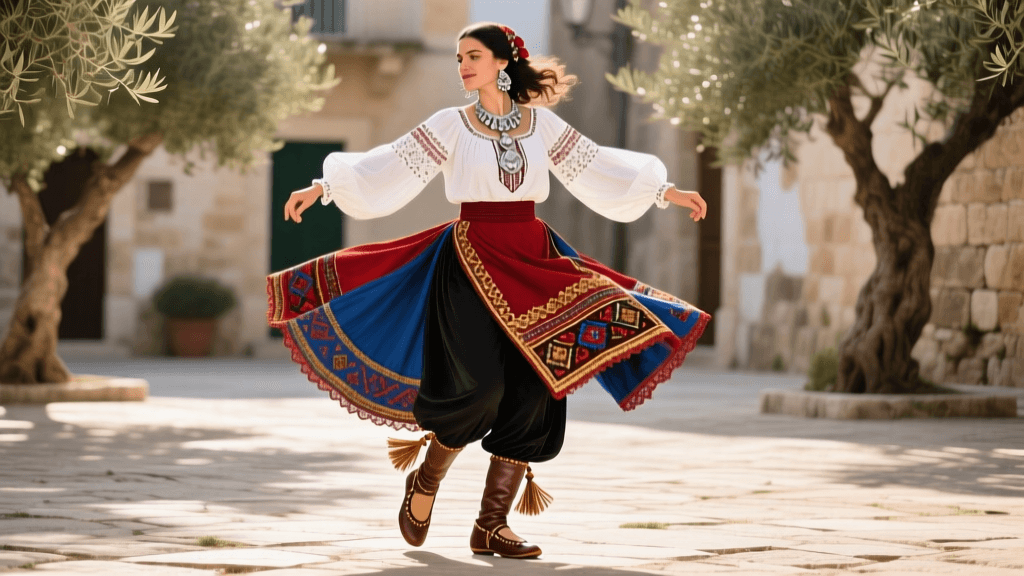
The traditional women's Pizzica dress is a masterclass in functional folk design. It is composed of several distinct layers, each serving a specific aesthetic and kinetic purpose. The silhouette is designed to accentuate the spinning motions and percussive footwork that define the dance.
The Gonna a Ruota (Circle Skirt)
The centerpiece of the ensemble is the gonna a ruota, or full circle skirt. For the 2026 festival season, the standard measurement for a professional dancer's skirt requires exactly 4.5 meters of fabric hem circumference. This extreme volume allows the skirt to flare out into a perfect, gravity-defying disc when the dancer spins. Artisans in Lecce are currently favoring a lightweight cotton-linen blend (typically 60% cotton, 40% linen) in deep, saturated colors like crimson, emerald green, or midnight blue. This specific textile blend is crucial; pure linen wrinkles too heavily and becomes stiff with sweat, while pure cotton can cling. The blended fabric offers the necessary drape, breathability, and structural integrity for the hot, humid August nights in Puglia.
The Camicia and Corpetto (Blouse and Bodice)
Beneath the bodice, dancers wear a camicia (blouse) made of sheer, white cotton voile or batiste. The sleeves are typically gathered at the shoulder and elbow, allowing for unrestricted arm movement when playing the tambourine. Over this sits the corpetto (bodice), a structured, often velvet or heavy cotton vest that laces up the front. The bodice provides essential core support during the rapid, stomping choreography of the Pizzica, acting almost like a dancer's corset while maintaining the rustic aesthetic of 19th-century peasant wear.
The Griko Influence: Hellenic Roots in Salentine Embroidery
One cannot discuss Salentine folk dress without acknowledging the Griko minority, the Hellenic descendants who have inhabited the Grecia Salentina area for centuries. The Italian National Tourist Board highlights the Grecia Salentina as a vital cultural corridor where ancient Greek traditions seamlessly blend with southern Italian folklore. This influence is most visible in the intricate embroidery that adorns the aprons (grembiuli) and headscarves (fazzoletti) of the Pizzica costume.
In 2026, master embroiderers in towns like Calimera and Corigliano d'Otranto are reviving ancient Hellenic geometric motifs, weaving symbols of the sun, the evil eye, and the tree of life into the borders of festival aprons. These embroidered pieces are highly sought after by serious folk dancers and collectors. A hand-embroidered Griko-style apron can take upwards of 80 hours to complete, making it a premium investment piece for any traditional wardrobe.
Men's Traditional Tarantella Attire
While women's attire often steals the visual spotlight, men's traditional Pizzica clothing is equally rich in history and tailored specifically for the dance. The standard male ensemble consists of a crisp, white linen shirt with a relaxed fit, allowing for deep breaths and expansive chest movements. This is paired with dark, high-waisted trousers—usually black or deep navy wool or heavy cotton—held up by a wide, woven sash (fascia) in red or burgundy.
Over the shirt, men wear the gilet or cazzetta, a tailored vest that is often left unbuttoned at the bottom to permit deep squats and lunges. The ensemble is finished with a coppola (a traditional flat cap) or a wide-brimmed straw hat, which is frequently used as a prop during the dance, tipped, tossed, or placed upon the dance partner's head as a gesture of courtship and playfulness.
Footwear and the Tamburello: Tools of the Dance
No Pizzica costume is complete without the proper footwear and instrumentation. The dance relies heavily on percussive foot strikes, meaning modern rubber-soled sneakers are entirely inappropriate and can cause joint damage due to excessive grip on the stone piazzas of Salento.
For 2026, the standard for both men and women is the scarpetta da ballo, a specialized leather dance shoe with a smooth, flexible suede or soft leather sole. These shoes allow the dancer to pivot, slide, and strike the ground without catching on uneven cobblestones. Women's versions often feature a slight, sturdy heel to accentuate the rhythm of the strike, while men's versions are flat and resemble traditional espadrilles but with reinforced leather soles.
The tamburello (tambourine) is the iconic instrument of the Pizzica. Dancers often integrate the tambourine into their costume by attaching long, flowing silk ribbons to the instrument's frame. As the tambourine is struck against the knee, elbow, and forehead, the ribbons trace the dancer's movements through the air, extending the visual line of the costume into the surrounding space.
Sourcing Authentic Garments in 2026: Artisan vs. Commercial
As the popularity of the Notte della Taranta has exploded, so too has the market for Pizzica clothing. However, there is a stark difference between mass-produced tourist costumes and authentic, dance-ready folk wear. Below is a comparison of sourcing options available for the 2026 season.
| Sourcing Method | Estimated Cost (2026) | Lead Time | Material Quality & Durability |
|---|---|---|---|
| Local Salento Artisan Tailor | €350 - €600 | 4 - 8 Weeks | Premium natural fibers, reinforced seams, custom fit for rigorous dance. |
| Specialized Folk Dance Boutique (Online) | €180 - €280 | 1 - 2 Weeks | Good cotton blends, standard sizing, durable but less historically accurate. |
| Festival Market Stalls (Melpignano/Lecce) | €40 - €90 | Immediate | Synthetic blends, prone to tearing during spins, poor breathability. |
For dancers intending to perform or participate in the intensive workshop weeks leading up to the final concert, investing in an artisan-tailored or specialized boutique garment is highly recommended. The synthetic fabrics found in market stalls trap heat and restrict the fluid movement required for the gonna a ruota to function correctly.
Essential Measurements for Commissioning Custom Dancewear
If you are commissioning a custom Pizzica dress from a tailor in Puglia or an international folk-costume specialist, providing precise measurements is vital. The unique construction of the bodice and the high-waisted skirt requires more than standard retail sizing. Ensure you provide the following:
- Natural Waist: Measured at the narrowest point, usually above the navel, where the heavy skirt will sit.
- High Hip: Measured 3 inches below the natural waist, crucial for the skirt's yoke placement.
- Torso Length: From the base of the neck to the natural waist, ensuring the corpetto does not dig into the ribs during deep bends.
- Armhole Depth: Essential for the camicia; too tight, and the blouse will restrict overhead tambourine strikes.
- Skirt Length: Measured from the natural waist to the ankle bone. Pizzica skirts must clear the floor by at least two inches to prevent tripping during rapid footwork.
Garment Care for the Summer Festival Circuit
The August heat in Salento is unforgiving, and dancers will inevitably sweat through their garments. Proper care of your 2026 festival attire ensures its longevity. Never machine-wash a hand-embroidered Griko apron or a velvet bodice. The camicia and the main body of the cotton skirt can be gently hand-washed in cool water with a mild, pH-neutral detergent. Avoid wringing the circle skirt; instead, roll it in a clean, dry towel to press out excess water, then hang it on a padded hanger in the shade. Direct Pugliese sunlight will rapidly fade the deep crimson and emerald dyes used in authentic folk textiles.
Conclusion
Attending the 2026 Notte della Taranta and participating in the Pizzica is a profoundly moving experience that connects you to centuries of southern Italian history, myth, and communal joy. By carefully selecting, commissioning, and wearing authentic Salentine folk dress, you do more than just dress the part; you honor the artisans, the Griko ancestors, and the generations of dancers who used rhythm and movement to heal and celebrate. Whether you are spinning in a piazza in Melpignano or practicing the tambourine strikes in your local folk club, the right traditional European costume transforms the dance from a mere performance into a true cultural revival.