Romanian Ie Blouse Revival: 2026 Ethical Styling Guide
The Renaissance of the Romanian Ie in 2026
The traditional Romanian blouse, universally known as the Ie, has transcended its status as a mere historical artifact to become a cornerstone of the global slow fashion movement. As we navigate the fashion landscape of 2026, the Ie stands out not just for its breathtaking aesthetic, but for its deep cultural resonance and alignment with sustainable wardrobe practices. Following its monumental inscription on the UNESCO Representative List of the Intangible Cultural Heritage of Humanity, the global appreciation for this garment has matured. Today, conscious consumers are moving away from the cultural appropriation seen in early 2010s fast-fashion knockoffs, pivoting instead toward cultural appreciation, direct-to-artisan sourcing, and heritage preservation.
In 2026, wearing an Ie is a statement of sartorial intelligence and ethical consumption. The modern revival focuses on preserving ancient stitching techniques while adapting the silhouette for contemporary life. According to the UNESCO Intangible Cultural Heritage registry, the traditional shirt with embroidery on the shoulder represents a vital element of cultural identity in Romania and the Republic of Moldova. This international recognition has empowered rural artisan cooperatives, allowing them to command fair wages and sustain their craft in an increasingly automated textile industry.
Decoding the Anatomy of the Traditional Blouse
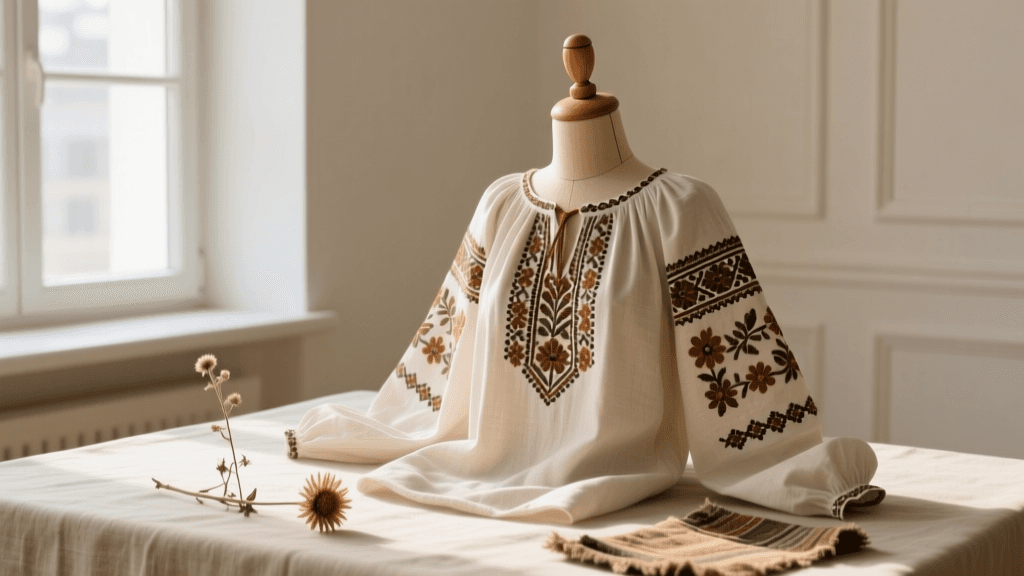
To truly appreciate and style the Ie, one must understand its intricate architectural structure. The blouse is not merely a piece of cloth; it is a canvas of symbolic geometry and regional storytelling. The construction is defined by three primary elements that dictate its visual rhythm and cultural meaning.
The Altita is the most crucial element, located on the shoulder. Historically, this heavily embroidered rectangular panel served as a protective shield for the wearer, featuring the most complex and dense motifs of the entire garment. In 2026, contemporary designers often use the Altita as the focal point of minimalist outfits, allowing the shoulder craftsmanship to shine against clean, modern lines.
Below the Altita lies the Incret, a horizontal band of gathers or smocking that bridges the shoulder panel to the rest of the sleeve. This section provides the garment with its signature volume and structural integrity. Finally, the Rauri (meaning rivers) are the vertical stripes of embroidery that flow down the length of the sleeves. These rivers guide the eye downward and are often populated with floral, solar, or geometric motifs that reflect the natural environment of the artisan's specific village.
Regional Variations and Motif Meanings
Romania's diverse topography has given rise to distinct regional styles, each with its own color palette and symbolic lexicon. Understanding these variations is essential for the modern collector and stylist.
The Muscel region is famous for its refined, aristocratic aesthetic. Blouses from this area typically feature dark backgrounds, such as deep navy or black linen, embroidered with metallic gold and silver threads alongside muted silk tones. These pieces are highly sought after in 2026 for evening wear and high-end office styling due to their subtle elegance.
Conversely, the Olt region produces blouses characterized by bold, high-contrast designs. Deep reds and stark blacks dominate the palette, featuring striking geometric patterns that convey strength and vitality. Meanwhile, the Vrancea region favors earth tones, utilizing ochre, olive green, and brown threads to create protective symbols like the horn and the diamond, reflecting a deep, agrarian connection to the land. Archives at the Romanian Peasant Museum highlight how these regional distinctions served as a visual language, instantly communicating a wearer's marital status, wealth, and village of origin.
Ethical Sourcing: Artisans vs. Fast Fashion in 2026
As the demand for heritage garments surges, the market has become saturated with mass-produced imitations. Distinguishing between an authentic, hand-embroidered Ie and a factory-made replica is paramount for ethical sourcing. An authentic blouse crafted on natural borangic (Romanian silk) or hemp requires anywhere from 40 to 150 hours of meticulous hand-stitching. Consequently, the 2026 market price for a genuine, artisan-crafted Ie ranges from 350 to 850 Euros, reflecting the fair compensation of the maker's time and expertise.
Digital preservation efforts and open-access databases provided by Europeana offer invaluable resources for buyers to study authentic historical motifs, making it easier to spot the rigid, lifeless patterns typical of machine embroidery. When sourcing in 2026, prioritize certified artisan cooperatives and platforms that provide transparent supply chains, detailing the specific village and the name of the embroiderer.
| Feature | Authentic Artisan Ie | Mass-Market Replica |
|---|---|---|
| Base Fabric | Natural Borangic silk, hemp, or handwoven cotton | Polyester blends, rayon, or conventional bleached cotton |
| Embroidery | Hand-stitched (40-150 hours), slight natural variations | Machine-embroidered, uniform, synthetic threads |
| Cost (2026) | 350 - 850+ Euros | 45 - 90 Euros |
| Lifespan | Generational (heirloom quality) | 1-3 seasons before fabric degradation |
| Cultural Impact | Supports rural economies and preserves intangible heritage | Exploitative, often constitutes cultural appropriation |
Contemporary Styling: Integrating Heritage into Modern Wardrobes
The brilliance of the Ie in 2026 lies in its remarkable versatility. While it is deeply rooted in tradition, its voluminous silhouette and intricate textures make it a perfect companion for modern, minimalist tailoring. The key to styling the Ie today is contrast: balancing the romantic, historical volume of the blouse with sharp, contemporary, or structured pieces.
Look 1: The Modern Executive
For a sophisticated office environment, pair a Muscel-style Ie featuring subtle gold metallic threading with high-waisted, wide-leg tailored trousers in charcoal wool. Tuck the blouse in to define the waist and manage the volume of the sleeves. Finish the look with a structured, oversized blazer draped over the shoulders and minimalist leather loafers. The Altita peeking out from beneath the blazer lapel provides a striking, conversation-starting detail that elevates the standard corporate uniform.
Look 2: Weekend Elegance
For a relaxed yet refined weekend aesthetic, combine an Olt region blouse with heavy, raw-denim wide-leg jeans. The ruggedness of the indigo denim perfectly complements the delicate, time-intensive embroidery of the Rauri. Accessorize with a woven leather belt and sustainable, handcrafted leather sandals or ankle boots. This look bridges the gap between rural heritage and urban street style, grounding the ethereal nature of the blouse with utilitarian fabrics.
Look 3: Evening Edge
Transform the Ie into a striking evening piece by layering a sheer, black hemp-cotton blouse over a sleek, floor-length silk slip dress. The contrast between the opaque, intricate embroidery and the fluid, shimmering silk beneath creates a captivating visual depth. Pair with structured, pointed-toe boots and minimalist metallic jewelry. This styling approach honors the garment's historical use in festive and ceremonial contexts while firmly planting it in the contemporary eveningwear lexicon.
Garment Care and Preservation
Investing in an authentic Ie means committing to its preservation. These garments are designed to become heirlooms, but their natural fibers and delicate embroidery require specific care protocols to survive the decades.
Never machine wash an authentic Ie. The agitation will destroy the hand-stitched tension and cause natural fibers like borangic silk to warp or tear. Instead, hand wash the garment in cold water using a pH-neutral, mild detergent specifically formulated for delicate natural fibers. Submerge the blouse gently and allow it to soak for no more than ten minutes. Avoid wringing or twisting the fabric, as this will permanently distort the Incret gathers and damage the structural integrity of the Altita.
To dry, lay the blouse flat on a clean, dry cotton towel, rolling the towel gently to press out excess moisture. Reshape the garment and allow it to air dry away from direct sunlight, which can fade the natural plant-based dyes still used by traditional artisans. When ironing, always turn the blouse inside out and use a low-heat setting with a pressing cloth to protect the three-dimensional texture of the embroidery from being crushed.
For long-term storage, avoid wire or plastic hangers, which can stretch the shoulder seams and distort the neckline. Fold the Ie carefully, padding the folds with acid-free tissue paper to prevent deep creases in the embroidered panels. Store the garment in a breathable cotton bag in a cool, dry environment, and include natural lavender sachets to deter moths without exposing the delicate silk threads to harsh chemical repellents. By adhering to these preservation methods, your Ie will remain a vibrant, wearable piece of European folk history for generations to come.