Contemporary Styling for the Romanian Ie Blouse 2026
The 2026 Renaissance of the Romanian Ie
The global fashion landscape in 2026 has decisively pivoted away from fleeting micro-trends, embracing instead the profound narrative of 'heritage chic.' At the forefront of this European folk dress revival is the Romanian Ie (pronounced 'ee-eh'), a traditional hand-embroidered blouse that has transcended its rural origins to become a cornerstone of contemporary sustainable wardrobes. Once reserved strictly for village festivals and national holidays, the Ie is now being reimagined by modern stylists and slow-fashion advocates as a versatile, statement-making garment. This revival is not merely an aesthetic choice; it is a conscious rejection of mass-produced fast fashion in favor of artisanal craftsmanship, cultural preservation, and textile longevity. According to the Romanian Peasant Museum, the traditional techniques used to create these blouses represent a living history, making each piece a wearable archive of Eastern European folklore.
Anatomy and Symbolism of the Ie
To style the Ie effectively in a modern context, one must first understand its intricate architecture. The blouse is traditionally crafted from homespun hemp, linen, or cotton, and its embroidery is never random. The design is strictly divided into three primary zones:
- The Altiță: The shoulder panel, historically the most heavily embroidered section, designed to draw the eye and signify the wearer's regional identity and social status.
- The Încreț: A decorative band situated just below the altiță, originally used to conceal the structural gathers of the fabric where the sleeve was attached to the bodice.
- The Râuri (Rivers): Diagonal or vertical lines of embroidery that flow down the sleeves, symbolizing the rivers that sustain life and the continuous flow of time.
The motifs themselves are deeply agrarian and cosmological. You will frequently encounter the 'tree of life' (representing immortality and connection), the sun (symbolizing energy and prosperity), and wheat stalks (denoting fertility and harvest). In 2026, contemporary wearers often select specific motifs that resonate with their personal values, transforming the garment into a highly individualized talisman.
Regional Variations to Look For
Romania’s diverse topography has birthed distinct regional styles, each offering a different aesthetic for the modern wardrobe:
Olt and Muntenia
Characterized by striking geometric patterns and a bold color palette dominated by black, deep red, and occasionally metallic threads. The Olt region's Ie is highly graphic, making it an ideal pairing for minimalist, monochromatic modern tailoring.
Moldova and Bukovina
These northern blouses feature softer, more organic motifs, heavily utilizing floral patterns and the 'tree of life.' The colors are often more varied, incorporating blues, greens, and yellows, which lend themselves beautifully to bohemian or romantic contemporary styling.
Muscel and Argeș
Historically favored by royalty and the aristocracy, blouses from this region are renowned for their lavish use of gold and silver metallic threads woven into the cotton. These are the ultimate 'evening' Ie, perfect for elevated, high-fashion styling.
Sourcing Authentic Artisan Pieces in 2026
As the demand for authentic folk garments surges, the market has unfortunately seen an influx of machine-made knockoffs. In 2026, a genuine, hand-stitched Ie crafted by rural artisans using traditional loom-woven fabrics typically ranges from $220 to $650 USD, depending on the density of the embroidery and the rarity of the regional pattern. To ensure you are supporting ethical craftsmanship, look for pieces verified by the 'Semne Cusute' (Stitched Signs) community, a grassroots movement dedicated to preserving accurate traditional patterns. Avoid mass-market retailers offering 'peasant blouses' for under $50, as these appropriate the design without compensating the heritage communities. True artisanal pieces are investments that, when properly cared for, will last a lifetime and can be passed down as heirlooms.
2026 Styling Matrix: Integrating the Ie
Styling the Ie requires balancing its voluminous, romantic silhouette with structured, contemporary pieces to avoid looking like you are wearing a theatrical costume. The goal for 2026 is juxtaposition—pairing the historic, handcrafted top with modern, sharp, or avant-garde bottoms.
| Style Archetype | Occasion | Bottom Pairing | Footwear | Accessories |
|---|---|---|---|---|
| Office Heritage | Business Casual / Gallery Opening | High-waisted, wide-leg wool trousers (charcoal or navy) | Polished leather loafers | Minimalist gold hoop earrings, structured leather tote |
| Weekend Folkcore | Artisan Markets / Casual Dining | Dark wash, straight-leg vintage denim | Chunky leather Chelsea boots | Woven leather belt, layered delicate necklaces |
| Evening Elegance | Weddings / Fine Dining | Silk or satin midi slip skirt (emerald or burgundy) | Strappy minimalist heels | Statement metallic cuffs, silk clutch |
Look 1: The Office Heritage
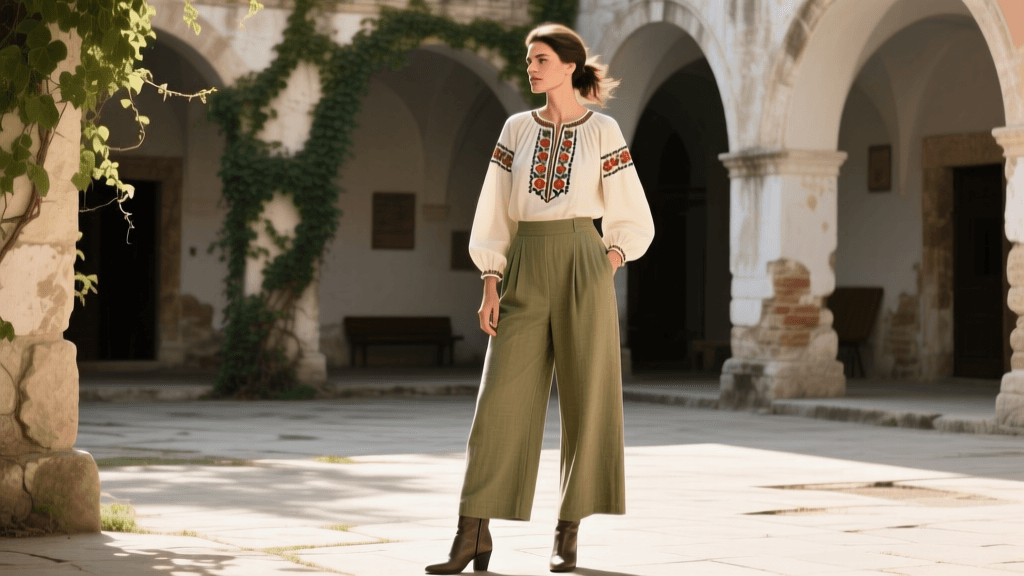
For a sophisticated daytime look, tuck a graphic Olt-region Ie (featuring black and red geometric embroidery) into a pair of impeccably tailored, high-waisted wide-leg trousers. The volume of the blouse should be managed by a subtle 'French tuck' at the front, allowing the râuri on the sleeves to drape elegantly over the wrists. Finish with polished leather loafers and a structured tote bag to ground the romanticism of the blouse with modern professional severity.
Look 2: The Weekend Folkcore
The 'folkcore' trend of 2026 leans heavily into textured, lived-in layers. Pair a cream linen Ie with soft floral motifs with rigid, dark-wash vintage denim. Allow the blouse to blouse out slightly over a thick, hand-tooled leather belt. Chunky leather boots add a necessary edge, preventing the outfit from skewing too pastoral. This look is perfect for weekend outings, embodying a relaxed, intellectual approach to traditional dress.
Look 3: Evening Elegance
For formal events, select an Ie from the Muscel region, utilizing subtle metallic gold or silver thread. Pair it with a bias-cut silk midi skirt in a deep, jewel-toned hue like emerald green or burgundy. The fluidity of the silk contrasts beautifully with the textured, homespun cotton of the blouse. Keep jewelry minimal—perhaps a single pair of sculptural metallic earrings—to let the intricate altiță shoulder embroidery take center stage.
Garment Care and Textile Preservation
Owning a hand-embroidered heritage garment requires a commitment to proper textile conservation. The natural fibers and traditional dyes used in authentic Ie blouses are highly sensitive to modern harsh chemicals and high heat. According to the Victoria and Albert Museum's textile conservation guidelines, historic and artisanal textiles should always be washed by hand in cool water (never exceeding 30°C) using a pH-neutral, eco-friendly detergent specifically formulated for delicate natural fibers.
Never wring or twist the fabric, as this can distort the embroidery and break the metallic threads. Instead, gently press the water out and lay the garment flat on a clean, dry towel to air dry, strictly away from direct sunlight to prevent the natural dyes from fading. When storing your Ie for the off-season, avoid wire hangers which can stretch the delicate shoulder seams. Fold the blouse carefully with acid-free tissue paper placed between the folds to prevent the embroidery from snagging, and store it in a breathable cotton garment bag in a cool, dry environment.
Embracing Slow Fashion and Cultural Respect
Integrating the Romanian Ie into a contemporary 2026 wardrobe is about more than just achieving a unique aesthetic; it is an active participation in the slow fashion movement. By choosing to invest in authentic, artisan-crafted garments, consumers are directly supporting rural economies and ensuring that centuries-old embroidery techniques are not lost to industrialization. The preservation of these traditional skills is so vital to global cultural diversity that traditional craftsmanship is frequently recognized and protected by organizations like UNESCO Intangible Cultural Heritage. When you wear an authentic Ie, you are not just wearing a beautiful piece of clothing; you are acting as a custodian of European cultural history, proving that true style is timeless, deeply meaningful, and inherently sustainable.