Hardanger Bunad vs Halland Folkdräkt: 2026 Regional Guide
Introduction to Scandinavian Folk Dress in 2026
The landscape of European folk dress has experienced a monumental revival over the last decade, culminating in the 2026 heritage craft renaissance. Today, traditional garments are no longer relegated to museum archives or annual midsummer parades; they are living, breathing textiles worn at weddings, graduations, and national holidays. Among the most meticulously preserved and highly sought-after regional costumes in Europe are Norway’s Hardanger bunad and Sweden’s Halland folkdräkt. Both represent the pinnacle of Scandinavian textile artistry, yet they diverge significantly in construction, silhouette, and regional symbolism. For collectors, tailors, and cultural enthusiasts navigating the 2026 market, understanding the nuanced differences between these two coastal and fjord-side traditions is essential. This comprehensive guide breaks down the anatomy, textile sourcing, and contemporary tailoring standards of these two iconic garments.
The Hardanger Bunad: Norway’s Crown Jewel
Originating from the dramatic fjord landscapes of the Hardanger region in Vestland county, the Hardanger bunad is often considered the archetype of the Norwegian national romantic movement. While its modern iteration was standardized in the early 20th century, its roots trace back to the 18th-century rural farming communities of the fjords. In 2026, the Hardanger bunad remains one of the most popular and recognizable bunads in Norway, celebrated for its striking color contrasts and intricate whitework.
Anatomy of the Hardanger Bunad
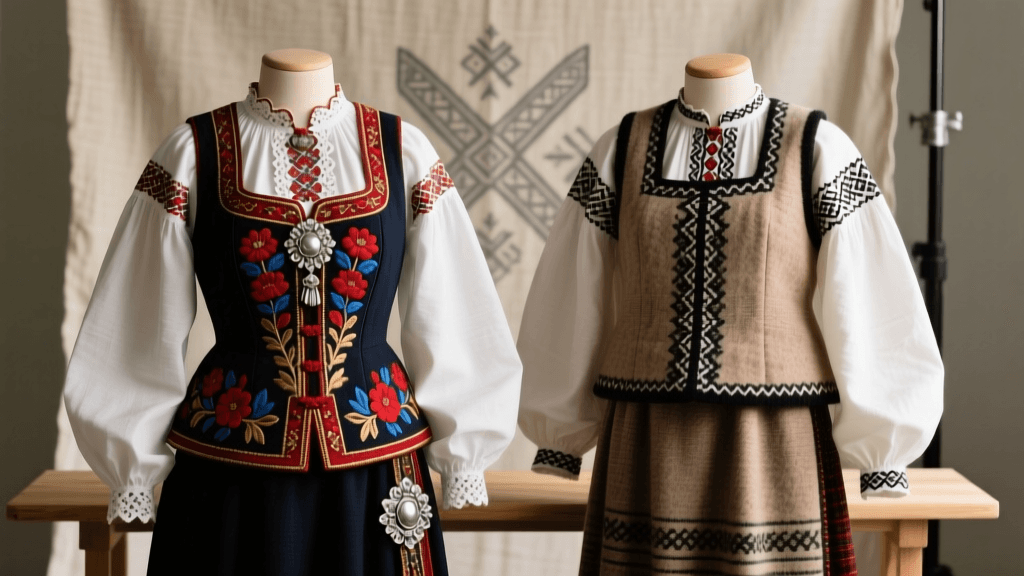
The traditional women’s Hardanger bunad consists of several highly specific components. The foundation is the stakk (skirt), woven from heavy black wool, featuring a broad band of vibrant cross-stitch embroidery at the hem. The liv (bodice) is typically crafted in deep green, red, or blue wool, heavily embroidered with floral motifs using silk and wool threads. Beneath the bodice, a pristine white linen shirt (linnet) is worn, featuring the world-renowned Hardanger embroidery (Hardangersøm)—a complex form of whitework that combines drawn thread work with satin stitches.
The ensemble is secured with a silk or wool apron (forkle) that mirrors the skirt's embroidery, and a distinctive white linen headpiece (skaut) for married women, or a floral crown for unmarried girls. According to the Norwegian Institute of Bunad and Folk Costume, strict adherence to historical color palettes and stitch counts is maintained by certified tailors to preserve the garment's regional integrity.
The Halland Folkdräkt: Sweden’s Coastal Heritage
Crossing the Skagerrak strait into Sweden, the Halland folkdräkt reflects the agricultural and coastal heritage of the Halland province on the western seaboard. Unlike the Norwegian bunad, which was heavily reconstructed during the national romantic period, the Swedish folkdräkt tradition relies heavily on continuous, unbroken rural usage and the meticulous archival work of institutions like the Nordic Museum. The Halland costume is characterized by its rustic elegance, practical construction, and striking use of red and black.
Anatomy of the Halland Folkdräkt
The women’s Hallandsdräkt is anchored by a vivid red wool skirt (kjol), often featuring subtle vertical stripes or a solid weave depending on the specific parish (such as Årstads or Faurås hundred). The bodice (snörliv) is typically black, laced at the front over a white linen shift (särk). The shift itself is a masterpiece of Scandinavian linen weaving, featuring delicate white-on-white embroidery at the cuffs and collar.
A defining feature of the Halland costume is the huvudbonad (headpiece), which varies drastically by marital status and parish. Married women traditionally wear a structured white linen cap, while unmarried women may wear a simple silk ribbon or a delicate floral wreath during midsummer. The outerwear often includes a tröja (jacket) made of vadmål, a dense, heavily fulled homespun wool that provides essential insulation against the harsh North Sea winds.
Comparative Analysis: Construction and Textiles
When commissioning or studying these garments in 2026, the differences in material sourcing and construction timelines are stark. Below is a comparative breakdown of the Hardanger bunad and the Halland folkdräkt based on current 2026 tailoring standards.
| Feature | Hardanger Bunad (Norway) | Halland Folkdräkt (Sweden) |
|---|---|---|
| Primary Skirt Color | Black wool | Red wool (often striped) |
| Bodice Style | Green/Red/Blue, front-closing | Black, front-laced (snörliv) |
| Signature Embroidery | Hardangersøm (whitework) & wool cross-stitch | White-on-white linen & floral wool accents |
| Metalwork / Jewelry | Sølje (oxidized sterling silver filigree) | Simple brass or silver clasps, pewter buttons |
| 2026 Base Price (USD) | $3,500 - $4,800 | $2,200 - $3,100 |
| Tailoring Lead Time | 12 - 18 months | 6 - 10 months |
Embroidery and Silverwork Techniques
The embroidery techniques employed in these two costumes represent entirely different branches of Scandinavian needlework. Hardanger embroidery (Hardangersøm) is a counted-thread technique that involves cutting and withdrawing warp and weft threads from the linen fabric to create geometric, lace-like patterns. In 2026, master embroiderers use high-count European-grown flax linen (typically 28 to 32 count) to ensure the structural integrity of the drawn thread work. The silk and wool floral embroidery on the bodice and skirt hem utilizes a specific satin stitch and stem stitch, requiring upwards of 300 hours of hand-stitching per garment.
Conversely, the Halland folkdräkt relies less on bold, colorful surface embroidery and more on the textural quality of the weave and the precision of the linen whitework. The shift’s collar and cuffs feature intricate pull-work and subtle floral motifs that catch the light without overwhelming the garment's rustic silhouette.
The Role of Silver and Metalwork
No Hardanger bunad is complete without its sølje (silver jewelry). The traditional set includes a brystsølje (breastpiece), halssølje (neck ring), and skjerpspenne (belt buckle). Crafted from oxidized sterling silver, these pieces feature intricate filigree work and dangling spoon-shaped pendants (skjeer) that historically warded off evil spirits. As of 2026, with the rising cost of precious metals, a complete, hand-forged Hardanger silver set from a certified Voss or Bergen silversmith costs between $1,200 and $2,500 USD. The Halland costume, by contrast, utilizes much more modest metalwork, often relying on simple silver or brass hook-and-eye clasps for the bodice and pewter buttons for the outer jackets, reflecting the historical economic realities of the Swedish coastal farming communities.
2026 Sourcing, Tailoring, and Garment Care
For those looking to acquire, commission, or properly care for these garments in 2026, understanding the modern heritage craft ecosystem is vital. The production of authentic folk dress is heavily regulated by cultural organizations to prevent the mass production of inaccurate 'costumes'.
Sourcing Authentic Textiles
The wool used for the Hardanger bunad skirt must be a specific heavy, tightly woven broadcloth that holds the dense hem embroidery without puckering. In 2026, the premier supplier for this textile is the historic Hjelmeland Veveri in Norway, which continues to use traditional shuttle looms. For the Halland folkdräkt, the sourcing of vadmål (homespun wool) has seen a resurgence thanks to local Swedish weaving cooperatives in the Varberg municipality, which have revived 18th-century fulling techniques using local Gotland and Swedish Finnsheep wool.
Tailoring and Measurements
Commissioning a bunad or folkdräkt requires a radically different approach to measurements than modern bespoke suiting. Because these garments are designed to be passed down through generations, tailors incorporate hidden seam allowances and adjustable lacing. For the Halland snörliv, the bodice is fitted over the linen shift, requiring the tailor to account for the bulk of the gathered fabric. The Hardanger bodice is structured with internal linen canvas and boning to provide a rigid, conical silhouette typical of 18th-century European fashion. According to guidelines from Norges Husflidslag (The Norwegian Craft Institute), a proper bunad fitting requires at least three separate sessions to ensure the embroidery aligns perfectly with the wearer's natural posture and movement.
Garment Care and Storage
Maintaining these investment pieces requires strict adherence to traditional care methods. Dry cleaning is universally forbidden for both the Hardanger bunad and the Halland folkdräkt, as the harsh chemicals strip the natural lanolin from the wool and degrade the silk embroidery threads. In 2026, conservationists recommend spot-cleaning wool with cold water and a mild, pH-neutral olive oil soap. The linen shifts and shirts should be hand-washed, boiled if necessary for stain removal (a traditional Scandinavian method), and mangled or heavily ironed while damp to achieve the crisp, glass-like finish required for the whitework to stand out. Garments must be stored flat in acid-free tissue paper within cedar chests to deter silverfish and moths, ensuring these masterpieces of European folk dress survive for the next generation.
Conclusion
Whether you are drawn to the dramatic, silver-adorned elegance of the Norwegian Hardanger bunad or the rustic, wind-swept practicality of the Swedish Halland folkdräkt, both garments offer a profound connection to European agrarian history. As the 2026 heritage craft movement continues to champion sustainable, slow-fashion practices, these regional costumes stand as testaments to the enduring power of local textiles, masterful hand-embroidery, and cultural pride. By understanding their distinct constructions, regional variations, and proper care protocols, enthusiasts can ensure these vital pieces of European folk dress continue to thrive in the modern era.