Mastering the Romanian Ie: Altitza Pattern Drafting 2026
The Renaissance of the Romanian Ie in 2026
The traditional Romanian blouse, universally known as the Ie, represents a pinnacle of European folk dress construction. In 2026, the global slow fashion and heritage craft movements have heavily embraced these historical garments, shifting focus from mass-produced approximations toward historically accurate, zero-waste patterning. The Ie is not merely a piece of clothing; it is a masterclass in geometric textile manipulation, relying entirely on rectangular cuts, strategic smocking, and intricate surface embroidery. According to the UNESCO Intangible Cultural Heritage registry, which officially recognizes the shoulder embroidery techniques of this garment, preserving these construction methods is vital for maintaining European textile identity. This guide will walk you through the precise construction patterns, zero-waste drafting, and smocking techniques required to build an authentic Ie in your own studio today.
Zero-Waste Anatomy: Drafting the Base Rectangles
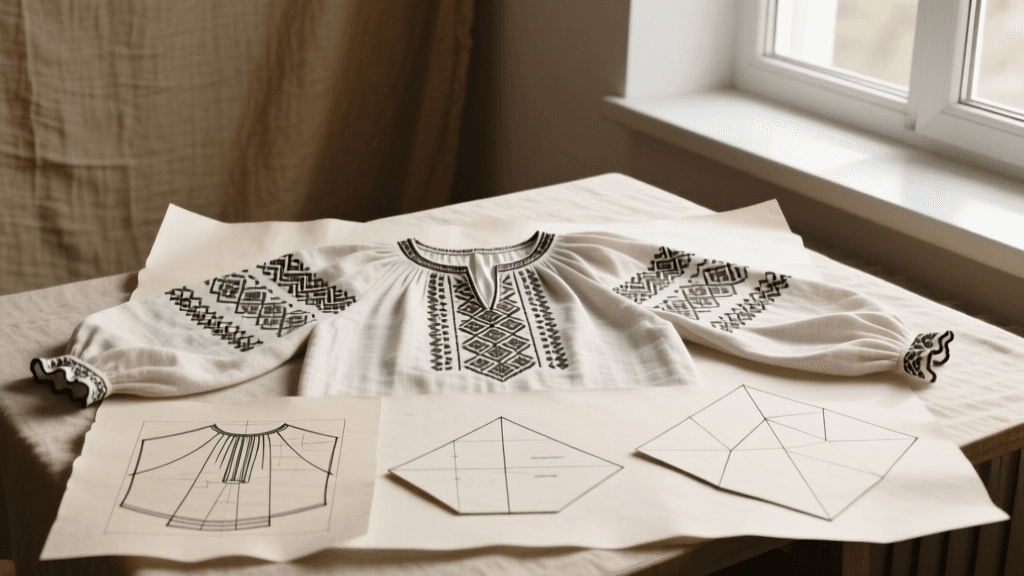
Unlike modern commercial patterns that rely on curved armholes and shaped side seams, the traditional Ie is constructed entirely from rectangles and squares. This zero-waste approach ensures that every inch of handwoven or high-quality evenweave linen is utilized. For a standard modern size medium (accommodating a 38-inch bust and 24-inch sleeve length), the base pattern requires the following specific cuts:
- Front and Back Panels: Two rectangles, each measuring 22 inches wide by 28 inches long.
- Sleeves: Two rectangles, each measuring 18 inches wide by 24 inches long.
- Underarm Gussets (Pui): Two squares, each measuring 6 inches by 6 inches.
- Neckband and Cuffs: Straight-grain strips cut to 3 inches wide, length determined by the smocked circumference.
The beauty of this geometric drafting lies in its adaptability. Because the garment is gathered into the neckband and cuffs, the width of the rectangles dictates the volume and drape of the blouse rather than a rigid fitted shape. In 2026, makers are favoring 28-count evenweave linen, such as the Zweigart Dublin line, which provides the perfect structural integrity for heavy embroidery while remaining breathable.
The Altitza: Mapping the Shoulder Architecture
The defining feature of the Romanian Ie is the Altitza, the heavily embroidered rectangular block that caps the upper sleeve. As highlighted by the Romanian Cultural Institute, the Altitza is historically the most protected and symbolically charged area of the garment, often featuring talismanic motifs to ward off evil and ensure fertility. Structurally, the sleeve embroidery is divided into three distinct architectural zones:
1. The Altitza (The Shoulder Block)
This is the dense, rectangular block of embroidery situated at the very top of the sleeve rectangle. It is typically worked in a combination of cross-stitch, the traditional Romanian stitch (a laid-thread technique secured by diagonal couching), and chain stitch. The motifs here are tightly packed and geometric, often featuring the 'horns of the ram' or 'sun wheel' symbols.
2. The Incret (The Transition Zone)
Directly below the Altitza is a narrow, smocked band that transitions the dense shoulder block into the flowing sleeve. This area is structurally crucial, as it absorbs the tension between the heavy embroidery above and the lighter fabric below.
3. The Rauri (The Rivers)
Below the transition zone, vertical columns of embroidery, known as rauri (rivers), flow down the length of the sleeve to the cuff. These are typically spaced evenly (e.g., three or five rivers per sleeve) and feature repeating diamond or leaf motifs that elongate the arm visually.
Incretitura: Smocking the Neckline and Cuffs
The Ie achieves its signature blouson silhouette through incretitura, a traditional form of smocking that gathers the wide rectangular panels into a narrow neckband and cuffs. Unlike modern elasticated casings, this technique uses a permanent, decorative honeycomb smocking stitch that allows the fabric to stretch and recover while maintaining a structured, textured appearance.
To execute the incretitura for the neckline in 2026, follow this precise grid method:
- Mark the Grid: On the wrong side of the linen, mark a grid of dots spaced exactly 1/4 inch apart horizontally and 1/2 inch apart vertically across the top 6 inches of the front, back, and sleeve panels.
- Run Gathering Threads: Using a strong, waxed linen thread, run horizontal gathering stitches through each row of dots. Do not tie off the ends; leave them loose.
- Pull and Secure: Gently pull the gathering threads to compress the fabric. The 38-inch neckline circumference will compress down to approximately 16 inches.
- Honeycomb Stitching: Using a contrasting or matching embroidery floss (such as DMC Cebelia size 20), work the honeycomb smocking stitch over the gathers. This stitch alternates between pulling adjacent folds together and pushing them apart, creating a three-dimensional hexagonal lattice that locks the gathers permanently in place.
Fabric and Thread Specifications for 2026
Selecting the correct materials is paramount for historical accuracy and structural longevity. The table below outlines the recommended specifications for constructing an heirloom-quality Ie using materials readily available from specialized textile merchants in 2026.
| Garment Component | Fabric Count & Weight | Thread Type (2026 Standard) | Needle Size |
|---|---|---|---|
| Base Blouse Panels | 28-count Evenweave Linen (Medium) | N/A (Construction) | Size 8 Sharps |
| Altitza Embroidery | 28-count Evenweave Linen | Wool/Silk Blend or 6-Strand Cotton | Size 22 Tapestry |
| Rauri (Sleeve Rivers) | 28-count Evenweave Linen | Perle Cotton Size 8 | Size 24 Tapestry |
| Incretitura (Smocking) | 28-count Evenweave Linen | Cebelia Crochet Thread Size 20 | Size 7 Crewel |
| Whitework Hemstitching | 28-count Evenweave Linen | 50/3 Cotton Machine Thread | Size 9 Betweens |
Gusset (Pui) Insertion for Underarm Mobility
Because the Ie lacks curved armholes, mobility is engineered through the insertion of the pui, or underarm gusset. This 6-inch square is the structural keystone of the blouse. To insert it, the side seams of the front and back panels are sewn together, stopping exactly 6 inches below the armhole edge. The sleeve seam is similarly sewn, leaving a 6-inch gap at the underarm point.
The gusset is then pinned into the resulting diamond-shaped void. In traditional construction, this seam is finished using a flat-felled technique, where the raw edges are enclosed and stitched down with a whipstitch. This not only prevents the linen from fraying but also creates a raised, decorative ridge on the inside of the garment that adds structural reinforcement to a high-stress area.
Motif Mapping and Digital Charting in 2026
While the physical construction of the Ie remains rooted in centuries-old techniques, the preparation phase has evolved. In 2026, textile artisans frequently use digital charting software on tablets to map out complex Altitza motifs before committing thread to linen. Applications designed for cross-stitch and blackwork allow makers to import photographs of antique museum pieces, auto-generate thread-count grids, and test color palettes. This digital preservation ensures that highly specific regional patterns—such as the dense, dark geometric motifs of the Muscel region or the vibrant, floral-influenced patterns of Olt—are accurately translated onto modern 28-count linens without losing their mathematical symmetry.
Assembly and Hemstitching Techniques
The final assembly of the Ie relies heavily on whitework and hemstitching (known as cheita). Where the sleeves meet the body panels, and along the side seams, makers often use a drawn-thread hemstitch technique. By carefully withdrawing horizontal warp threads from the linen and wrapping the remaining vertical threads in fine white cotton, a delicate, lace-like insertion is created. This technique serves a dual purpose: it joins the heavy rectangular panels with a flexible, decorative seam that prevents the rigid linen from tearing under tension.
Caring for Heritage Linens
Once your Ie is complete, proper care is essential to maintain the tension of the smocking and the vibrancy of the embroidery. Modern 2026 textile conservation standards recommend hand-washing the finished garment in lukewarm water with a pH-neutral, enzyme-free detergent. Never wring the smocked areas; instead, roll the blouse in a clean cotton towel to press out excess moisture. Block the garment flat, gently stretching the honeycomb smocking back to its intended circumference, and allow it to air dry away from direct sunlight. Ironing should only be done on the wrong side of the fabric over a thick, padded pressing cloth to preserve the three-dimensional relief of the Altitza and the incretitura.
Conclusion
Drafting and constructing the Romanian Ie is a profound engagement with European folk dress history. By adhering to zero-waste rectangular patterning, mastering the architectural zones of the Altitza, and executing traditional incretitura smocking, modern makers are doing more than sewing a blouse; they are actively preserving a UNESCO-recognized cultural legacy. Whether you are utilizing digital charting tools or working entirely by hand from antique charts, the geometric brilliance of the Ie continues to offer endless inspiration for the 2026 heritage wardrobe.