Romanian Ie Blouse Altitza Pattern Drafting Guide 2026
The Renaissance of the Romanian Ie in 2026
The traditional Romanian ie (peasant blouse) is a masterclass in zero-waste garment construction, geometric pattern drafting, and intricate textile embellishment. Following the profound global recognition of the altiță (the heavily embroidered shoulder band) by UNESCO, the year 2026 has seen an unprecedented resurgence in authentic, hand-crafted European folk dress. Modern sewists and sustainable fashion designers are increasingly turning to these historical techniques to create garments that are not only culturally significant but also inherently eco-friendly due to their zero-waste rectangular cutting methods.
This comprehensive guide will walk you through the precise construction patterns, the mathematics of the încreț (neckline smocking), and the meticulous embroidery techniques required to draft and assemble an authentic Romanian ie blouse in 2026. Whether you are a historical costumer or a sustainable fashion practitioner, mastering these techniques will elevate your traditional garment portfolio.
Sourcing Authentic Materials in the 2026 Market
Constructing a historically accurate ie begins with selecting the correct base fabric and threads. In 2026, the European flax market has stabilized, making high-quality, locally milled linen more accessible than ever. Avoid modern synthetic blends; the structural integrity of the smocking and the heavy embroidery relies on the natural grip and tensile strength of pure plant fibers.
| Material Component | Traditional Historical Standard | 2026 Accessible Alternative | Estimated Cost (per meter/skein) |
|---|---|---|---|
| Base Fabric | Hand-woven hemp or coarse flax | 150-180 gsm 100% European Flax Linen (evenweave) | $28 - $42 USD |
| Embroidery Thread | Hand-spun wool, silk, or cotton | DMC Perlé Cotton (Size 8) or Anchor Marlitt | $3.50 - $5.00 USD |
| Smocking Thread | Unbleached linen thread | Heavy-duty 100% linen upholstery thread | $8.00 USD (spool) |
| Needles | Hand-forged iron needles | John James Embroidery Crewel Needles (Size 5-7) | $4.00 USD (pack) |
When selecting your linen, ensure it is an evenweave fabric with a clear, countable grid (typically 28 to 32 count). This is non-negotiable for the altiță embroidery, which relies on counting warp and weft threads to maintain geometric symmetry. For authoritative context on the cultural significance of these materials, the UNESCO Intangible Cultural Heritage registry highlights the deep connection between the natural materials used and the regional identities expressed through the altiță patterns.
Drafting the Zero-Waste Geometric Base
Unlike modern commercial patterns that use curved armholes and princess seams, the traditional ie is drafted entirely from rectangles and triangles. This zero-waste approach ensures that every inch of the hand-woven cloth is utilized. For a modern women's size Medium (Bust 90cm), the base pattern consists of the following components:
- Front and Back Panels: Two identical rectangles. Width: 55cm each (allows for ease and smocking take-up). Length: 65cm.
- Sleeves: Two rectangles. Width: 45cm. Length: 60cm (measured from the shoulder edge to the desired cuff placement).
- Side Gores (Cliș): Two right-angled triangles or tapered rectangles inserted at the side seams to provide hip ease and mobility. Base width: 20cm. Height: 45cm.
- Underarm Gussets (Pavă): Two perfect squares or diamonds. Size: 15cm x 15cm. These are critical for underarm mobility in a drop-shoulder garment.
To draft the pattern, simply measure and cut these shapes directly onto your linen using a rotary cutter and a clear acrylic quilting ruler. Ensure you cut along the grainline to prevent the fabric from twisting after washing. Leave a 1.5cm seam allowance on all edges for flat-felled seam construction.
Engineering the Altitza (Shoulder Band)
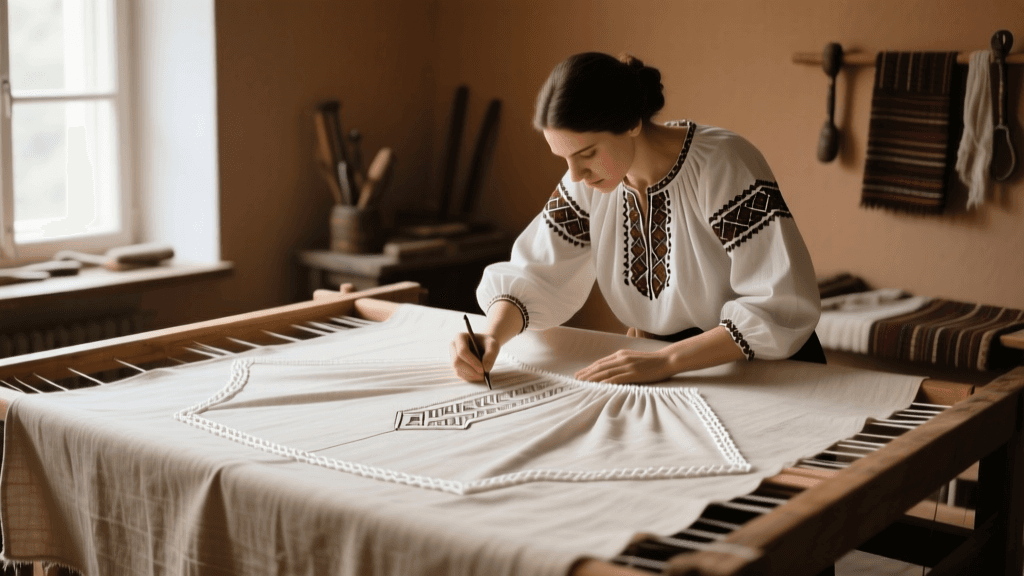
The altiță is the defining visual element of the Romanian ie. It is a wide, densely embroidered band that sits horizontally across the top of the sleeve, bridging the front and back panels. Historically, the altiță served as a protective talisman, as the shoulder was considered a vulnerable point where evil spirits could enter the body.
Grid Calculation and Pattern Mapping
In 2026, while many artisans use digital tablet apps to map out complex cross-stitch patterns before committing to fabric, the physical execution remains entirely by hand. The altiță is typically 12cm to 15cm wide and spans the entire width of the sleeve rectangle.
To prepare the sleeve for embroidery:
- Mark the center of the sleeve rectangle.
- Determine your thread count. If your linen is 32-count (32 threads per inch), a 10cm wide altiță will require approximately 128 stitches across.
- Baste a guiding grid using water-soluble thread every 10 stitches to prevent counting errors during the long embroidery process.
Essential Embroidery Stitches
The altiță utilizes specific traditional stitches. The most prominent is the punctul bătrânesc (the old man's stitch), a variation of the Romanian stitch where the couching thread creates a diagonal, textured line over the base satin stitches. This is often combined with the punctul cruce (cross-stitch) for filling geometric motifs like the romb (diamond) and the coada racului (crayfish tail). For broader research on historical European embroidery techniques and stitch evolution, the Victoria and Albert Museum's Textiles Collection offers extensive visual archives of traditional Eastern European stitch structures.
Mastering the Încreț (Neckline Smocking)
Once the altiță and the vertical sleeve motifs (râuri) are embroidered, the next major construction hurdle is the încreț, the smocked neckline. The ie does not use a separate collar piece; instead, the excess fabric from the front, back, and sleeves is gathered and smocked into a dense, flexible honeycomb structure that sits flat against the collarbone.
The Mathematics of Smocking
Smocking requires precise mathematical planning. A standard honeycomb smock reduces the fabric width by a ratio of 3:1. Therefore, if your finished neckline circumference needs to be 45cm, you must gather approximately 135cm of raw fabric.
Step-by-Step Smocking Execution
- Marking the Grid: On the wrong side of the fabric, mark a grid of dots 5mm apart horizontally and 8mm apart vertically across the top 10cm of all four main panels (front, back, and two sleeves).
- Running the Gathering Threads: Using a strong, waxed linen thread, sew running stitches along the horizontal rows. Do not tie off the ends; leave long tails.
- Pulling the Gathers: Gently pull the threads to gather the fabric. The goal is not to create tight, pleated ruffles, but rather soft, uniform folds that will be manipulated by the smocking stitches.
- The Honeycomb Stitch: Using your embroidery thread, work from left to right. Bring the needle up through the first dot, take a small stitch through the second dot, and pull the thread taut to bring the two dots together. Move down to the next row and repeat, alternating the pairing of the dots to create the hexagonal honeycomb structure.
The tension of your smocking thread is critical. If it is too tight, the neckline will pucker and warp; if it is too loose, the honeycomb structure will collapse. Practice on a linen scrap before working on the final garment.
Assembly, Gussets, and Finishing Techniques
With the embroidery and smocking complete, the garment is ready for assembly. The construction of the ie relies heavily on flat-felled seams, which enclose the raw edges and provide immense durability without the need for modern sergers or overlockers.
Inserting the Underarm Gusset (Pavă)
The most challenging aspect of assembling a zero-waste folk blouse is setting the square gusset into the intersection of the side seam and the sleeve seam.
- Sew the sleeve seam and the side seam, stopping exactly 1.5cm (your seam allowance) before the intersection point. Backstitch securely.
- Clip into the corner of the intersection diagonally, stopping just short of your stitching line. This allows the fabric to pivot.
- Pin the four sides of the diamond gusset to the four clipped edges (front sleeve, back sleeve, front bodice, back bodice).
- Hand-baste the gusset in place, then machine or hand-stitch using a tight 2.0mm stitch length. Pivot exactly at the corners of the gusset to prevent puckering.
Finishing the Cuffs (Brățări)
The sleeves of the ie are traditionally finished with narrow, heavily embroidered bands called brățări. These are cut as straight rectangles, embroidered, and then attached to the sleeve end using a narrow gathering technique similar to the neckline, though on a much smaller scale. The cuffs are typically fastened with a single fabric-covered button and a loop, or a traditional woven tie.
Conclusion
Drafting and constructing a traditional Romanian ie in 2026 is a deeply rewarding endeavor that bridges the gap between historical preservation and modern sustainable fashion. By mastering the zero-waste geometric cutting, the intricate altiță embroidery, and the structural mathematics of the încreț smocking, you are not merely sewing a garment; you are participating in a living, breathing textile tradition. As the demand for slow, intentional, and culturally rich fashion continues to grow, the techniques outlined in this guide will serve as a foundational pillar for any serious practitioner of European folk dress construction.