Mastering Romanian Ie Altita Embroidery Patterns 2026
The Resurgence of the Romanian Ie in 2026
The traditional Romanian blouse, universally known as the Ie, has long been a symbol of Eastern European cultural identity. However, in 2026, we are witnessing an unprecedented revival of its most complex and sacred element: the Altita embroidery. Following its inscription on the UNESCO Representative List of the Intangible Cultural Heritage of Humanity, the global appreciation for the authentic, hand-stitched Ie has skyrocketed. Today, contemporary artisans and textile enthusiasts across the Balkans are moving away from mass-produced, machine-embroidered imitations, returning instead to the meticulous, geometric hand-stitching that defines genuine Slavic and Balkan folk dress.
For textile historians and modern makers alike, understanding the Altita is not merely about fashion; it is about decoding a visual language. The patterns stitched onto the shoulder of the blouse historically conveyed the wearer’s age, marital status, and specific village of origin. In this comprehensive 2026 guide, we break down the anatomy of the Altita, compare regional variations, and provide actionable advice on sourcing authentic materials for your own traditional garment projects.
Anatomy of the Ie: Understanding the Altita
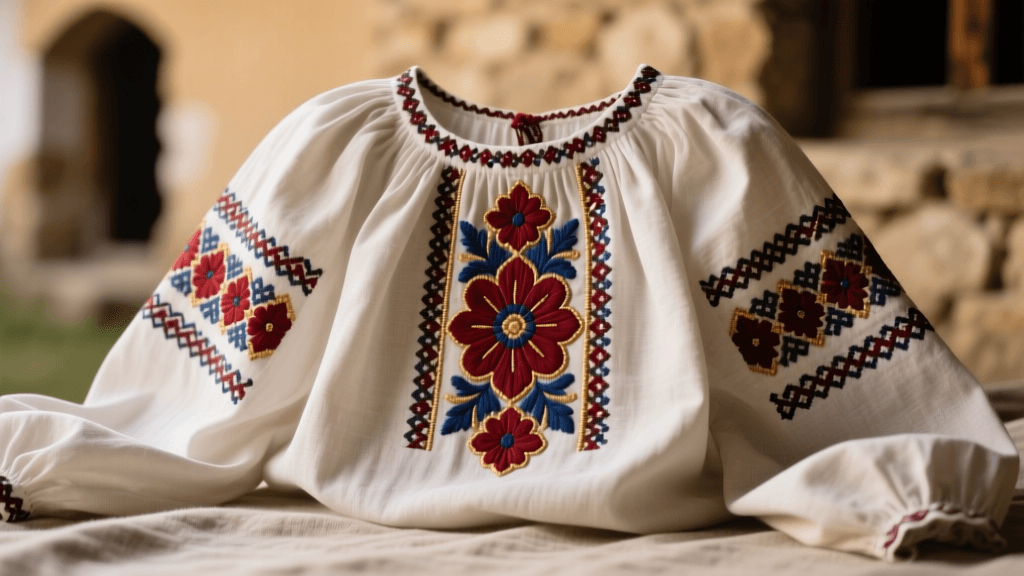
The traditional Romanian Ie is constructed from rectangular panels of woven fabric, designed to minimize waste. The embroidery is strategically placed on the chest, sleeves, and shoulders. The Altita (derived from the Latin altus, meaning high) is the decorative, heavily embroidered rectangular panel located on the upper shoulder.
The Altita is traditionally divided into three distinct structural zones:
- The Altita (Shoulder Panel): The dense, square or rectangular focal point featuring complex geometric or solar motifs.
- The Incret (Gathering): A narrow, tightly pleated band situated just below the Altita, serving as a transitional element.
- The Rauri (Rivers): Vertical or diagonal bands of embroidery that flow down the sleeve from the Incret, symbolizing the flow of water and life.
In 2026, the most sought-after museum-quality reproductions strictly adhere to the rule that the Altita must never be interrupted by seams. The fabric is gathered organically around the neckline, allowing the shoulder panel to lay flat and fully visible.
Regional Variations: Neamț vs. Argeș vs. Olt
To accurately recreate or identify an authentic Ie, one must understand the distinct regional dialects of Romanian embroidery. The color palettes, motif densities, and stitch types vary drastically from the Carpathian Mountains to the southern plains.
| Region | Dominant Colors (2026 Natural Dyes) | Primary Motifs | Signature Stitch | Fabric Base |
|---|---|---|---|---|
| Neamț (Moldavia) | Deep madder red, black, olive green | Dense geometric, rhombuses, 'ram's horns' | Tighel (Whipstitch) & Lanț (Chain) | Heavy hand-woven hemp |
| Argeș (Muntenia) | Muted burgundy, gold thread, dark brown | Floral-geometric hybrids, 'little eyes' | Crunț (Cross-stitch) on counted threads | Fine linen-cotton blend |
| Olt (Oltenia) | Vibrant crimson, indigo blue, metallic silver.td> | Highly stylized birds, solar wheels | Broderie spartă (Drawn threadwork) | Sheer borangic (raw silk) |
According to curators at the National Museum of the Romanian Peasant, the Oltenian use of borangic (raw silk) combined with metallic thread remains the most challenging and expensive to replicate today, as authentic silk production in the Balkans has become highly specialized and localized.
Sourcing Authentic Materials in 2026
The modern folk dress revival demands authenticity not just in pattern, but in textile composition. Synthetic threads and polyester blends are heavily frowned upon in serious preservation circles. If you are commissioning or crafting an Ie this year, here is what you need to know about sourcing.
Hemp and Linen Blends
Historically, the base fabric was woven from locally grown hemp (cânepă) or flax. Today, Eastern European weavers in rural Romania and Ukraine produce small-batch, hand-loomed hemp that perfectly mimics the slightly irregular, slubby texture of 19th-century textiles. When purchasing, look for a fabric weight of 180–220 GSM for winter blouses, and 120–150 GSM for summer wear. Ensure the fabric has been traditionally boiled in wood ash lye to achieve the necessary off-white, ivory tone.
Natural Dyes and Wool Threads
The shift toward sustainable, eco-friendly fashion in 2026 has perfectly aligned with traditional Balkan practices. Authentic Altita embroidery uses fine, worsted wool or silk threads dyed with botanical sources:
- Red: Madder root (Rubia tinctorum) or fermented St. John’s Wort.
- Black: Iron-modified oak galls or walnut husks.
- Yellow/Gold: Weld or onion skins.
- Blue: Japanese or European woad (Indigo is historically inaccurate for most inland Carpathian regions).
Step-by-Step: Recreating the Altita Motif
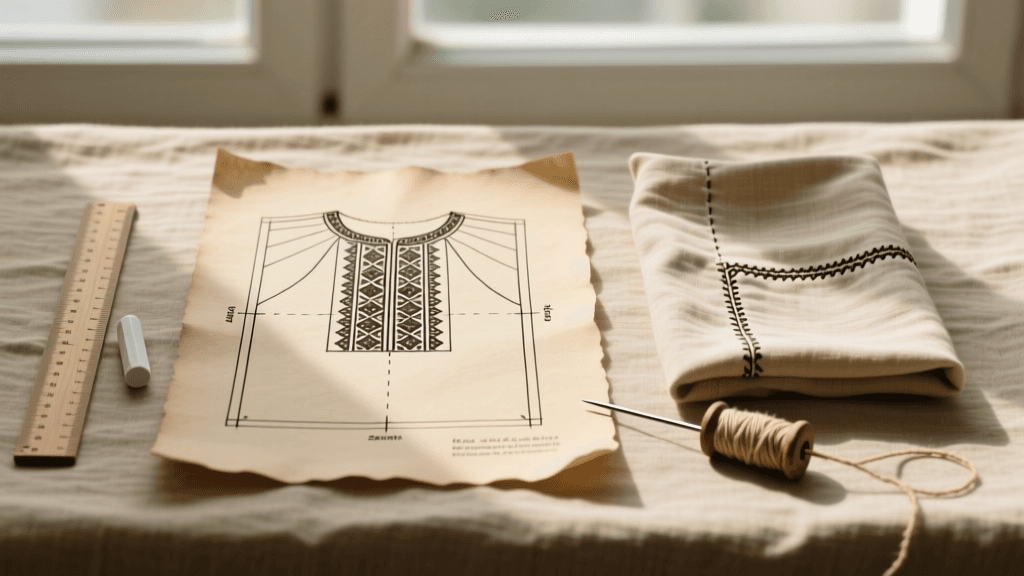
Embroidering an Altita requires patience, precision, and a grasp of counted-thread techniques. Unlike freehand embroidery, the Altita relies entirely on the warp and weft of the woven base fabric.
- Map the Grid: Identify the central axis of your shoulder panel. Traditional Altita motifs are symmetrical, expanding outward from a central 'seed' or solar cross.
- Outline First: Use a single strand of black or dark brown wool to outline the primary geometric shapes using a backstitch or whipstitch. This contains the denser filling stitches.
- Fill with the 'Tighel': The tighel is a tight, slanted whipstitch that completely covers the fabric base within the outlined shapes. It creates a raised, textured effect that catches the light.
- Execute the Incret: Below the main square, gather the fabric tightly. Embroider a narrow band of interlocking triangles. This band structurally reinforces the gathers while providing a visual break.
- Flow into the Rauri: Transition from the dense shoulder panel to the vertical 'rivers' down the sleeve. Ensure the spacing between the rivers matches the width of the Altita motifs to maintain visual harmony.
"The Altita is not merely decorative; it is an apotropaic shield. In traditional Carpathian belief, the shoulder is a vulnerable point where evil spirits might enter the body. The dense, impenetrable geometry of the Altita acts as a spiritual armor, protecting the wearer as they move through the world."
— Dr. Elena Ionescu, Ethnographer and Textile Historian, Institute of Ethnography and Folklore
Caring for Your Handmade Ie
A hand-embroidered Ie featuring natural dyes and wool threads requires specialized care to survive for generations. Never machine wash an authentic piece. Instead, soak the blouse in cool water with a pH-neutral, enzyme-free detergent designed for delicate wools and silks. Do not wring the fabric; gently press the water out and lay it flat on a clean, dry towel in the shade. Direct sunlight will rapidly degrade natural madder and woad dyes.
When storing the garment for the winter months, wrap it in unbleached cotton or acid-free tissue paper. Avoid plastic garment bags, which trap moisture and encourage mold growth on organic hemp and wool fibers. Cedar blocks are highly recommended to deter moths without introducing harsh chemical odors into the natural fibers.
The Future of Balkan Textile Heritage
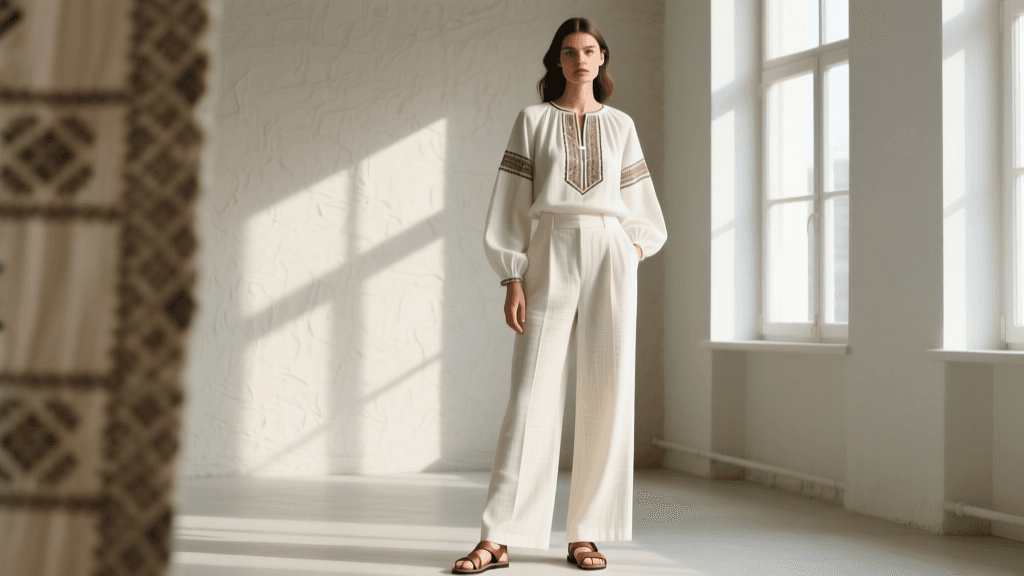
As we navigate 2026, the line between historical preservation and contemporary fashion continues to blur in the most respectful ways. Designers in Bucharest, Chișinău, and across the diaspora are integrating the Altita into modern silhouettes without compromising the sacred geometry of the stitches. By understanding the deep regional roots, sourcing ethical materials, and honoring the slow, meditative process of counted-thread embroidery, we ensure that the Romanian Ie remains a living, breathing masterpiece of Eastern European folk dress.