Styling the Romanian Ia Blouse in 2026: Modern Folk Revival
The 2026 Heritage Luxury Movement
The global fashion landscape in 2026 has decisively pivoted away from fleeting micro-trends, embracing what industry analysts now call 'Heritage Luxury.' At the forefront of this European folk dress revival is the Romanian Ia (pronounced 'ee-ah'), a traditional hand-embroidered blouse that has transcended its rural origins to become a cornerstone of contemporary, sustainable wardrobes. No longer relegated to festival costumes or museum archives, the Ia is being recontextualized by modern stylists who appreciate its architectural volume, intricate symbolism, and unparalleled artisanal craftsmanship.
As consumers increasingly demand transparency and longevity in their garments, the Ia offers a masterclass in slow fashion. Each authentic piece requires anywhere from two weeks to three months of meticulous hand-stitching. In 2026, integrating this masterpiece of Eastern European textile history into a modern, minimalist wardrobe is not just a stylistic choice; it is a statement of cultural preservation and conscious consumption. According to the UNESCO Intangible Cultural Heritage frameworks, the traditional art of the white shirt with embroidery has been globally recognized, cementing its status as a protected and celebrated textile art form.
Anatomy of the Authentic Ia
Before styling the garment, one must understand its structural and decorative anatomy. The traditional Ia is constructed from rectangular panels of hand-woven linen or hemp, minimizing fabric waste—a zero-waste pattern-making technique that modern 2026 sustainable brands are desperately trying to replicate. The garment is defined by three primary embroidered zones:
- The Altiță (Shoulder Band): The most densely embroidered part of the blouse, historically signaling the wearer's region, social status, and marital status. In contemporary styling, the altiță acts as a natural focal point, drawing the eye upward and framing the collarbone.
- The Încreț (Neckline Gather): A smocked, geometric band that sits just below the altiță, providing structural tension and allowing the blouse to drape elegantly over the shoulders.
- The Râuri (Rivers): Vertical or diagonal streams of embroidery that flow down the sleeves. These 'rivers' guide the eye and add a sense of movement, making the wide sleeves look fluid rather than bulky.
Contemporary Styling Frameworks for 2026
Styling the Ia in 2026 requires a careful balance between honoring its voluminous heritage and anchoring it with modern silhouettes. The key is to treat the blouse as a piece of structural art, allowing its embroidery and shape to dictate the rest of the outfit.
1. The Structured Contrast
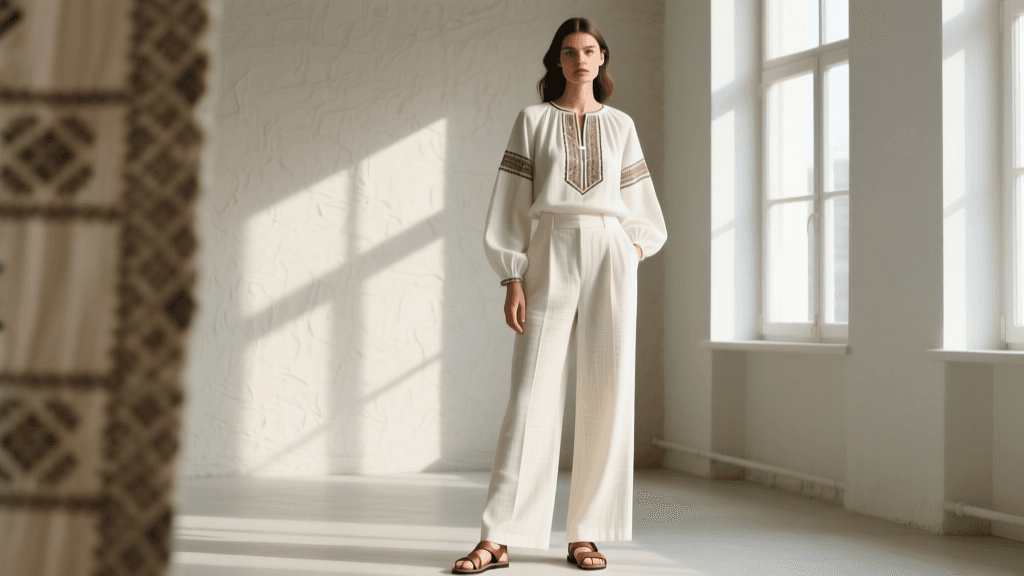
The inherent softness and volume of the hand-woven linen Ia demand contrast. In 2026, the most prominent styling technique involves pairing the blouse with hyper-tailored, structured bottoms. Imagine a classic Muscel-region Ia with its stark black and silver geometric embroidery, tucked into high-waisted, wide-leg wool trousers with a 32-inch inseam and a sharp front crease. The juxtaposition of the fluid, smocked neckline against the rigid, architectural lines of modern tailoring creates a sophisticated tension perfect for creative workspaces or gallery openings. Finish this look with a minimalist leather belt and structured loafers to ground the ethereal top half.
2. Monochromatic Minimalism
Because the embroidery on an authentic Ia is incredibly detailed, introducing competing patterns or loud colors will overwhelm the garment. The 2026 approach champions monochromatic grounding. If you are wearing an Ia from the Olt region, characterized by its vibrant crimson and black thread work, anchor it with head-to-toe black or deep charcoal. A sleek, black silk midi skirt or tailored black denim allows the red 'rivers' on the sleeves to pop brilliantly without visual clutter. This method aligns perfectly with the 'quiet luxury' ethos, where the investment is in the craftsmanship of a single statement piece rather than an accumulation of logos.
3. Transitional Layering and Outerwear
As climate-adaptive dressing becomes standard in 2026, the Ia proves to be an exceptional layering piece. The wide, gathered sleeves can easily slide under oversized, unstructured blazers or long-line wool coats. For a striking evening look, layer a sheer, black-embroidered Ia from the Vrancea region under a sharp, monochromatic tuxedo suit, leaving the blazer unbuttoned to reveal the intricate altiță. The smocked neckline naturally forms a soft cowl or scoop, eliminating the need for additional jewelry.
Regional Variations and Modern Pairings
Romania's diverse topography has given rise to distinct regional styles of the Ia. Understanding these variations can help you curate a highly specific, intentional wardrobe. Below is a guide to regional styles and their ideal 2026 contemporary pairings.
| Region | Key Design Features | Base Fabric | Ideal 2026 Modern Pairing |
|---|---|---|---|
| Muscel | Geometric patterns, predominantly black, silver, and gold metallic threads. | Unbleached hemp or heavy linen. | Charcoal wool wide-leg trousers and structured leather mules. |
| Olt | Floral and vegetal motifs, vibrant crimson red and black silk threads. | Fine white cotton or lightweight linen. | Black silk slip skirts and minimalist strappy heels. |
| Vrancea | Curvilinear patterns, deep navy blues, burgundy, and subtle gold accents. | Semi-sheer borangic (raw silk). | Monochromatic navy tuxedo suits or tailored denim. |
| Neamț | Dense, cross-stitch geometric bands, earthy tones like ochre and forest green. | Textured, homespun linen. | Olive green cargo trousers and chunky artisanal boots. |
Sourcing Authentic Artisans in 2026
The commercialization of folk dress has unfortunately led to a market saturated with mass-produced, polyester knockoffs that appropriate traditional patterns without supporting the communities that created them. In 2026, conscious consumers are bypassing fast-fashion retailers and sourcing directly from artisan cooperatives and specialized heritage boutiques.
When sourcing an authentic Ia, expect to invest between €250 and €800, depending on the complexity of the embroidery and the fineness of the hand-woven textile. Institutions like the Romanian Peasant Museum frequently host artisan fairs and maintain directories of certified weavers and embroiderers. Additionally, global textile archives and institutions, such as the Victoria and Albert Museum's fashion collections, continually highlight the importance of provenance in European folk textiles, encouraging buyers to look for hallmarks of handcraft: slight irregularities in the stitching, the natural slub of hand-spun linen, and the use of natural, plant-based dyes.
Red Flags to Avoid When Purchasing
- Machine-made chain stitch: Authentic Ia relies on the Romanian cross-stitch (altiță) and hemstitching. Uniform, perfectly locked machine stitching is a clear indicator of factory production.
- Synthetic fabrics: Traditional Ia breathes. If the fabric melts under a flame test or lacks the natural, slightly coarse texture of linen, hemp, or raw silk, it is not authentic.
- Fused motifs: Patterns should be woven or embroidered into the fabric, never printed or heat-pressed onto the surface.
Garment Care and Preservation
An authentic Ia is an heirloom garment meant to outlive its original owner. Proper care in 2026 relies on gentle, non-toxic methods that preserve both the structural integrity of the natural fibers and the vibrancy of the dyed threads.
- Washing: Never machine wash an Ia. Submerge the garment in lukewarm water (never exceeding 30°C) using a pH-neutral, enzyme-free detergent specifically formulated for delicate natural fibers. Gently agitate by hand for no more than five minutes.
- Drying: Do not wring or twist the smocked încreț, as this will permanently distort the tension of the gathers. Roll the blouse in a clean, dry cotton towel to press out excess moisture, then lay it flat on a mesh drying rack away from direct sunlight to prevent the embroidery threads from fading.
- Ironing and Storage: Iron the blouse while it is still slightly damp, using a low-heat setting and always pressing on the reverse side to protect the raised embroidery. Store the Ia flat in acid-free tissue paper within a cedar-lined drawer to deter moths without the use of harsh chemical mothballs.
By embracing the Romanian Ia in 2026, you are doing more than adopting a beautiful garment; you are participating in a vital cultural dialogue. Styling this piece with modern intentionality ensures that the hands that wove the linen and stitched the rivers are honored in the contemporary world, proving that true folk dress is not a relic of the past, but a living, breathing element of the future wardrobe.