Ancient Greek Chiton & Roman Toga Guide: 2026 Draping Methods
The Revival of Classical Garments in 2026
As we navigate through 2026, the European historical reenactment and classical theater communities have experienced an unprecedented renaissance. Driven by immersive museum exhibitions across the Mediterranean and a growing demand for hyper-accurate "living history" experiences, the recreation of ancient Greek and Roman garments has moved beyond simple costume design into the realm of experimental archaeology. Understanding the precise architecture of the ancient Greek chiton and the Roman toga is no longer just for academics; it is a vital skill for modern reenactors, theater wardrobe masters, and heritage festival participants.
Unlike tailored modern clothing, classical antiquity relied on the art of draping. Garments were woven to specific dimensions on looms and then pinned, folded, and belted directly onto the body. This comprehensive guide explores the construction, measurement, and draping techniques required to authentically recreate these iconic garments using the best textile sourcing methods available in 2026.
Understanding the Ancient Greek Chiton
The chiton was the foundational garment of ancient Greece, worn by both men and women. According to the Metropolitan Museum of Art, the Greeks viewed the body as a reflection of divine proportion, and their clothing was designed to enhance, rather than obscure, the natural form through elegant, mathematical folds.
Doric vs. Ionic Variations
There are two primary classifications of the chiton, each requiring different fabric weights and draping techniques:
- The Doric Chiton (Peplos): Originating earlier, this garment was typically made from heavier wool. It featured an apoptygma (an overfold at the top) and was pinned at the shoulders with heavy fibulae. It was sleeveless and relied on the weight of the wool to create deep, structured vertical flutes.
- The Ionic Chiton: Emerging later and popularized during the classical period, the Ionic chiton was crafted from lightweight, finely woven linen. It was much wider than the Doric version, creating voluminous sleeves when pinned at multiple intervals along the upper arms, and lacked the heavy overfold.
Measurements and Draping the Chiton
To recreate a historically accurate Ionic chiton for a modern adult in 2026, you must abandon standard sewing patterns and rely on body-centric measurements. The fabric is woven as a single, large rectangle.
- Width Calculation: Measure the wearer's wingspan (fingertip to fingertip with arms outstretched). Add 12 to 18 inches to this measurement to allow for the sleeve volume and body drape.
- Height Calculation: Measure from the highest point of the shoulder to the floor. Add 10 to 15 inches to this measurement to account for the kolpos (the bloused overhang created by belting).
- Draping Process: Wrap the fabric around the body. Pin the top edges together at the shoulders using brooches or sewn ties, leaving gaps for the head and arms. Tie a cord belt around the waist, then pull the fabric up and over the belt to create the bloused kolpos, adjusting the hemline to the desired length (ankle-length for women, knee-length for men or active laborers).
Mastering the Roman Toga and Stola
While the Greeks favored the simplicity of the chiton, the Romans developed highly complex garments that served as strict markers of social status, citizenship, and gender. The World History Encyclopedia emphasizes that Roman clothing was deeply codified; wearing the wrong garment or draping it improperly was a severe social faux pas in antiquity.
The Toga: Architecture and Status
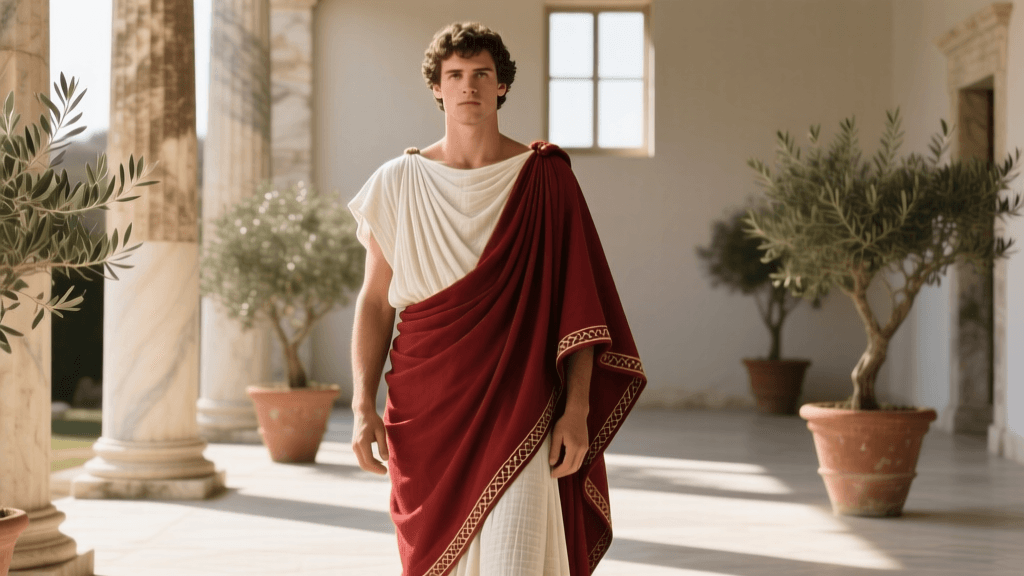
The toga was exclusively worn by male Roman citizens. It was not a simple semicircle, as often depicted in mid-20th-century cinema, but a complex, elliptical shape that required immense skill to drape. By the Imperial period, the toga was a massive garment, often measuring up to 18 feet in length and 7 feet in width.
Draping the Toga Virilis (The Toga of Manhood):
- The Preparation: The toga requires a lightweight, tropical-weight wool to prevent the wearer from collapsing under the sheer weight of the fabric. The fabric is folded lengthwise, with the bottom half slightly narrower than the top.
- The First Drape: One end is thrown over the left shoulder, hanging down to the calves in the front.
- The Wrap: The fabric is brought across the back, under the right arm, and across the chest.
- The Sinus and Umbo: The fabric is draped over the left shoulder once more. The excess fabric hanging across the chest is pulled downward to create a deep, pouch-like fold called the sinus (which could be used to hold small items). A knob of fabric, the umbo, is pulled up and secured over the left shoulder to lock the entire structure in place.
The Stola: Matronly Elegance
Respectable Roman women did not wear the toga; instead, they wore the stola over a basic linen tunica. The stola was a long, sleeveless dress suspended from the shoulders by straps or short sleeves. The defining feature of the stola was the instita—a decorative border or flounce at the hem and sometimes at the neckline, which signaled the wearer's status as a married matron. In 2026, reenactors often use contrasting silk or dyed linen bands to recreate the instita, ensuring the colors align with historical sumptuary laws.
2026 Fabric Sourcing and Cost Guide
The success of any classical garment relies entirely on the textile. Modern synthetic blends will not drape correctly and will cause overheating during summer heritage festivals. Below is a comparative guide to the most historically accurate and practical fabrics available on the 2026 European textile market.
| Fabric Type | Weave / Weight | Drape Quality | 2026 Avg. Cost (per yard) | Best Used For |
|---|---|---|---|---|
| Medium-Weight Linen | 5.3 oz / Plain Weave | Crisp, structured flutes | $18 - $24 | Doric Chiton, Peplos, Basic Tunics |
| Lightweight Wool | Tropical / Worsted | Fluid, warm, excellent drape | $28 - $35 | Roman Toga, Ionic Chiton |
| Silk-Linen Blend | 3.5 oz / Satin Weave | Luxurious, highly fluid | $45 - $60 | Patrician Toga, Elite Stola |
| Organic Hemp | 6.0 oz / Twill Weave | Heavy, durable, rustic | $22 - $28 | Working-class Tunics, Cloaks |
| Cotton Muslin | 4.0 oz / Plain Weave | Sheer, breathable, fragile | $8 - $12 | Theater props, draping practice |
Essential Accessories: Fibulae, Belts, and Footwear
A chiton or toga is incomplete without the hardware and footwear that anchored the garments in antiquity.
- Fibulae (Brooches): The ancient safety pin. For a Doric chiton, you need heavy bronze or iron penannular or bow brooches capable of supporting thick wool without tearing. For the Ionic chiton, smaller, decorative rosette or disc fibulae are appropriate. In 2026, custom bronze castings from historical reenactment artisans in Italy and Greece remain the gold standard for accuracy.
- Cingulum (Belts): Leather or woven wool cords were used to belt the chiton. Roman soldiers and officials wore the cingulum militare, a highly decorated leather belt with metal plates and a studded apron (the pteruges), which served as a badge of military identity.
- Footwear: The Greeks favored the chitoniskos and simple leather sandals. The Romans utilized the calceus (an enclosed leather shoe worn in the city with a toga) and the caliga (a heavy, hobnailed military sandal). For modern reenactors traversing uneven terrain at archaeological sites, investing in custom-made, historically accurate caligae with modern ergonomic insoles is highly recommended for joint health.
Care and Maintenance of Classical Textiles
Maintaining large, un-tailored lengths of linen and wool requires specific care to preserve the drape and prevent shrinkage. Avoid modern machine agitation, which can felt wool and warp linen threads. For wool togas, dry brushing and airing out in the sun remain the most historically authentic and practically effective cleaning methods. Linen chitons should be hand-washed in cool water with eco-friendly, pH-neutral detergents, and ironed while damp to achieve the sharp, pleated flutes characteristic of classical Greek statuary.
Conclusion
Recreating the chiton and the toga is an exercise in understanding the intersection of ancient engineering, social hierarchy, and textile artistry. By utilizing precise body measurements, sourcing high-quality natural fibers, and mastering the intricate draping techniques of the ancients, modern enthusiasts can bring the classical world to life with breathtaking authenticity. Whether preparing for a major 2026 Mediterranean heritage festival or a classical theater production, respecting the architecture of these garments ensures that the legacy of Greek and Roman dress continues to captivate and educate.