Scandinavian Folk Dress: Bunad vs Folkdräkt in 2026
The Living Heritage of Scandinavian Folk Dress in 2026
When discussing traditional European folk costumes, few regions command as much respect, meticulous craftsmanship, and active daily participation as Scandinavia. In 2026, the distinction between Norway’s heavily regulated bunad and Sweden’s diverse folkdräkt remains a focal point for textile enthusiasts, cultural historians, and festival-goers alike. Unlike many European folk costumes that are relegated to museum displays or occasional tourist performances, Scandinavian folk dress is a living, breathing garment tradition. From the vibrant celebrations of Syttende Mai (Norwegian Constitution Day) to the sunlit Midsommar festivals in Sweden, these garments are worn with immense pride.
However, navigating the intricate rules of regional authenticity, sourcing hand-woven materials, and commissioning custom tailoring requires precise knowledge. This comprehensive guide breaks down the regional variations, 2026 market costs, and practical fitting requirements for the two most prominent Scandinavian folk dress traditions.
The Philosophy of Scandinavian Dress: Unbroken vs. Revived Traditions
To understand the current landscape of Scandinavian folk dress, one must understand the philosophical divide between Norway and Sweden. In Norway, the bunad is governed by strict regionalism. You do not simply choose a bunad because you like the colors; traditionally, you wear the bunad of your ancestral homeland or the region where you currently reside. In Sweden, the folkdräkt (folk costume) is historically tied to the parish (socken) system, but modern revival movements have allowed for greater flexibility, including the creation of a unified national costume.
According to archival records preserved at the Norsk Folkemuseum, the Norwegian bunad movement gained massive traction in the early 20th century as a symbol of national romanticism and independence. Conversely, Swedish folk dress evolved through a complex history of sumptuary laws and regional isolation, resulting in over 800 documented local variations cataloged by institutions like the Nordiska Museet.
The Norwegian Bunad: Strict Rules and Regional Mastery
The Norwegian bunad is not a single garment, but a collection of over 450 distinct regional variations. The National Council for Bunad and Folk Costumes (Bunad- og folkedraktrådet) categorizes these garments based on their historical continuity. A 'Category 1' bunad represents an unbroken folk tradition, while a 'Category 3' bunad is a modern reconstruction based on historical fragments or paintings.
The Hardangerbunad: The Mother of All Bunads
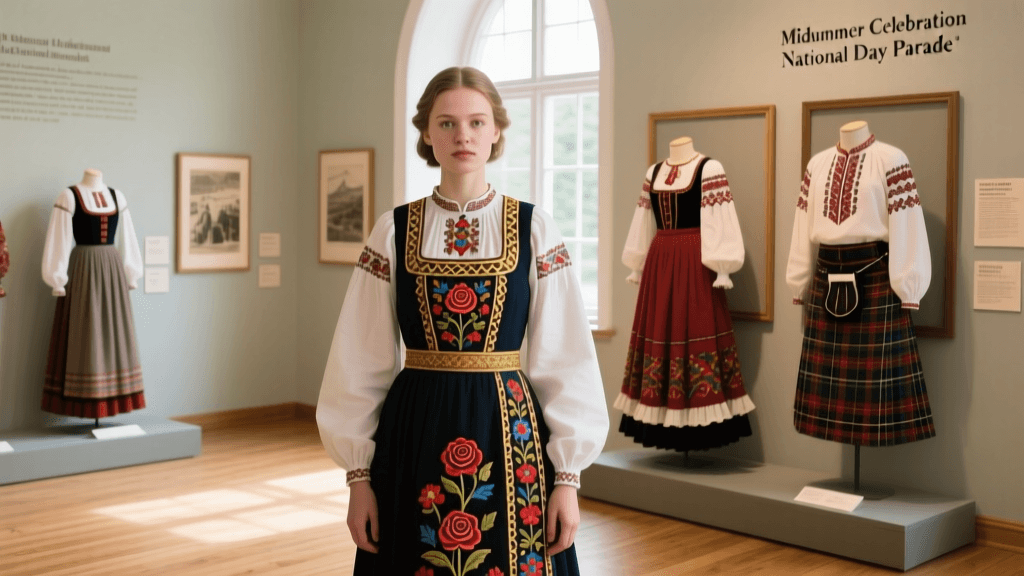
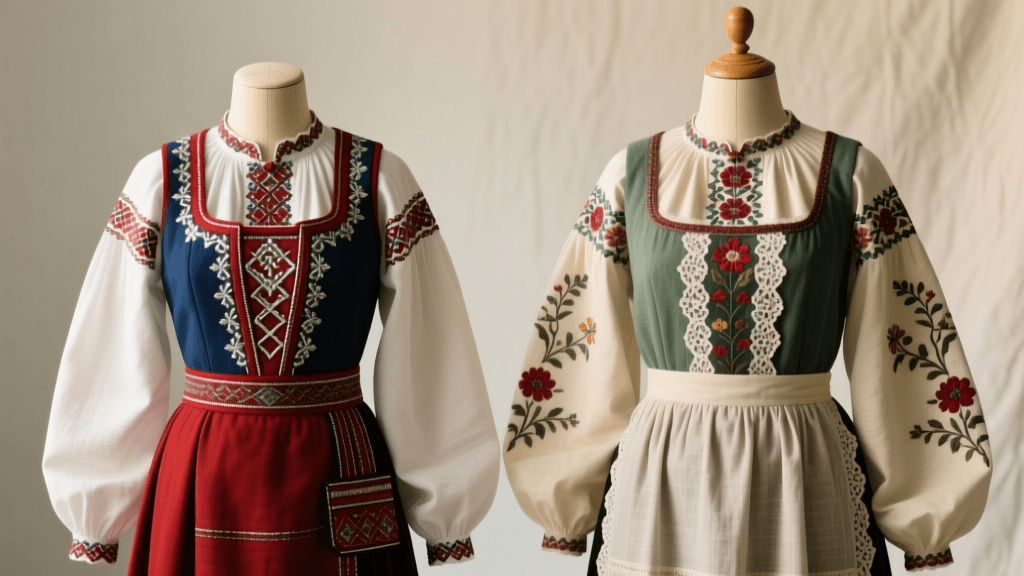
Originating from the Hardanger fjord region, this is arguably the most famous Norwegian bunad. Characterized by its deep black wool bodice and skirt, contrasted with a crisp white linen shirt featuring intricate svartsaum (blackwork) and white drawn-thread embroidery, the Hardangerbunad is a masterpiece of textile art. In 2026, commissioning a fully hand-embroidered Hardangerbunad from authorized artisans requires a lead time of 12 to 18 months. The embroidery alone can take hundreds of hours, making it one of the most expensive regional variants on the market.
The Nordlandsbunad: A Tapestry of the North
Hailing from Nordland county, this bunad is instantly recognizable by its striking blue and green color palette. The design is heavily inspired by a 17th-century altar cloth from the Alstahaug church. The women’s bodice features elaborate floral embroidery using silk threads in shades of red, yellow, and blue, set against a rich blue wool background. For men, the Nordlandsbunad features a deep blue wool coat with silver buttons and a brocade vest, making it a highly sought-after garment for grooms in 2026.
The Swedish Folkdräkt: Provincial Diversity and the Sverigedräkten
While Norway focused on strict regional adherence, Sweden’s approach to folk dress in the 20th and 21st centuries has been characterized by both deep provincial pride and a unifying national movement. The Swedish folkdräkt is heavily influenced by the agrarian calendar, with specific garments designated for Sundays, weddings, and periods of mourning.
Leksandsdräkt: The Crown Jewel of Dalarna
The Leksand costume from the Dalarna province is perhaps the most iconic Swedish folkdräkt. It is characterized by its vivid color blocking: a black bodice, a white linen blouse, a striped skirt (often featuring deep reds, greens, and blacks), and a highly distinctive apron. The apron itself dictates the wearer's status and the specific liturgical season. In 2026, sourcing authentic hand-woven linen for the Leksand blouse has become a priority for purists, with many turning to specialized weavers in Västra Götaland to ensure the thread count and slub match 19th-century archival samples.
Sverigedräkten: The National Unifier
Created in 1903 by Märta Jörgensen, the Sverigedräkten (Sweden Costume) was designed to be a national dress that any Swedish citizen could wear, regardless of their specific parish ancestry. Featuring the national colors of blue and yellow, it remains incredibly popular for National Day (June 6th) celebrations. For those looking to participate in Swedish cultural events in 2026 without claiming a specific regional lineage, the Sverigedräkten is the most culturally appropriate and widely accepted choice.
2026 Sourcing, Tailoring Costs, and Material Realities
Acquiring an authentic Scandinavian folk dress is an investment in heritage craftsmanship. The costs associated with these garments reflect the living wages of skilled tailors, embroiderers, and silversmiths. Below is a comparative breakdown of what buyers and cultural enthusiasts should expect when sourcing these garments in 2026.
| Feature | Norwegian Bunad (e.g., Hardanger/Nordland) | Swedish Folkdräkt (e.g., Leksand/Sverigedräkten) |
|---|---|---|
| Regulation Level | Extremely High (Governed by National Council) | Moderate (Parish traditions + personal adaptation) |
| Base Garment Cost (2026) | 45,000 - 75,000 NOK ($4,200 - $7,000 USD) | 15,000 - 30,000 SEK ($1,400 - $2,800 USD) |
| Silver / Jewelry Cost | 15,000 - 35,000 NOK (Extensive silver sets required) | 2,000 - 8,000 SEK (Modest brooches and pins) |
| Tailoring Lead Time | 12 - 24 Months (Waitlists for master embroiderers) | 3 - 8 Months (More accessible seamstresses) |
| Primary Retailers | Authorized Husfliden stores, independent master tailors | Local hemslöjd (craft) shops, specialized dräkt tailors |
For those purchasing in 2026, authorized retailers like Husfliden in Norway remain the gold standard for guaranteeing that your bunad meets the strict material and pattern guidelines set by the Bunad Council. In Sweden, local hemslöjd (handicraft) associations are the best resource for sourcing historically accurate woven fabrics and aprons.
Precision Measurement and Fitting Guide
Unlike modern off-the-rack clothing, Scandinavian folk dresses are tailored to the millimeter. The bodice of a bunad or folkdräkt must fit like a second skin, providing structural support without the need for modern undergarments. If you are commissioning a garment in 2026, you must provide your tailor with the following precise measurements, ideally taken by a professional while wearing the specific linen shift you intend to wear underneath:
- Overbust & Full Bust: Crucial for drafting the bodice neckline and ensuring the silver breastpins sit flat against the sternum.
- Underbust: Determines the bottom band of the bodice, which must sit snugly against the ribcage to support the weight of the heavy wool skirt.
- Natural Waist: Measured at the narrowest part of the torso. The skirt of a bunad is pleated to hang exactly from this point.
- Back Waist Length: Measured from the prominent bone at the base of the neck (C7) down to the natural waist. This ensures the bodice does not pull at the shoulders.
- Skirt Drop (Hemline): A critical rule for Norwegian bunads: the skirt must hang exactly 10 to 15 centimeters from the floor when the wearer is standing in their designated traditional festival shoes. Measuring this in bare feet will result in a ruined hemline.
Silver, Accessories, and 2026 Market Trends
No Norwegian bunad is complete without its accompanying sølv (silver). The silver jewelry is not merely decorative; historically, it served as a portable bank account for farming families. A complete Hardanger silver set includes a massive oxidized silver belt buckle, a breastpin (sølje), cufflinks, shoe buckles, and multiple rings. Due to the significant fluctuations in the precious metals market leading into 2026, the cost of a complete, hand-cast silver set has risen sharply. Buyers are increasingly opting for phased purchasing, buying the essential breastpin and belt buckle first, and adding cufflinks and rings in subsequent years.
Swedish folkdräkt accessories are generally more subdued. The focus is on intricate silk ribbons, hand-woven apron bands, and modest silver or pewter brooches. However, the brudkrona (bridal crown) remains a spectacular exception. In regions like Dalarna, bridal crowns made of gilded silver, glass stones, and river pearls are still rented or purchased for traditional weddings, serving as a breathtaking focal point of the ensemble.
Archival Care and Textile Preservation
Owning a piece of Scandinavian heritage requires rigorous maintenance. The heavy wools and starched linens are highly susceptible to moth damage and humidity. In 2026, conservation experts strongly advise against the use of chemical mothballs, which can tarnish the silver and degrade natural silk embroidery threads. Instead, garments should be stored in unbleached cotton garment bags with natural cedar blocks and dried lavender.
Silver requires special attention. The traditional Norwegian method of cleaning oxidized silver involves a paste of precipitated chalk and denatured alcohol, applied with a soft cotton cloth. Ultrasonic cleaners, while popular for modern jewelry, are strictly forbidden for bunad silver, as the high-frequency vibrations can loosen the delicate filigree work and dislodge historical glass stones. By respecting these meticulous care protocols, owners ensure that their folk dress remains a vibrant, wearable link to European history for generations to come.