Mastering Romanian Ia Blouse Pattern Techniques in 2026
The Enduring Genius of Rectangular Construction
The traditional Romanian ia (peasant blouse) represents one of the most sophisticated examples of zero-waste pattern cutting in global textile history. For centuries, village artisans crafted these iconic garments using strict geometric constraints, ensuring that not a single scrap of precious hand-woven linen was wasted. As we navigate the sustainable fashion landscape of 2026, the rectangular construction methods of Eastern European folk dress offer vital lessons for modern makers, pattern drafters, and slow-fashion designers looking to minimize textile waste without sacrificing mobility or elegance.
Unlike modern Western tailoring, which relies heavily on curved armholes, princess seams, and complex darts to contour the body, the ia achieves its distinctive silhouette through strategic gathering, straight-line cutting, and the ingenious use of gussets. According to the UNESCO Intangible Cultural Heritage registry, the art of the traditional blouse with shoulder embroidery (known as the altiță) is a protected cultural practice that relies on these exact historical drafting techniques. In this comprehensive guide, we will break down the mathematical and structural principles of the ia pattern, providing actionable steps for drafting your own zero-waste folk garment using 2026 textile standards.
The Core Philosophy: Working with the Loom Width
To understand the pattern of the ia, one must first understand the limitations of the traditional loom. Historically, hand-woven hemp and linen fabrics were produced in narrow widths, typically ranging from 40 to 50 centimeters (16 to 20 inches). The pattern was dictated by the fabric width rather than the body's curves. The garment was constructed using a series of rectangles and squares that utilized the entire width of the cloth.
In 2026, while commercial linens are readily available in 140cm to 150cm widths, heritage makers and sustainable brands are intentionally returning to narrow-width weaving or artificially restricting their pattern layouts to mimic historical zero-waste constraints. When drafting your pattern, you must establish your "base rectangle" width. For a standard modern adaptation using commercial fabric, a base panel width of 45cm to 55cm is ideal for the front and back body panels, allowing for deep, traditional gathering at the neckline.
Drafting the Body Panels and Neckline
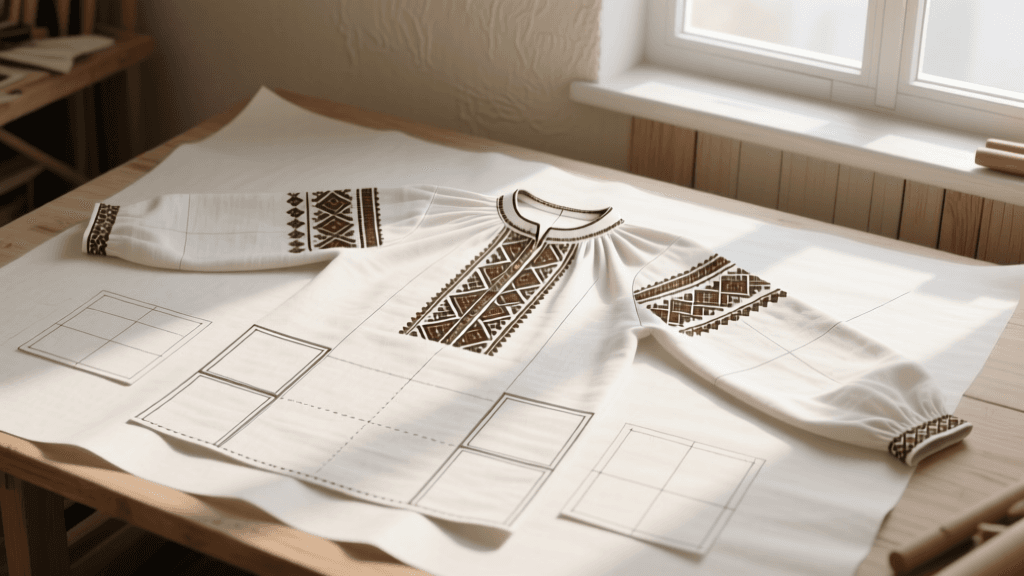
The body of the ia is essentially a modified T-tunic. It consists of a front panel, a back panel, and two large rectangular sleeves. There are no shoulder seams in the most traditional iterations; the front and back panels are often cut as one continuous piece of fabric folded over the shoulder, though side seams are standard.
Step-by-Step Body Drafting
- Length Measurement: Measure from the highest point of the shoulder to the desired hemline (traditionally hip-level, designed to be tucked into a woven fotă or skirt). Add 4cm for hem and casing allowances.
- Width Calculation: Cut two identical rectangles for the front and back. The width should be approximately 1.5 to 2 times your upper bust measurement divided by two, to allow for the iconic gathering.
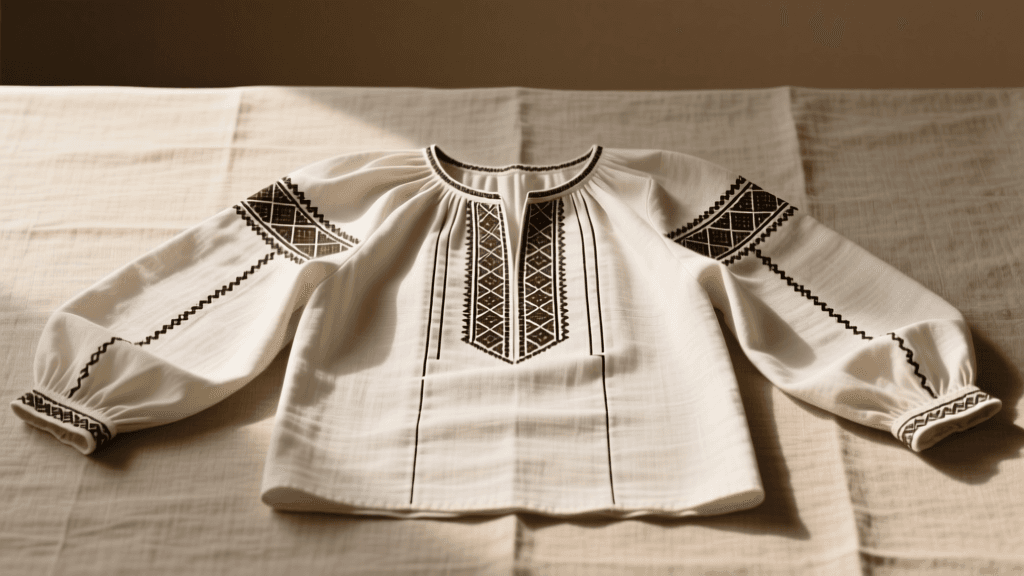
- The Neckline Slit: Instead of a curved scoop neck, the traditional ia features a straight horizontal slit or a small T-shaped opening at the center front. This is finished with a narrow, straight-grain binding or a drawstring casing known as the creț.
The Pavă (Gusset): Engineering Mobility
The most critical structural element of the Romanian ia—and indeed many Slavic and Balkan folk shirts—is the pavă, or underarm gusset. Because the sleeves are cut as straight rectangles attached perpendicularly to the body panels, lifting the arms would cause immense strain on the side seams and restrict movement. The pavă solves this geometric problem brilliantly.
The pavă is a diamond-shaped (rhombus) piece of fabric inserted at the intersection of the side seam and the underarm sleeve seam. It acts as a three-dimensional hinge, providing the necessary ease for the wearer to raise their arms and perform agricultural or domestic labor without tearing the garment.
Drafting and Inserting the Gusset
In 2026, pattern drafting software like CLO3D or Browzwear is often used by heritage brands to simulate the drape of the gusset before cutting physical linen. However, the physical drafting remains straightforward:
- Cut a perfect square of fabric, typically 12cm x 12cm to 15cm x 15cm, depending on the wearer's bust circumference and desired ease.
- Fold the square diagonally to create a triangle, and then fold again to find the exact center point, marking your grainlines.
- Leave a 10cm to 15cm opening at the top of the side seam and the corresponding underarm sleeve seam.
- Insert the diamond into the opening, sewing the four edges of the rhombus to the four edges of the garment's crossroads seam. The points of the diamond should align perfectly with the sleeve and body seam lines.
2026 Fabric Selection and Zero-Waste Layouts
Choosing the right textile is paramount. The heavy, crisp hand-woven hemp of the 19th century behaves very differently from the fluid, commercially milled linens of today. Below is a comparison of the most popular fabric choices for ia construction in 2026, factoring in drape, shrinkage, and embroidery suitability.
| Fabric Type (2026 Market) | Weight (gsm) | Shrinkage Rate | Embroidery Suitability | Best For |
|---|---|---|---|---|
| Heritage Slub Linen (Narrow Width) | 180-210 | 8-10% | Excellent (holds heavy wool/silk threads) | Museum replicas, high-end artisan pieces |
| Organic Medium-Weight Linen | 150-170 | 5-7% | Very Good (standard cotton/mouliné floss) | Everyday slow-fashion wear, modern adaptations |
| Linen-Cotton Blend (55/45) | 120-140 | 3-4% | Good (requires stabilizer for dense patterns) | Lightweight summer blouses, commercial production |
| Raw Hemp/Linen Union | 220+ | 10-12% | Superior (traditional structural seams) | Outerwear shirts, historical reenactment |
Crucial 2026 Prep Step: Because natural fibers are experiencing higher variability in tension due to modern eco-friendly milling processes, you must pre-wash and boil your linen before cutting. Submerge the fabric in hot water (60°C) and tumble dry on high to force maximum shrinkage before you draft your rectangles. Failure to do so will result in a gusset that warps after the first wash.
Structural Embroidery: The Cheiță and Altiță
In European folk dress, embroidery is rarely just decorative; it is deeply structural. The ia features specific embroidered motifs that serve to hide, reinforce, and protect the garment's seams from wear and tear. Understanding these placements is vital for accurate pattern drafting, as the embroidery must be mapped before the garment is assembled.
- The Altiță: The dense, rectangular block of embroidery on the upper shoulder/sleeve. This area historically bore the brunt of friction from carrying yokes and baskets. Drafting the sleeve rectangle requires leaving a precise 15cm x 20cm block at the top edge exclusively for this motif.
- The Râuri (Rivers): Vertical or diagonal bands of embroidery flowing down the sleeve. These act as visual guides that draw the eye vertically, balancing the voluminous horizontal gathering of the sleeve.
- The Cheiță (Little Keys): This is a specialized lace-like embroidery stitch used to join two rectangular panels together. Instead of a standard French seam or flat-felled seam, the edges of the front and back panels are hemmed, and then the cheiță is worked by hand to bridge the 3mm gap between them. This creates a flexible, breathable, and highly decorative seam that is a hallmark of premium European traditional dress preserved in continental archives.
Modern Tools for the 2026 Heritage Maker
While the geometry of the ia is ancient, the tools used to execute it in 2026 have evolved. Artisans and slow-fashion studios are now utilizing laser-cut water-soluble stabilizers to map out complex altiță patterns directly onto the linen rectangles before the sleeves are attached. This ensures perfect symmetry and prevents the fabric from puckering under the tension of dense silk thread embroidery.
Furthermore, digital pattern projection systems are replacing paper templates in zero-waste cutting rooms. By projecting the rectangular layout directly onto the narrow-width linen on the cutting table, makers can dynamically adjust the spacing of the body panels, sleeves, and gussets in real-time, ensuring a literal 100% fabric utilization rate. The remaining microscopic gaps are reserved for cutting the narrow straight-grain binding strips for the neckline and cuffs.
Conclusion: The Future of Folk Geometry
Mastering the construction patterns of the Romanian ia is an exercise in respecting the material. By embracing rectangular cutting, engineering mobility through the pavă gusset, and utilizing structural embroidery, modern sewists can create garments that are not only historically resonant but inherently sustainable. As the fashion industry continues to grapple with its environmental impact in 2026, the zero-waste genius of Eastern European folk dress provides a timeless, mathematically elegant blueprint for the future of garment construction.