Drafting Carpathian Sorochka Patterns & Gussets 2026
The Geometry of the Carpathian Sorochka
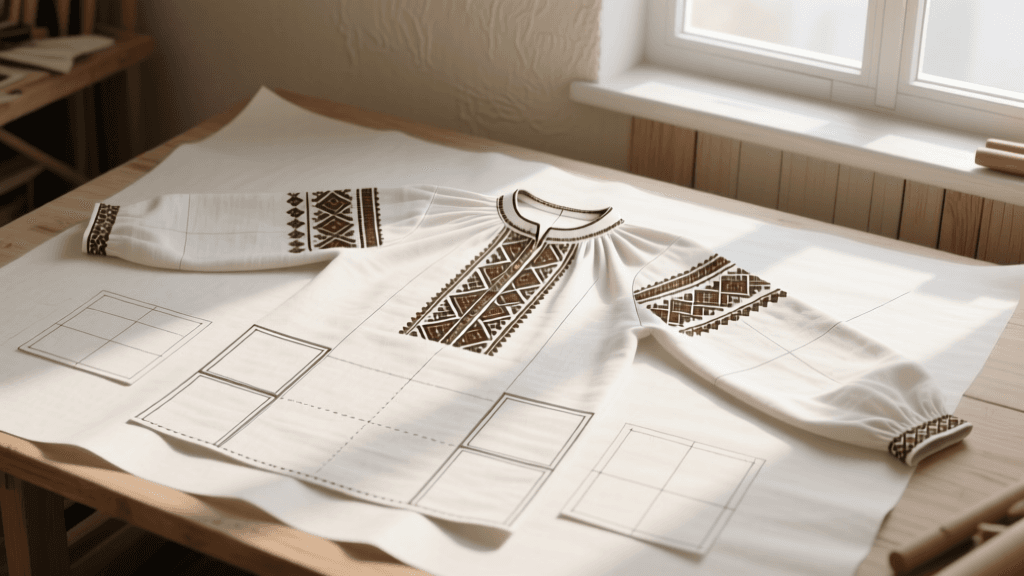
The traditional Carpathian sorochka (a regional variant of the Slavic folk shirt) represents a masterclass in zero-waste garment construction. Unlike modern tailored clothing, which relies on curved armholes and shaped side seams to contour the body, the sorochka is built entirely from rectangles and squares. This geometric approach is deeply rooted in the history of textile production, where fabric was woven on narrow handlooms and every inch of material was precious. As we navigate the 2026 landscape of sustainable fashion and historical sewing, the zero-waste philosophy of Eastern European folk dress has experienced a massive resurgence among contemporary makers and textile conservators.
Understanding the construction patterns and techniques of the sorochka requires a shift in perspective. Instead of cutting away fabric to create a three-dimensional shape, the folk tailor uses strategic folds, gathering, and gussets to transform flat, two-dimensional rectangles into a highly mobile, comfortable garment. Digital repositories like Europeana's Fashion and Costume collection provide extensive visual archives of these historical garments, revealing the brilliant simplicity of their underlying geometry.
Sourcing Materials in 2026: European Flax Linen
To authentically reconstruct a Carpathian folk shirt, the choice of fabric is paramount. Historically, these shirts were woven from locally grown flax, resulting in a slightly slubbed, medium-weight linen. In 2026, the market for premium European flax linen is robust, with major suppliers in Lithuania and Belgium offering historically accurate weaves. Current 2026 pricing for high-quality, garment-dyed or unbleached mid-weight linen (150gsm to 200gsm) typically ranges from €28 to €45 per meter.
When sourcing linen for rectangular construction, pay close attention to the fabric width. Modern linens are usually woven on industrial looms at widths of 140cm to 150cm (55 to 60 inches). This is significantly wider than the historical handwoven linen, which rarely exceeded 60cm (24 inches). This discrepancy fundamentally alters how you lay out your pattern pieces and calculate yardage, a challenge we will address in the drafting section below.
Drafting the Rectangular Body and Sleeves
The foundation of the sorochka is the central body panel. In the most traditional Carpathian cuts, the front and back are not separate pieces; rather, a single, long rectangle is folded over the shoulders. To draft this, you need two primary measurements: the desired shirt length (from the shoulder to the knee or calf) and the circumference of the chest plus ease.
- Body Panel Width: Calculate the total chest circumference, add 15-20cm of ease for movement, and divide by two. This gives you the width of the front (and back) rectangle.
- Body Panel Length: Measure from the nape of the neck to the desired hemline. Multiply this by two, as the fabric will fold over the shoulders.
- Sleeve Rectangles: The sleeves are also simple rectangles. The width is determined by the bicep circumference plus generous ease (often 15cm or more), and the length is measured from the shoulder point to the wrist, minus the width of the cuff.
Because modern 2026 linen is 140cm+ wide, you can often cut the front and back as separate rectangles rather than a single continuous folded piece, which saves fabric and reduces bulk at the shoulder fold. However, purists advocating for strict historical accuracy in 2026 often seek out specialty narrow-loom weavers to replicate the original shoulder fold, which eliminates a seam and provides a stronger structural point for the heavy embroidery typical of the region.
The Lastka: Mastering the Underarm Gusset Insertion
The most critical and technically demanding element of the sorochka is the lastka—the diamond-shaped underarm gusset. Because the body and sleeves are simple rectangles, sewing them together at a 90-degree angle would result in a rigid, restrictive joint that would tear under tension. The lastka acts as a three-dimensional hinge, providing the necessary mobility for the wearer to raise their arms, work in the fields, or dance during festivals.
According to textile analysis from the Victoria and Albert Museum's textile archives, the precision of the gusset insertion is the hallmark of a skilled folk tailor. Here is the step-by-step technique for inserting a lastka using modern sewing methods while maintaining historical integrity:
- Cut the Gusset: Cut a perfect square of linen, typically 10cm x 10cm or 12cm x 12cm, depending on the wearer's size. When placed on the bias (rotated 45 degrees), it forms a diamond.
- Mark the Pivot Points: On the wrong side of the gusset, mark a dot exactly 1cm (your seam allowance) from each corner. These dots are your pivot points.
- Prepare the Slit: The bottom of the sleeve rectangle and the side of the body panel must be prepared. Historically, a slit was cut into the body panel. In modern practice, it is often easier to sew the body side seam and the sleeve underarm seam partially, leaving an opening that matches the edges of the gusset.
- Pin and Sew the First Edge: Align one edge of the diamond gusset with the sleeve opening. Sew from the outer corner toward the underarm, stopping exactly on your marked pivot point with the needle down in the fabric.
- The Pivot: Raise the presser foot, pivot the fabric, and align the next edge of the gusset with the body panel edge. Lower the foot and continue sewing. This precise pivoting at the inner corners is what prevents puckering and tearing.
- Flat-Felling the Seams: To finish the interior without a serger (overlocker), historical sewists use flat-felled seams. Trim one side of the seam allowance, fold the longer allowance over the shorter one, and topstitch it down. This creates a clean, durable interior that can withstand decades of wear and repeated laundering.
Fabric Widths: Historical Looms vs. 2026 Standards
Adapting historical patterns to modern fabric widths is a common hurdle for contemporary costumers. The table below illustrates how the shift in textile manufacturing impacts the construction and yardage requirements of the sorochka.
| Parameter | Historical Loom (Pre-1900) | Modern 2026 Linen Standard |
|---|---|---|
| Fabric Width | 45cm - 60cm (18" - 24") | 140cm - 150cm (55" - 60") |
| Body Panel Construction | Multiple narrow panels sewn vertically | Single wide panels or continuous fold |
| Sleeve Layout | Cut along the warp (lengthwise grain) | Can be cut across the weft to save yardage |
| Yardage Required (Avg) | 6 to 8 meters of narrow cloth | 2.5 to 3.5 meters of wide cloth |
| Waste Generated | Near zero (selvedge edges utilized) | Moderate (requires creative zero-waste layout) |
To achieve a true zero-waste layout with modern 140cm linen in 2026, pattern drafters often use the remaining fabric width to cut the gussets, collar stands, and cuff rectangles, ensuring that no scraps are sent to the landfill.
Gathering, Smocking, and Embroidery Placement
Once the structural rectangles and gussets are assembled, the voluminous fabric must be controlled at the neck and wrists. The Carpathian sorochka typically features a gathered neckline finished with a narrow stand collar or a simple drawstring casing. The technique of smocking (honeycomb or trellis stitches) is often employed not just for decoration, but as a structural method to hold the gathers evenly in place while allowing the neckline to stretch over the head.
Embroidery in Carpathian folk dress is never placed randomly; it follows the structural lines of the garment. Cross-stitch, satin stitch, and drawn-thread work are concentrated along the shoulder seams, the sleeve cuffs, and the hem. The Metropolitan Museum of Art's European textiles department notes that these embroidered borders historically served an apotropaic (protective) function, guarding the openings of the garment where evil spirits were believed to enter. When drafting your pattern, you must account for these embroidery zones by adding 2-3cm of extra fabric allowance in these specific areas to prevent the dense stitching from pulling the structural seams out of alignment.
Modern 2026 Tools for Historical Accuracy
While the techniques remain centuries old, the tools used by historical costumers in 2026 have evolved. Open-source pattern drafting software like Seamly2D is widely used to parametrically generate rectangular sorochka patterns based on individual body measurements, automatically calculating the exact dimensions of the lastka gusset. Furthermore, for makers producing small batches of folk-inspired garments, desktop laser cutters are increasingly used to score fold lines and precisely cut the delicate linen gussets, eliminating the risk of fraying before the seams are sewn.
By marrying the brilliant, zero-waste geometry of the past with the precision tools of 2026, modern makers can keep the tradition of the Carpathian sorochka alive. Mastering the rectangular draft and the underarm gusset is not just an exercise in historical costuming; it is a profound lesson in sustainable, functional, and deeply cultural garment construction.