Mastering the Chiton & Toga: Authentic Draping Guide 2026
The Resurgence of Classical Antiquity in Modern Reenactment
As we navigate the 2026 season of historical interpretation, the demand for textile accuracy in classical antiquity has never been higher. The 2026 Classical Reenactment Guild recently updated its authenticity rubrics, placing a heavy emphasis on correct drape, historically accurate fiber content, and proper garment construction for Greco-Roman portrayals. Whether you are preparing for the upcoming Mediterranean Heritage Festivals this summer, designing for a theatrical production, or simply seeking to understand the engineering of ancient fashion, mastering the chiton and the toga is essential. Unlike modern tailored clothing, ancient Greek and Roman garments were fundamentally based on the art of draping rectangular or semi-circular pieces of woven cloth directly onto the body. This comprehensive guide will walk you through the history, fabric sourcing, and step-by-step draping techniques required to achieve a flawless, historically grounded silhouette.
Understanding the Core Garments of Antiquity
To accurately portray the ancient world, one must first understand the distinct differences between Greek and Roman sartorial traditions. While they share some visual similarities, the cultural significance and structural execution of these garments vary wildly. According to The Metropolitan Museum of Art's Heilbrunn Timeline of Art History, the ancient Greeks viewed the draped garment not merely as clothing, but as an extension of the human form, allowing for freedom of movement and showcasing the body's natural proportions through carefully arranged folds.
The Greek Chiton: Doric and Ionic Variations
The chiton was the foundational garment for both men and women in ancient Greece. It existed primarily in two forms: the Doric and the Ionic. The Doric chiton, often associated with older, more austere traditions, was typically made of heavier wool and featured a simple, fold-over top edge known as an apoptygma. It was pinned at the shoulders with fibulae and belted at the waist, creating a bloused effect called a kolpos. Conversely, the Ionic chiton was crafted from lighter, finely woven linen. It featured multiple pins or small stitches along the upper arms, creating the illusion of short sleeves, and lacked the heavy fold-over of the Doric style. As noted by the World History Encyclopedia's guide on Greek Dress, the transition between these styles often reflected shifting trade routes and the availability of imported Eastern textiles.
Roman Garments: The Toga and the Stola
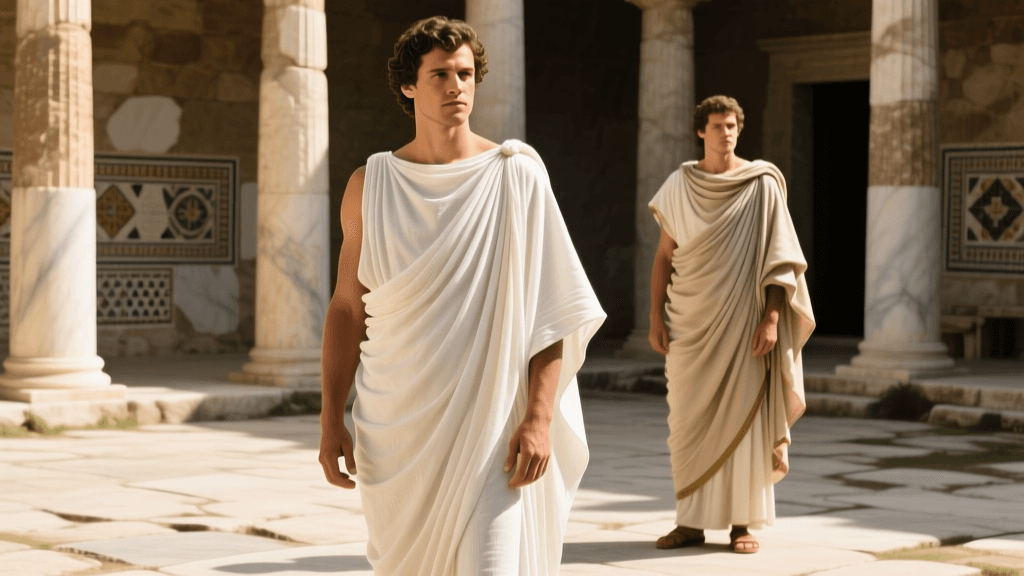
Roman clothing was deeply tied to social status, citizenship, and gender. The toga was the ultimate symbol of Roman male citizenship. Far from the simple bedsheet costumes of mid-century cinema, the authentic Roman toga was a massive, complex elliptical or semi-circular piece of heavy wool that required meticulous draping and constant adjustment. The World History Encyclopedia's overview of Roman Clothing emphasizes that the toga was so cumbersome it was largely reserved for formal, civic, and religious occasions. For Roman women, the stola was the traditional marker of a respectable married citizen. Worn over a tunica, the stola was characterized by its instita—a distinctive flounce or border at the hem—and was often gathered with a high belt just below the bust.
Sourcing Authentic Fabrics in 2026
The success of any Greco-Roman garment relies entirely on the drape and weight of the fabric. Modern synthetic blends or overly processed cottons will fail to produce the correct structural folds. In 2026, the historical costuming community has largely standardized around certified natural fibers to ensure both accuracy and sustainability.
- European Flax Linen: For Ionic chitons and Roman tunicae, seek out 100% European Flax certified linen. A medium weight of 140 to 160 GSM (grams per square meter) provides the ideal balance of breathability and structural drape. Current 2026 market prices for high-quality, unbleached organic linen average around $25 to $35 per yard.
- Merino and Worsted Wool: For Doric chitons, himations, and togas, lightweight worsted wool or fine Merino is mandatory. Avoid heavy coating wools; instead, look for tropical weight or suiting wool (180-220 GSM) which grips itself when draped, preventing the toga from slipping off the shoulder.
- Silk Accents: While rare for the core garments, raw silk was occasionally used by the elite in the later Roman Empire for delicate stolas or decorative borders.
Fabric Weight and Yardage Comparison Chart
Use the following table to determine the correct fabric requirements and weights for your specific 2026 reenactment project. Measurements assume an average adult height of 5'6" to 5'10".
| Garment Type | Cultural Origin | Recommended Fabric | Ideal GSM Weight | Required Yardage |
|---|---|---|---|---|
| Doric Chiton | Greek | Worsted Wool | 180 - 220 GSM | 2.5 - 3.5 Yards |
| Ionic Chiton | Greek | Medium Linen | 140 - 160 GSM | 3 - 4 Yards |
| Himation / Palla | Greek / Roman | Lightweight Wool | 150 - 190 GSM | 3.5 - 4.5 Yards |
| Toga Virilis | Roman | Suiting Wool | 200 - 240 GSM | 6 - 8 Yards |
| Stola | Roman | Linen or Silk Blend | 120 - 150 GSM | 4 - 5 Yards |
Step-by-Step Draping Techniques
Draping is an active process. Unlike tailored garments that maintain their shape on a hanger, classical garments require the wearer to manipulate the fabric into place. Here is how to achieve the most historically accurate silhouettes.
Draping the Doric Chiton
Begin with a rectangular piece of wool. The width should be roughly 1.5 times your wingspan, and the height should be your shoulder-to-floor measurement plus 12 inches for the fold-over and blousing.
- Create the Apoptygma: Fold the top edge of the fabric down by about 10 to 12 inches. This creates the characteristic heavy overfold seen on classical Greek statuary.
- Pin the Shoulders: Wrap the fabric around your body. Bring the front and back layers together at your left shoulder and secure them with a penannular or bow fibula. Repeat on the right shoulder, leaving enough space for your head to pass through the neck opening.
- Belt and Blouse: Tie a woven wool or linen cord around your natural waist. Pull the fabric up and over the belt until the hem falls gracefully to your ankles (for women) or knees (for men). This bloused section is the kolpos, and it is crucial for hiding the waist tie and adding volume to the silhouette.
Draping the Roman Toga
The toga is notoriously difficult and requires a semi-circular piece of wool measuring roughly 18 feet across the curved edge. It is highly recommended to have a second person assist you.
- The Umbo (Anchor Point): Drape one end of the toga over your left shoulder, letting the straight edge hang down your back. The hem of this front piece should touch the floor near your left foot.
- Wrapping the Back: Pull the remaining fabric across your back, under your right arm, and across your chest.
- The Sinus (The Pouch): As you bring the fabric across your front, allow a deep, sweeping fold to drop down toward your right knee. This decorative and functional pouch is called the sinus.
- Finishing the Drape: Throw the remaining fabric over your left shoulder, allowing it to cascade down your back. The weight of the wool and the friction of the fibers should hold the garment in place, though a skilled wearer will use their left arm to cradle the folds and maintain tension.
Accessories and Footwear for Historical Accuracy
No classical garment is complete without the appropriate accessories. The fibula (brooch) was both functional and decorative. For 2026 reenactments, cast bronze or iron fibulae with historical patinas are preferred over shiny, modern jewelry alloys. Footwear is equally important. Avoid modern leather sandals; instead, invest in a pair of hand-stitched caligae (Roman military sandals) or simple Greek leather thong sandals with woven straps that wrap up the calf. For outerwear, the Greek himation and the Roman palla served as massive rectangular shawls that provided warmth and modesty, draped elegantly over the left shoulder and sometimes pulled up to cover the head during religious rites.
Care and Maintenance of Natural Fibers
Maintaining authentic wool and linen requires a departure from modern laundry habits. Never machine wash your toga or chiton. The agitation will cause the wool to felt and the linen to develop permanent, unnatural creases. Instead, hand wash your garments in cool water using a pH-neutral detergent designed for natural fibers. After washing, do not wring the fabric; gently press the water out and lay the garment flat on a drying rack, blocking it into its original rectangular shape. The natural oils in the wool will help repel light dirt and moisture during outdoor festival events, keeping your garments looking fresh throughout the 2026 reenactment season.
Conclusion
Mastering the chiton and the toga is a rewarding journey into the engineering and aesthetics of the ancient world. By sourcing the correct 2026-compliant natural textiles, understanding the cultural nuances of Greco-Roman dress, and practicing the art of the drape, you can elevate your historical portrayal from a simple costume to a living, breathing piece of antiquity. Embrace the weight of the wool, the crispness of the linen, and the timeless elegance of classical draping.