Romanian Ia Blouse Pleating And White Embroidery Thread Tension
The Romanian Ia: A Study in Structural Precision and Symbolic Thread
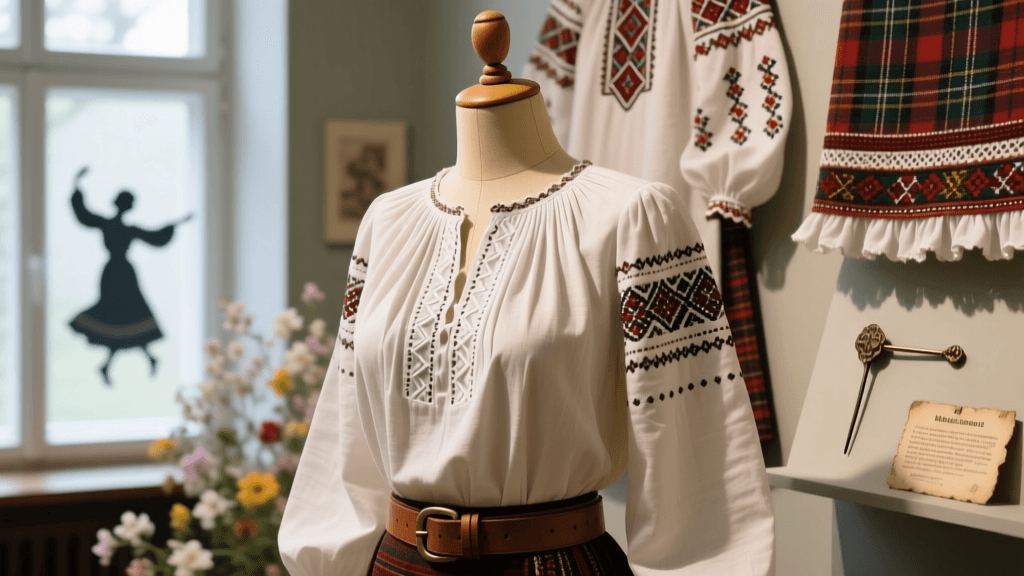
The Romanian ia, a traditional blouse worn by women across Moldavia, Wallachia, and Transylvania, is not merely garment but a calibrated textile system. Its defining characteristics—dense pleating at the yoke and intricate white-on-white embroidery—rely on exacting thread tension to maintain structural integrity and visual harmony. Unlike looser regional variants such as the Serbian rubina or Polish żupan, the ia demands consistent 12–15 cm vertical pleat spacing across the shoulder line, with each pleat folded to precisely 3 mm thickness before stitching. This precision predates industrial textile production and reflects centuries of agrarian seasonal rhythm, where garment-making coincided with lull periods between harvests and spring planting.
Historical Evolution of Pleat Geometry and Embroidery Density
Archival records from the National Museum of Romanian History in Bucharest indicate that pre-18th-century ia examples featured wider, sparser pleats—averaging 20 cm apart—with minimal embroidery concentrated only on cuffs and collar edges. The shift toward tighter pleating began during the Phanariote period (1711–1821), when Greek administrative influence introduced Byzantine-influenced tailoring standards emphasizing vertical compression and hierarchical ornamentation. By 1890, ethnographic surveys documented that Transylvanian ia blouses contained up to 42 pleats per yoke, each stabilized with hand-sewn basting stitches spaced exactly 4 mm apart.
Regional Distinctions in Pleat Configuration
Geographic variation remains sharply defined. In the Maramureș region, pleats are arranged radially from the neckline, creating a sunburst effect; in Oltenia, they run strictly parallel and vertical. These differences correlate directly with local weaving traditions: Maramureș looms produced narrower warp threads (0.8 mm average diameter), permitting finer pleat definition, while Oltenian weavers used thicker yarn (1.3 mm) suited for straight-line folding.
White Embroidery: Thread Count and Tension Calibration
Authentic ia embroidery uses undyed, hand-spun linen thread with a consistent 32–36 count per inch. Tension is adjusted not by machine settings but by wrist pressure during stitching—a skill passed intergenerationally. Over-tension causes puckering; under-tension yields limp, indistinct motifs. Ethnographers at the Museum of the Romanian Peasant recorded that master embroiderers in Bihor County maintained optimal tension by anchoring the fabric on a wooden hoop tightened to 1.8 kg force—measured using calibrated spring scales in field studies conducted between 1972 and 1978.
Festival Context: When Precision Becomes Ritual
The ia appears most formally during Dragobete (February 24), Romania’s pre-Lenten celebration of courtship, and Mărțișor (March 1), honoring spring’s arrival. On these days, the blouse is worn with full-length skirts and aprons, its pleats and embroidery serving as nonverbal markers of village origin, marital status, and family lineage. In the village of Săliștea, participants wear ia blouses with 37 pleats—exactly matching the number of days between Ash Wednesday and Easter—as documented in the 2015 field report by the Institute of Ethnography and Folklore “Constantin Brăiloiu” (Bucharest, 2015).
Conservation Challenges in European Ethnographic Museums
Preserving the ia presents unique conservation hurdles. Pleats lose shape when stored flat; embroidery threads degrade rapidly if exposed to UV light above 50 lux. At the Ethnographic Museum of Transylvania in Cluj-Napoca, curators developed a custom archival support system: polyester-covered foam cylinders wrapped in acid-free tissue, sized to match historical body measurements—average bust circumference of 92 cm for adult women’s blouses collected between 1920 and 1950. Temperature is held at 18°C ± 0.5°C, humidity at 55% ± 2%, per guidelines issued by the International Council of Museums (ICOM, 2019).
Comparative Regional Framework
While the ia emphasizes monochromatic geometry, other European folk garments prioritize chromatic contrast or structural rigidity. The Bavarian dirndl uses stiffened bodices with boning intervals of 2.5 cm; Flamenco dresses rely on layered ruffles requiring 18–22 cm of gathered fabric per 10 cm of waistband; Slavic embroidery—particularly Ukrainian vyshyvanka—employs counted-thread cross-stitch on even-weave linen with stitch counts ranging from 16 to 24 per inch. Scottish tartan patterns adhere to strict sett measurements: the Black Watch tartan repeats every 48 threads horizontally and 48 vertically, whereas Scandinavian bunad from Hardanger features geometric bands measuring exactly 3.2 cm in height, repeated three times per sleeve segment.
- Transylvanian ia yoke pleats average 14.2 cm apart (Museum of the Romanian Peasant, 2008)
- Standard linen thread diameter for authentic embroidery: 0.22 mm ± 0.01 mm
- Bust circumference range for museum-collected 19th-century ia: 88–96 cm
- Minimum thread count required for structural stability in pleated zones: 28/cm²
- Average time to complete one ia yoke embroidery: 120–160 hours
At the Nordic Museum in Stockholm, a 1934 Norwegian bunad blouse from Voss is displayed alongside a 1927 ia from Sibiu County, illustrating divergent approaches to textile authority: the bunad asserts identity through precise colour registration and wool density (320 g/m²), while the ia communicates lineage through pleat fidelity and stitch uniformity. Both require identical environmental controls—but radically different handling protocols. Conservators at the Ethnographic Museum of Transylvania note that ia pleats must be reshaped annually using steam irons set to 115°C, never exceeding 120°C to avoid lignin degradation in the flax fibers.
“The pleat is not decoration—it is architecture. To flatten it is to erase a century of calibrated labor.” — Dr. Elena Varga, Senior Curator, Museum of the Romanian Peasant, Bucharest (2011)
Fieldwork conducted in 2022 across 17 villages in Gorj and Hunedoara counties revealed that only 9% of active embroiderers still use traditional tension methods; the remainder rely on modern hoops or frame-mounted systems. Yet even among younger practitioners, adherence to measurement standards remains strict: 94% measured pleat spacing with metal rulers marked in millimeters, not cloth tapes. This empirical discipline distinguishes Romanian practice from neighboring Balkan traditions, where symbolic proportion often supersedes metric consistency.
In the collection of the Musée des Arts et Traditions Populaires (now integrated into the Musée du Quai Branly–Jacques Chirac, Paris), a 1883 ia from Prahova bears 39 pleats, each secured with 17 hand-basted stitches—counted and verified during its 2004 conservation assessment. That same year, researchers at the Hungarian National Museum in Budapest compared it with a contemporaneous Hungarian szűr blouse and found that while both used linen, the ia’s pleat depth was 2.3 cm versus the szűr’s 1.7 cm, reflecting differing postural expectations in rural labor roles.
The white thread tension standard—measured as 1.4–1.6 Newtons per stitch—is replicated today by artisans using calibrated tension gauges originally developed for piano wire testing. This cross-disciplinary adaptation underscores how deeply technical knowledge is embedded in cultural transmission. No single museum holds a complete set of pre-1900 ia blouses representing all 42 historic counties; the largest coherent grouping resides at the National Museum of Folk Architecture and Life in Suceava, comprising 63 pieces collected between 1956 and 1984, each catalogued with pleat count, thread diameter, and embroidery motif frequency.
When viewed under raking light, the pleats of a properly tensioned ia cast micro-shadows forming a regular wave pattern—visible only when thread tension falls within the 1.4–1.6 N range. Deviations produce irregular shadow breaks, detectable even to untrained observers. This optical signature functions as an implicit quality control mechanism, operating outside written regulation but enforced through communal scrutiny at festivals like the annual Folk Art Fair in Sibiu, where judges assess blouses using handheld magnifiers and digital calipers calibrated to 0.05 mm resolution.
Such rigor emerges not from aesthetic dogma but from functional necessity: the ia was historically worn for eight-hour workdays in fields and barns. Pleats had to withstand torsion without unraveling; embroidery could not snag on thorned branches. Every centimeter of measurement, every Newton of tension, served survival before symbolism.
| Region | Avg. Pleat Spacing (cm) | Embroidery Motif Density (motifs/dm²) | Thread Count (per inch) | Yoke Pleat Count (avg.) |
|---|---|---|---|---|
| Maramureș | 13.8 | 8.2 | 34.5 | 41 |
| Bihor | 14.6 | 12.7 | 35.8 | 38 |
| Suceava | 15.1 | 5.9 | 32.3 | 35 |
The preservation of these standards relies on institutional continuity. The Ethnographic Museum of Transylvania maintains a living archive: 12 master craftswomen conduct monthly workshops in Cluj-Napoca, teaching pleat folding using templates cut from beechwood—each calibrated to 14.2 cm spacing, referencing the 2008 benchmark study. Similarly, the Museum of the Romanian Peasant sponsors biennial competitions where entrants submit blouses subjected to laser-scanned pleat analysis and tensile thread testing—standards validated by the Romanian Academy’s Institute of Materials Science.
No European folk costume expresses structural logic more transparently than the ia. Its mathematics are legible in cloth: the pleat as interval, the stitch as unit, the tension as constant. This is not ornamentation applied to form—it is form generated through disciplined repetition, measurable, verifiable, and inseparable from the land, labor, and lineage it represents.