2026 Guide to Crafting an Authentic 16th-Century Tudor Kirtle
The Renaissance Revival: 2026 Standards for the Tudor Kirtle
The 16th-century Tudor kirtle remains one of the most iconic and structurally fascinating garments of the European Renaissance. As we navigate the historical costuming and reenactment landscape in 2026, the demand for absolute historical accuracy has never been higher. Modern enthusiasts and professional theatrical wardrobe departments alike have moved far beyond the synthetic approximations of the past decade. Today, crafting an authentic kirtle requires a deep understanding of period-correct textiles, structural engineering, and hand-finishing techniques.
At The Garment Atlas, while we frequently explore the rich tapestry of Asian traditional garments, our European Folk Dress category is dedicated to preserving the intricate tailoring heritage of the Western world. According to the Victoria and Albert Museum's fashion archives, the kirtle served as the primary supportive garment and foundational layer for women across various social classes during the Tudor period. It was designed to support the bust, flatten the torso, and provide a rigid base for the heavy outer gowns and elaborate sleeves characteristic of the era.
This comprehensive 2026 guide will walk you through the exact processes of sourcing heritage textiles, drafting a historically accurate bodice, and executing the complex cartridge pleating required for the skirt. Whether you are preparing for a high-level historical interpretation event or expanding your museum-quality portfolio, these methodologies reflect the current gold standards of the 2026 reenactment community.
Sourcing Historically Accurate Textiles in 2026
The most common pitfall in Renaissance garment construction is the use of modern, drapey fabrics that lack the structural integrity required for 16th-century silhouettes. In 2026, the global supply chain for heritage textiles has stabilized, allowing costumers to access museum-grade wools and linens from specialized mills in the United Kingdom, Italy, and Eastern Europe.
The Foundation: Linen and Wool Specifications
The Tudor kirtle is typically a bi-material garment. The bodice and skirt are often constructed from a medium-to-heavyweight wool, while the lining is made from a sturdy, tightly woven linen. The linen lining is not merely for comfort; it acts as a structural canvas that prevents the wool from stretching out of shape under the tension of the boning and the weight of the skirt.
- Bodice and Skirt Outer: 100% worsted wool or wool flannel, weighing between 12 oz and 16 oz per yard. The fabric must have a tight weave and minimal bias stretch.
- Lining: 100% medium-weight linen (minimum 5.3 oz to 7 oz). Avoid soft, heavily washed 'handkerchief' linens, as they lack the tensile strength needed for the boning channels.
- Thread: For structural seams, use a 60/2 or 80/3 linen thread. For visible topstitching and eyelets, 100% silk buttonhole twist provides the correct historical sheen and durability.
2026 Heritage Textile Supplier Comparison
Sourcing the correct materials is half the battle. Below is a comparative overview of the top-tier heritage textile suppliers available to historical tailors in 2026, reflecting current pricing and stock availability for period-accurate Tudor materials.
| Supplier (2026) | Fabric Type | Weight / Weave | Approx. Price (Per Yard) | Best Application |
|---|---|---|---|---|
| Burnley & Trowbridge | Worsted Wool Broadcloth | 14 oz, Tight Weave | $42.00 - $48.00 | Outer Skirt and Bodice |
| Historic Fabric Company | Russian Drill Linen | 7.5 oz, Heavy Canvas | $24.00 - $28.00 | Structural Bodice Lining |
| Wm. Booth Draper | Wool Flannel (Custom Dye) | 12 oz, Soft Nap | $35.00 - $40.00 | Lower Class / Working Kirtles |
| Fabrics-Store (IL019) | Medium Weight Linen | 5.3 oz, Plain Weave | $16.00 - $19.00 | Sleeve Linings and Chemises |
Pattern Drafting and Structural Boning
Drafting a 16th-century bodice requires a departure from modern tailoring principles. Modern garments are drafted to follow the natural curves of the body, but the Tudor kirtle is engineered to reshape the torso into a smooth, conical silhouette. Experts at The Tudor Tailor emphasize that the bodice must be fitted over the undergarments (the smock and any secondary supportive layers) to ensure the final silhouette is historically accurate and physically comfortable.
The Square Neckline and Bodice Fit
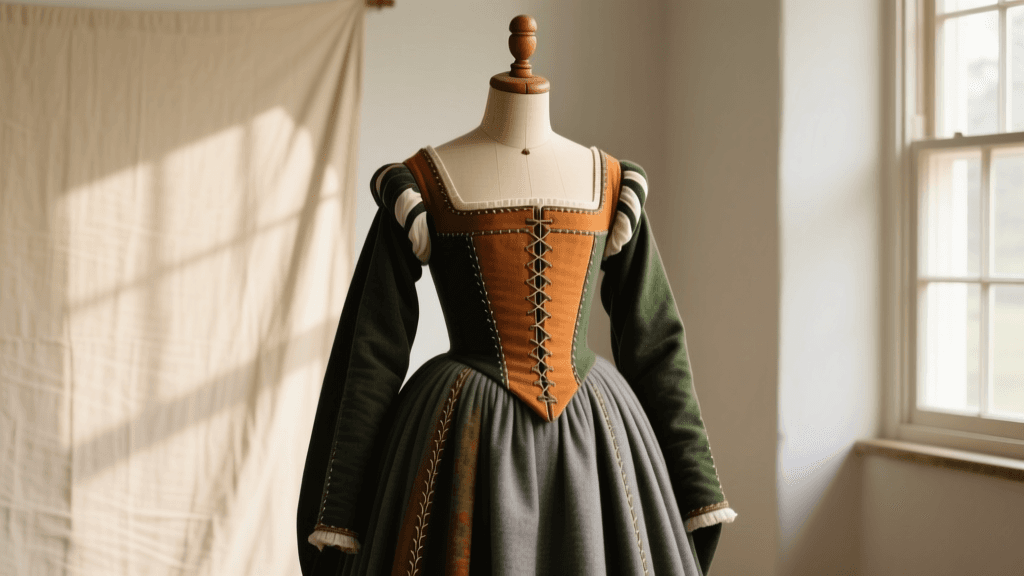
The classic Tudor kirtle features a wide, squared neckline and a high, rigid back. When drafting your pattern in 2026, it is highly recommended to use the draping method on a dress form padded to your exact corseted measurements, rather than relying solely on flat-pattern drafting. The armscye (armhole) must be cut high and tight under the arm to prevent the fabric from buckling when the wearer moves. The side seams and back seams are heavily curved to pull the bust upward and flatten the front of the torso.
Boning Materials: Reeds vs. Synthetics
Historically, kirtles were stiffened with layers of heavy canvas, buckram, and eventually reeds or bents (whalebone). In 2026, ethical and practical considerations have shifted the standard toward high-quality synthetic alternatives that mimic the behavior of historical materials.
- German Plastic Boning: The current industry standard for 2026. It is lightweight, flexible enough to move with the body, but rigid enough to prevent the bodice from wrinkling. Use 1/4 inch or 1/2 inch widths.
- Natural Reeds: For strict museum-level accuracy, bundled natural reeds are still used. However, they are highly susceptible to moisture and require meticulous care and storage in climate-controlled environments.
- Cable Ties: While popular in the early 2000s, heavy-duty nylon cable ties are now largely discouraged in high-level 2026 reenactment circles due to their tendency to permanently crease and snap under the heavy tension of a fully pleated skirt.
Skirt Construction and Cartridge Pleating
The skirt of the Tudor kirtle is where the garment truly comes alive. To achieve the distinctive bell-shaped silhouette that projects outward from the waist without adding bulk to the stomach, tailors utilize cartridge pleating. The Metropolitan Museum of Art's Heilbrunn Timeline notes that Renaissance silhouettes relied heavily on this type of structural layering and fabric manipulation to convey wealth and status through sheer volume.
Calculating Fabric Yardage and Pleat Ratios
Cartridge pleating requires an immense amount of fabric. A standard historically accurate Tudor skirt requires a minimum of 4 to 5 yards of 60-inch wide wool. The goal is to compress this massive circumference down to the exact measurement of the bodice's lower edge.
To execute the pleats, you must mark parallel lines across the top edge of the skirt. In 2026, many tailors use specialized pleating boards or laser-guided marking tools to ensure absolute precision, though traditional chalk and ruler methods remain perfectly acceptable. The standard ratio for a heavy wool kirtle is one pleat every 1/4 inch to 3/8 inch.
- Run two to three rows of heavy gathering stitches (using upholstery thread) along the marked lines.
- Pull the threads simultaneously, ensuring the pleats stack neatly like a accordion or a cartridge belt.
- Bind the raw top edge of the pleated skirt with a strip of sturdy linen or wool tape to protect the fibers from the tension of the stitching.
- Whipstitch the bound edge directly to the bottom edge of the finished bodice, catching only the very top fold of each pleat to allow them to flare outward.
Final Assembly and Hand-Finishing
While modern sewing machines can be used for the long, non-structural seams of the skirt to save time, the bodice assembly, boning channels, and all visible exterior stitching must be completed by hand to meet 2026 authenticity standards. The eyelets for the front or back lacing must be hand-bound using an awl to part the fabric fibers rather than cutting them, followed by tight buttonhole stitches. This ensures the eyelets will not tear under the extreme tension required to close the bodice.
Hemming a kirtle skirt is equally specialized. Because the skirt is cartridge pleated, it hangs differently than a modern gathered skirt. You must hem the garment while it is being worn over the appropriate historical petticoats or bum-rolls to ensure the hem sits perfectly parallel to the floor. A deep facing of heavy linen or a wool brush-braid is applied to the inside of the hem to protect the delicate wool from mud and wear during outdoor historical events.
Conclusion
Constructing a 16th-century Tudor kirtle is a masterclass in historical engineering. By adhering to the stringent textile sourcing standards and structural techniques recognized in 2026, you ensure that your garment is not merely a costume, but a living, breathing piece of European folk and courtly history. Whether you are stepping into the role of a Tudor merchant's wife or a high-ranking courtier, the foundation of your wardrobe begins with the impeccable tailoring of the kirtle.