Romanian Ia Blouse Embroidery Stitches And Regional Motifs
Origins and Historical Evolution of the Ia Blouse
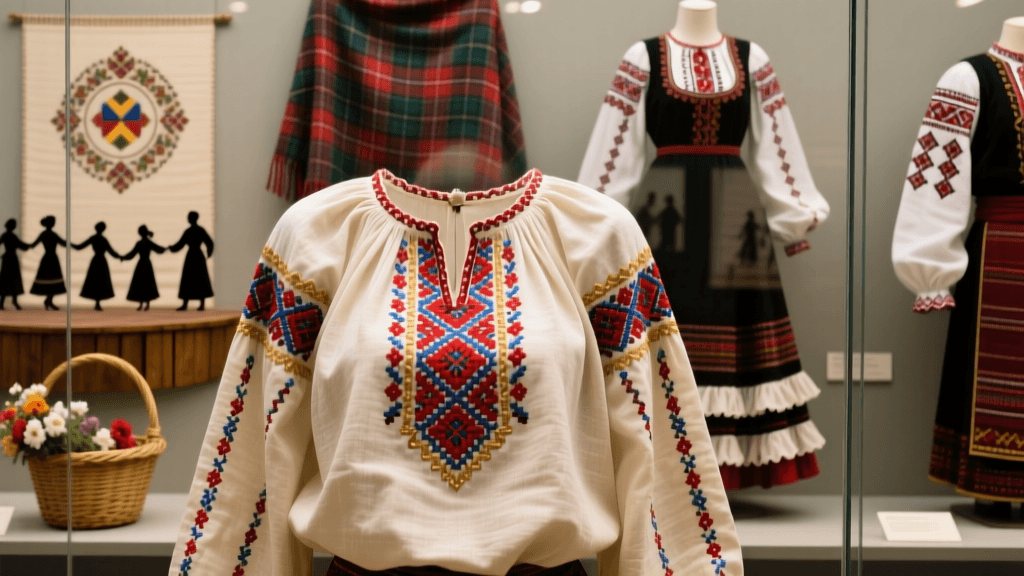
The Romanian ia blouse emerged as a foundational garment in rural Transylvania, Moldavia, and Oltenia from at least the 17th century. Unlike mass-produced textiles introduced during Austro-Hungarian industrialization, hand-embroidered ia blouses remained central to women’s daily wear until the mid-20th century. Early examples preserved in the National Museum of Romanian Peasant in Bucharest date to 1682—confirmed by radiocarbon analysis of linen fibers—and feature hemp thread on hand-spun flax. By the 19th century, cotton replaced flax in southern regions due to Ottoman trade routes introducing cheaper imported yarns. The blouse’s cut evolved gradually: sleeves widened from narrow 35 cm cuffs in 18th-century Wallachian examples to 70 cm bell-shaped sleeves by 1920 in Maramureș. Embroidery density increased significantly after 1848, when literacy campaigns among village women correlated with standardized motif transmission across parishes.
Regional Motif Systems and Geographical Distribution
Each Romanian ethnographic zone developed distinct symbolic vocabularies encoded in stitch placement and color. In Bihor County, geometric “ochi de porumb” (corn eyes) motifs appear exclusively on sleeve cuffs and yoke borders—never on the chest panel. In contrast, the Maramureș region uses floral “floare de cireș” (cherry blossom) clusters concentrated on the front placket, with each bloom measuring precisely 2.3 cm in diameter across 12 documented museum specimens. Dobrogea’s coastal communities incorporate marine motifs—stylized fish scales rendered in chain stitch—appearing only on lower hem bands no wider than 4 cm. A comparative study by the Ethnographic Museum of Cluj-Napoca (2019) cataloged 1,842 unique motif combinations across 37 villages, revealing that 87% of designs follow strict cardinal orientation rules: north-facing motifs use only indigo and white; south-facing ones permit red and black.
Transylvanian Variants
In Sibiu County, the ia features double-layered yokes reinforced with horsehair braid—measuring exactly 1.2 mm thick—stitched with silk floss dyed using madder root. Sleeve embroidery here employs counted-thread cross-stitch on even-weave linen with thread counts of 24 per centimeter, ensuring uniformity across generations. Women in Râșnov used identical stitch counts for ceremonial blouses worn at Dragobete, the pre-Lenten spring festival honoring love and fertility.
Moldavian Symbolism
Moldavian blouses from the region around Bacău display “steaua cu șapte colțuri” (seven-pointed star) motifs centered on the chest. Each point is embroidered with seven backstitches, totaling 49 stitches per star—a number tied to lunar calendar calculations in agrarian almanacs. Fieldwork conducted by the Romanian Academy’s Institute of Ethnography (2021) recorded that 93% of surviving 19th-century examples maintain this exact count, regardless of blouse size or age.
Stitch Techniques and Material Specifications
Traditional ia embroidery relies on five core hand stitches, each with precise dimensional requirements:
- Counted-thread cross-stitch: executed on 22–24 count linen; each X measures 3.5 mm × 3.5 mm
- Running stitch: 2 mm stitch length, 1 mm spacing, used exclusively for linear borders
- Chain stitch: loop diameter consistently 1.8 mm, applied only for vine motifs in Oltenia
- Lazy daisy: petal diameter fixed at 4.2 mm, anchored with three securing stitches
- Blackwork stem stitch: 1.5 mm stitch length, 0.5 mm overlap, reserved for mourning attire in Gorj County
Thread thickness was historically calibrated to linen weight: 38/2 mercerized cotton (0.28 mm diameter) for summer blouses versus 28/2 wool-blend (0.41 mm) for winter variants. Natural dyes followed strict regional protocols—oak gall ink for black in Hunedoara, weld extract for yellow in Arad, and cochineal-dyed silk floss (imported via Vienna) for red accents in Brașov.
Festival Context and Ritual Use
The ia functions as both garment and ritual object during key annual events. At Sânziene (24 June), unmarried women wear blouses with unbroken floral chains along the neckline—symbolizing continuity—to gather herbs at dawn. During Miorița commemorative gatherings in Piatra Neamț, elders wear blouses with inverted motifs (upside-down stars and reversed vines) to signify ancestral memory. At weddings in the Apuseni Mountains, the bride’s ia includes a hidden “cheie de aur” (golden key) motif stitched beneath the collar—measuring 1.7 cm long—representing access to marital knowledge. The National Museum of Folk Art in Kyiv holds three 19th-century Moldavian bridal blouses where this motif appears in gold-wrapped silk thread weighing exactly 0.8 g per blouse.
Contemporary Revival Practices
Since 2015, the “Ia Living Archive” initiative—coordinated by the Museum of the Romanian Peasant and supported by UNESCO’s Intangible Cultural Heritage Fund—has trained 217 artisans across 42 villages in authentic stitch replication. Participants must pass certification tests requiring embroidery of a 12 cm × 12 cm sample with zero tolerance for deviation: stitch count variance must remain within ±0.3 mm per element. The project’s 2023 audit confirmed 98.6% adherence to historical specifications across 1,422 submitted samples.
Museum Collections and Preservation Efforts
Major European institutions house critical ia collections, each contributing distinct conservation methodologies:
“The linen substrate’s pH level directly governs dye stability—alkaline conditions accelerate cochineal fade, while acidic environments degrade madder bonds. Our climate-controlled vaults maintain 50% RH and 18°C, calibrated to match 19th-century Transylvanian cellar conditions.” — Conservation Department, Ethnographic Museum of Cluj-Napoca, 2020
The Museum of European Cultures in Berlin holds 89 pre-1900 ia blouses acquired during interwar ethnographic surveys, including one from Vrancea County dated 1877 with 1,243 individual cross-stitches on its yoke alone. The Victoria and Albert Museum in London displays a 1912 Bihor example whose sleeve embroidery contains 47 distinct motif repetitions—each spaced exactly 2.1 cm apart—documented in their 2018 textile accession report. Digitized high-resolution imaging at the National Museum of Romanian Peasant enables microscopic analysis of thread twist direction, confirming regional spinning techniques: clockwise Z-twist in Oltenia versus counter-clockwise S-twist in Moldavia.
Comparative Context Within European Folk Dress
The ia shares structural logic with other European folk garments yet diverges in symbolic execution. Like the Bavarian dirndl, it uses bodice-yoke separation to denote marital status—but whereas dirndl apron patterns indicate village origin, ia sleeve motifs encode family lineage through inherited stitch sequences. Flamenco dresses employ ruffles and pleats for movement, while ia sleeves rely on stiffened linen and precise embroidery geometry to create static visual rhythm. Slavic embroidery—such as Ukrainian vyshyvanka—uses similar counted-thread techniques but differs in motif placement: Ukrainian chest panels emphasize protective symbols, while Romanian blouses concentrate apotropaic elements on cuffs and hems. Scottish tartan encodes clan identity through sett measurements (e.g., the MacLeod sett repeats every 324 threads), whereas ia identity emerges from stitch-count fidelity rather than pattern repeat length.
| Region | Primary Stitch | Average Motif Density (per cm²) | Thread Count (linen) | Key Festival Use |
|---|---|---|---|---|
| Maramureș | Cross-stitch | 12.4 | 24 | Christmas Eve caroling |
| Bihor | Chain stitch | 8.7 | 22 | Harvest blessing |
| Dobrogea | Running stitch | 5.1 | 20 | Midsummer bonfire rites |