Drafting the Romanian Ia Blouse: 2026 Altiță Smocking Guide
Introduction to the Romanian Ia and Zero-Waste Construction
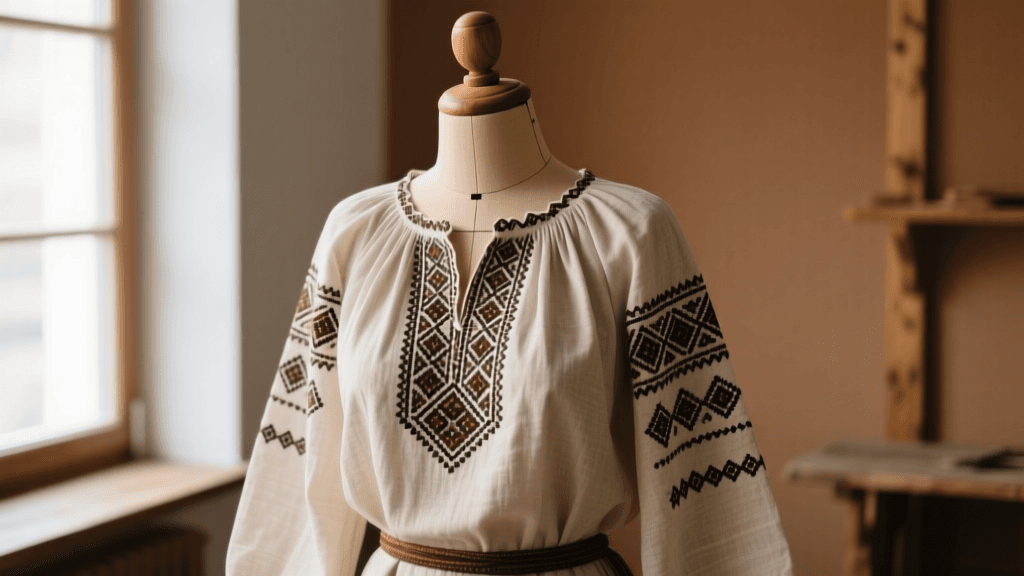
The Romanian Ia (pronounced 'ee-ah') represents a pinnacle of Eastern European folk dress construction. Far from being a simple peasant tunic, the Ia is a masterclass in zero-waste pattern drafting, geometric mathematics, and structural smocking. In 2026, the global slow-fashion movement and a renewed interest in historical sewing techniques have pushed the traditional construction of the Ia into the mainstream among advanced garment makers. Unlike modern Western pattern drafting, which relies on curved armholes and shaped side seams, the traditional Ia is constructed entirely from rectangles, squares, and triangular gussets. This ensures that not a single scrap of hand-woven linen is wasted.
Recognized globally for its cultural significance, the art of the traditional blouse with embroidery on the shoulder was officially inscribed on the UNESCO Intangible Cultural Heritage list, cementing its status as a vital textile tradition. Today, we explore the exact construction patterns, drafting techniques, and the intricate altiță smocking methods required to build an authentic Romanian Ia in 2026.
The Zero-Waste Anatomy of the Ia Blouse
Before cutting into your linen, it is crucial to understand the architectural components of the blouse. The traditional Ia does not use standard bodice blocks. Instead, it relies on a modular system of rectangular panels. According to research found in the Victoria and Albert Museum Textile Collections, this modular approach allowed rural makers to maximize the use of narrow, hand-loomed fabric widths.
- Față (Front Panel): A single wide rectangle or two narrower rectangles joined at the center, featuring the primary vertical embroidery motifs (râuri).
- Spate (Back Panel): A rectangle matching the width of the front, usually left plain or featuring minimal geometric stitching.
- Mânecă (Sleeves): Wide, rectangular panels that are gathered at the shoulder and cuff. The upper portion hosts the altiță.
- Pavă (Gussets): Small diamond or square pieces of fabric inserted under the arm to provide mobility and prevent tearing at the stress points.
- Crep (Side Inserts): Narrow rectangular strips connecting the front and back panels, allowing for hip ease without flaring the main body panels.
- Bentiță (Neckband): A narrow, straight-grain band used to finish the gathered neckline.
Drafting the Base Pattern: 2026 Measurements and Math
In 2026, modern makers frequently use open-source parametric software like Seamly2D to draft historical patterns, but understanding the manual math is essential for authentic proportions. The foundation of the Ia is the chest circumference and the desired sleeve width.
Calculating the Panels
To draft the front and back panels, take the full bust measurement and divide it by two. Add a minimum of 8 cm to 12 cm of ease per panel to accommodate the heavy smocking and the natural drape of the linen. For a 100 cm bust, each main panel should be drafted at 62 cm wide. The length is traditionally measured from the base of the neck to the high hip, usually around 60 cm to 65 cm, allowing the blouse to be tucked into a heavy wool skirt or apron.
Drafting the Sleeves and Gussets
The sleeves are drafted as pure rectangles. The width of the sleeve rectangle should be at least 1.5 times the bicep circumference to allow for the dramatic gathering at the shoulder. The length is measured from the shoulder edge to the wrist bone plus 4 cm for the cuff casing. The pavă (gusset) is drafted as a 15 cm by 15 cm square, which is rotated 45 degrees to form a diamond when inserted into the underarm seam.
Mastering the Altiță: Smocking and Embroidery Techniques
The altiță is the defining feature of the Romanian Ia. It is a dense, horizontal band of geometric embroidery located on the upper sleeve, just below the shoulder gather. Historically, the altiță served to reinforce the fabric where the heavy sleeve pulled against the neckline gathering. In 2026, it is primarily a canvas for intricate regional motifs, but the structural smocking beneath it remains vital.
The Smocking Process
Before any embroidery begins, the top edge of the sleeve rectangle must be smocked. Using a strong, waxed linen thread, sew two parallel rows of running stitches along the top edge of the sleeve. Pull the threads tightly to gather the wide sleeve rectangle down to the exact measurement of the shoulder seam (usually around 12 cm to 15 cm). This dense gathering creates the structural foundation for the altiță embroidery, providing a thick, padded base that makes the geometric stitches pop.
2026 Thread and Needle Comparison Chart
Selecting the correct materials is critical for historical accuracy and durability. The market for heritage embroidery supplies has evolved, with 2026 offering excellent options for makers seeking authentic results.
| Thread Type | Brand / Origin | Best Application | 2026 Avg Cost |
|---|---|---|---|
| Mercerized Cotton | DMC Retors Mat | High-friction areas, dense altiță backgrounds | $3.50 / skein |
| Hand-Dyed Linen | Artisan 2026 Batches | Authentic historical look, traditional râuri motifs | $8.00 / skein |
| Silk Blend | Madeira Burmilana | Subtle sheen on dark linen, delicate cuff detailing | $6.50 / spool |
| Waxed Linen Cord | Historic Crafts Co. | Structural smocking, gathering, and casing ties | $12.00 / roll |
For needles, the 2026 consensus among historical costumers is to use John James tapestry needles (size 22 or 24) for counting threads on 28-count evenweave linen, ensuring the needle glides through the fabric without piercing and breaking the warp threads.
Geometric Motifs and Counting Techniques
The embroidery on the Ia is never freehand; it is strictly counted-thread work. The most common stitches are the cross-stitch, the Romanian hem stitch, and the satin stitch. The motifs are heavily symbolic, featuring rhombuses (representing fertility and the sown field), crosses (protection), and winding vines (the river of life).
When mapping your pattern, always start from the center of the altiță band and work outward. In 2026, many makers use digital grid paper apps on tablets to map out their specific regional motifs before committing thread to linen. The Metropolitan Museum of Art Costume Institute digital archives remain an invaluable resource for zooming in on high-resolution macro photographs of antique Ia blouses to count the exact stitch ratios used by 19th-century artisans.
Assembly: Setting the Gusset (Pavă)
The most technically challenging aspect of Ia construction is setting the underarm gusset. Because the garment lacks curved armholes, the intersection of the side seam, the sleeve seam, and the gusset is a major stress point.
- Prepare the Pivot Point: Mark the exact corner of the gusset diamond. Sew a small reinforcing square of stitching (about 1 cm) at this corner on the sleeve and body panels before cutting the fabric open.
- Clip the Seam: Carefully clip into the corner of the reinforced square, stopping exactly one thread away from your stitching line.
- Pin and Sew: Pin the gusset to the sleeve and body panels, right sides together. Sew with a very tight stitch length (1.5 mm) to ensure durability. In 2026, using a modern walking foot on a domestic machine helps feed the heavy linen layers evenly, though hand-backstitching remains the gold standard for purists.
- Finish the Seams: Traditional Ia blouses use flat-felled seams or French seams to enclose all raw edges, ensuring the garment is as beautiful on the inside as it is on the outside.
Neckline and Cuff Finishing Techniques
The neckline of the Ia is finished with a bentiță (a narrow straight-grain band) or a ciupag (a self-fabric drawstring casing). For the ciupag method, the top edge of the front, back, and sleeves are folded over twice and stitched to create a tunnel. A braided linen cord is threaded through, allowing the wearer to adjust the neckline gathering. This method is highly preferred for its adjustability and historical accuracy.
The cuffs, or brățări, are finished similarly. The bottom edge of the sleeve rectangle is heavily smocked to fit the wrist, then bound with a narrow embroidered band. The smocking at the cuff must be dense enough to hold the heavy sleeve in place but loose enough to allow the hand to pass through when the ties are loosened.
Conclusion: The 2026 Revival
Drafting and constructing a traditional Romanian Ia blouse is a rewarding exercise in historical engineering. By embracing zero-waste pattern drafting, mastering the structural smocking of the altiță, and utilizing high-quality 2026 linen and threads, modern makers can keep this vital Eastern European folk dress tradition alive. Whether you are drafting by hand or using parametric software, the mathematical precision and geometric beauty of the Ia ensure it remains a timeless masterpiece of textile construction.