Authentic Greek Chiton and Roman Toga Draping Guide 2026
The Renaissance of Classical Garments in 2026
The year 2026 has witnessed an unprecedented surge in the demand for historically accurate ancient Mediterranean clothing. Driven by a new wave of high-definition digital museum archives, immersive historical reenactment societies, and classical theater productions, modern costumers and historians are abandoning the inaccurate "Hollywood" approximations of the past. Today, the focus is entirely on mathematical precision in draping, authentic fiber content, and period-accurate hardware. Whether you are outfitting a university classics department, preparing for a large-scale historical festival, or curating a living history exhibit, understanding the structural engineering of the chiton, peplos, and toga is essential.
Ancient Greek and Roman garments were rarely cut and sewn in the modern sense. Instead, they were masterclasses in textile manipulation—relying on gravity, tension, and strategic pinning to transform flat, woven rectangles into elegant, three-dimensional silhouettes. According to the The Metropolitan Museum of Art's Heilbrunn Timeline of Art History on Greek Dress, the beauty of ancient clothing lay in its dynamic relationship with the human body in motion. This guide will break down the exact measurements, sourcing techniques, and draping methodologies required to recreate these iconic garments today.
The Doric Chiton and Peplos: Mastering Heavy Wool
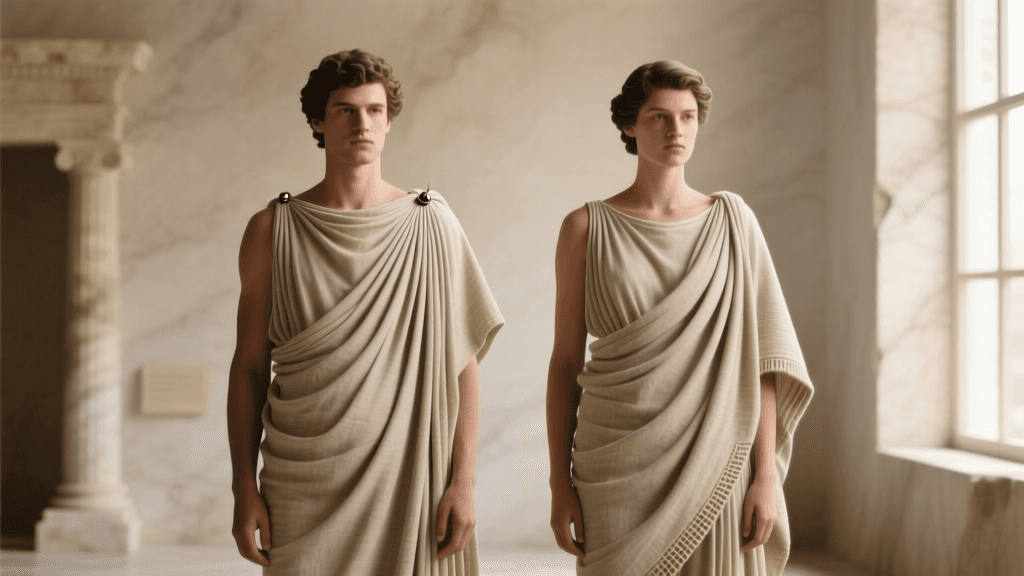
Often conflated in modern terminology, the Doric chiton and the peplos share a similar structural DNA, relying on heavy, densely woven wool to create deep, sculptural folds. The Doric style is characterized by its simplicity and its reliance on the natural weight of the fabric to hold the garment in place.
Fabric Mathematics and the Kolpos
To construct a historically accurate Doric chiton, you must abandon standard modern sewing patterns. The garment is formed from a single, massive rectangle of wool. The width of the fabric should equal the wearer's wingspan (fingertip to fingertip with arms outstretched) plus an additional 12 to 18 inches for overlap and ease. The height must be calculated from the wearer's shoulder to the floor, plus an extra 10 to 15 inches to accommodate the kolpos.
The kolpos is the signature bloused overhang created by belting the garment at the waist and pulling the excess fabric up and over the belt. This not only allowed for ease of movement but also created a functional pouch for carrying small items. In 2026, historical textile mills specializing in reenactment fabrics recommend a tightly spun, medium-weight wool twill (around 250-300 GSM) that mimics the output of the ancient warp-weighted loom. This weight ensures the fabric drapes heavily and resists the wind, maintaining the columnar silhouette seen in classical marble sculpture.
The Apoptygma and Fastening
The top edge of the Doric chiton is folded over outward or inward to create the apoptygma (overfold). This fold is then pinned at the shoulders using heavy bronze or iron fibulae (brooches). Modern reenactors must ensure their fibulae feature a secure, tension-based pin mechanism, as the heavy wool will easily pull away from weak, decorative clasps.
The Ionic Chiton: Linen, Pleats, and the Epiblēma
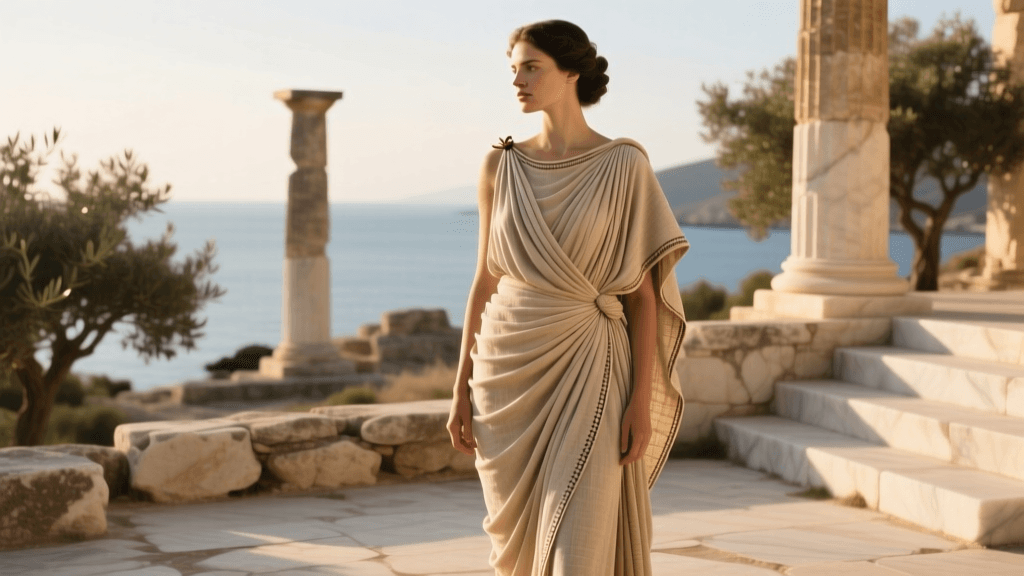
While the Doric chiton relied on heavy wool, the Ionic chiton was a celebration of lightweight, semi-sheer linen. Originating from the eastern Mediterranean and later adopted by the Greeks, the Ionic style is instantly recognizable by its multitude of tiny, crinkled pleats and its distinctive sleeves.
Creating the Sleeves
Unlike the Doric chiton, which is pinned only at the two shoulder points, the Ionic chiton is fastened at multiple intervals along the upper arm. By pinning the front and back layers of the wide linen rectangle together at regular gaps, the wearer effectively creates a fitted, elbow-length sleeve. The distance between these pins dictates the tightness of the sleeve and the size of the decorative gaps (which often revealed the skin or a secondary undergarment).
Modern 2026 Pleating Techniques
The microscopic crinkles of the Ionic chiton were historically achieved by twisting the wet linen tightly and allowing it to dry, or by using a rudimentary starch. For 2026 theater and reenactment applications, costumers are utilizing eco-friendly, plant-based sizing agents like agar-agar or specialized liquid wheat starches. The linen is soaked, twisted into tight ropes, bound with cotton thread, and left to cure. Once unbound, the fabric holds a permanent, wash-resistant crinkle that beautifully catches the light and mimics the intricate fluting seen on the caryatids of the Erechtheion. For a comprehensive look at regional variations, the World History Encyclopedia's overview of Greek Clothing provides excellent visual references for these distinct draping styles.
The Roman Toga: Engineering the Semicircle
The Roman toga is perhaps the most misunderstood garment in historical costuming. It is not a simple rectangular bedsheet wrapped around the body; it is a highly complex, precisely tailored semicircle (or slightly elliptical shape) that served as the ultimate marker of Roman male citizenship.
The Semicircular Cut and Dimensions
By the Imperial period, the toga had grown to massive proportions. A full adult toga required a piece of heavy, fulled wool measuring up to 18 feet in length and 11 feet in width at its deepest point. Because modern fabric widths rarely exceed 60 inches, creating a toga in 2026 requires seamlessly joining multiple panels of wool flannel or heavily fulled broadcloth. The seams must be flat-felled and pressed aggressively so they disappear into the dense folds of the drape.
Mastering the Sinus and Umbo
The draping of the toga requires a second person (a vestiplicus or slave in antiquity). The front hem is draped over the left shoulder, falling to the calves. The bulk of the fabric is then wrapped around the back, under the right arm, and across the chest. The key to a successful toga drape lies in creating the sinus (a deep, pouch-like fold across the front that could be pulled up over the head for religious ceremonies) and the umbo (a decorative, knotted clump of fabric resting on the chest that acted as a counterweight to keep the heavy garment from slipping). Modern costumers often use hidden, period-accurate lead weights sewn into the hem to help the toga maintain its precarious balance during movement.
The Roman Stola and Palla: Matronly Elegance
While the toga was reserved for male citizens, the stola was the traditional garment of the married Roman woman (the matrona). Worn over a base tunic, the stola was a long, sleeveless or short-sleeved dress suspended from the shoulders by broad straps or knotted ties.
The defining feature of the stola was the instita, a decorative, often brightly colored or gold-embroidered band sewn to the lower hem. This hem band served both as a status symbol and as a practical weight to keep the skirt hanging straight. Over the stola, women wore the palla, a large rectangular mantle draped over the shoulders and often pulled over the head when outdoors. The World History Encyclopedia's guide to Roman Clothing notes that the color and border of the palla could indicate a woman's social standing and wealth, making the choice of dye and trim a critical aspect of any modern reconstruction.
2026 Sourcing and Construction Comparison Table
To assist historical societies and theatrical departments in planning their 2026 budgets and sourcing strategies, the following table outlines the core requirements for the major classical garments.
| Garment | Primary Fiber | 2026 Sourcing Recommendation | Fastening Method | Draping Complexity |
|---|---|---|---|---|
| Doric Chiton / Peplos | Heavy Wool Twill | Custom mill wool flannel (280 GSM) | Large bronze/iron fibulae at shoulders | Moderate (Requires kolpos adjustment) |
| Ionic Chiton | Lightweight Linen | Wet-spun European flax linen (120 GSM) | Multiple small pins along arms; waist belt | High (Requires pre-pleating and starching) |
| Roman Toga | Fulled Wool Broadcloth | Joined panels of heavily felted wool | Friction, tension, and hidden lead weights | Extreme (Requires an assistant to drape) |
| Roman Stola | Wool or Silk/Linen Blend | Medium-weight woven wool with silk trim | Shoulder straps (anameschalides) and belt | Low (Cut and sewn, unlike draped garments) |
Authentic Dyeing and Hardware in the Modern Era
A garment is only as accurate as its color and hardware. In 2026, the historical reenactment community has largely moved away from synthetic chemical dyes in favor of botanical and mineral dyes that replicate the ancient palette. Madder root (Rubia tinctorum) remains the gold standard for achieving the deep, brick-red tones associated with Roman military and patrician garments, while woad (Isatis tinctoria) and weld (Reseda luteola) are utilized for authentic blues and vibrant yellows.
For the ultra-elite Tyrian purple, which was historically extracted from the murex sea snail, modern artisans have developed sustainable, lab-cultivated bacterial dyes that perfectly mimic the chemical structure and lightfastness of the ancient original without harming marine ecosystems. When it comes to hardware, the lost-wax casting method has been revitalized by 2026's accessible 3D-printing technologies. Artisans can now scan museum artifacts and print exact wax molds, allowing for the creation of flawless, museum-grade bronze fibulae and belt buckles that are historically indistinguishable from the originals.
Conclusion
Recreating the chiton, peplos, and toga is an exercise in architectural draping and material science. By respecting the mathematical proportions of the ancients, sourcing appropriate natural fibers, and utilizing period-accurate dyeing and fastening techniques, modern historians and costumers can bring the classical world to life with breathtaking authenticity. As we continue through 2026, the line between ancient textile tradition and modern historical preservation grows ever closer, ensuring these magnificent garments endure for future generations.