Drafting the Traditional Romanian Cămașă: Zero-Waste Patterns 2026
The Enduring Logic of Rectangular Construction
The traditional Romanian Cămașă (peasant blouse or shirt) is a masterclass in zero-waste pattern making. Long before the sustainability mandates and circular fashion trends of 2026, rural artisans across Eastern Europe were driven by a profound respect for their materials. Hand-woven linen and hemp were incredibly labor-intensive to produce, from harvesting the flax to spinning the yarn and weaving the cloth on narrow looms. Consequently, wasting even a single scrap of fabric was unthinkable.
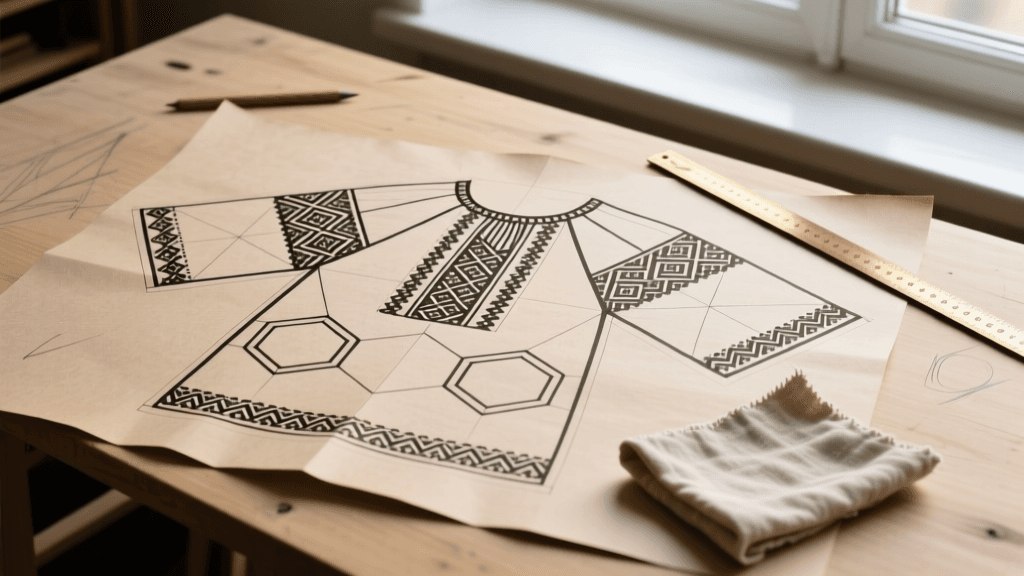
To achieve this, historical garments were constructed entirely from geometric shapes: rectangles, squares, and triangles. Curved armholes, princess seams, and tailored waistlines were entirely absent from the pattern draft. Instead, the garment relied on the strategic placement of rectangular panels and diamond-shaped gussets to create volume, drape, and mobility. Today, as the global fashion industry grapples with textile waste, the Cămașă offers a brilliant, historically proven blueprint for zero-waste design. According to the Victoria and Albert Museum's textile archives, these geometric construction methods are not merely historical curiosities but foundational techniques that continue to influence sustainable pattern drafting today.
Sourcing Heritage Linens in 2026
The success of a traditional folk shirt relies heavily on the textile. In 2026, the market for traceable, GOTS-certified heritage linens has expanded significantly, allowing modern makers to replicate the drape and texture of historical fabrics without compromising on ethical standards. When drafting a Cămașă, the fabric width dictates the pattern layout. Historical looms produced fabric roughly 60 to 80 centimeters wide. Modern heritage linens are typically woven at 140 centimeters, which requires a strategic adaptation of the zero-waste marker to ensure no offcuts are left behind.
For a standard women's Cămașă, a medium-weight linen (between 150gsm and 180gsm) is ideal. Slub linens or half-bleached linens provide the authentic rustic texture that takes traditional embroidery and smocking beautifully. Before cutting, it is imperative to scour and pre-wash the linen in hot water to remove modern manufacturing sizing agents and to allow for maximum shrinkage. This step is non-negotiable, as traditional smocking techniques rely on precise, stable fabric dimensions.
Drafting the Cămașă: A Zero-Waste Blueprint
The beauty of the Cămașă lies in its modular geometry. The pattern does not require complex curve rulers or extensive grading. Instead, it is drafted using straight lines based on the wearer's bust, hip, and arm measurements, plus generous ease for the signature gathered silhouette. The entire garment is mapped out on the fabric so that the selvedge edges are utilized as finished hems or seam allowances, completely eliminating textile waste.
| Component | Geometric Shape | Dimensions & Placement | Function |
|---|---|---|---|
| Front & Back Panels | Rectangles | Cut side-by-side along the warp; width = 1/4 body circumference + ease. | Main body volume; utilizes selvedge for side seams. |
| Sleeves | Rectangles | Cut from remaining width; length = arm length + smocking allowance. | Straight sleeves that gather into cuffs. |
| Pavă (Gussets) | Diamonds/Squares | 15cm x 15cm squares cut on the bias; placed in the underarm void. | Provides crucial underarm mobility without curved armholes. |
| Collar & Cuffs | Narrow Rectangles | Cut from the narrow strips left between the main panels and selvedge. | Bands that anchor the smocked gathers. |
Essential Tools for 2026 Makers
While the pattern drafting requires only a straight ruler and measuring tape, the assembly of the Cămașă demands specific tools to honor traditional techniques:
- Wooden Smocking Dots or Transfer Paper: For marking the precise grid required for the creț (smocking) at the neckline and cuffs.
- Tapestry Needles (Blunt Tip):strong> Essential for weaving the cheiță (decorative joining seams) without piercing and breaking the linen warp threads.
- Beeswax: Used to condition linen embroidery threads, reducing friction and preventing tangling during the dense smocking process.
- Awl: For gently opening the weave of the linen when executing needle-weaving and drawn-thread work.
The Art of the Cheiță and Creț
Because the Cămașă is constructed from straight rectangles, the seams are entirely linear. However, simply sewing these panels together with a standard machine stitch lacks the flexibility and aesthetic of historical garments. This is where the cheiță (pronounced 'key-tsah') comes in. The cheiță is a decorative needle-weaving or fagoting technique used to bridge the gap between two adjacent fabric panels. Instead of overlapping the fabric and sewing a standard seam, the edges are turned under, and a series of geometric figure-eight or cross-stitches are worked across the gap. This creates a flexible, lace-like join that allows the garment to stretch and move with the body. The Textile Society of America frequently highlights these structural seams as prime examples of functional embellishment in European folk art.
Equally important is the creț, the traditional smocking technique used to gather the wide rectangular neckline and sleeve cuffs. Unlike modern elastic, which degrades over time, the creț uses a dense grid of running stitches that are pulled tight and secured with a secondary wrapping stitch. This creates a highly structured, elastic-free gather that molds to the shoulders and wrists while maintaining the garment's architectural silhouette. In 2026, makers are increasingly combining the creț with biodegradable elastic cores hidden within the linen thread wrapping to offer modern comfort without sacrificing the historical exterior aesthetic.
Digital Prototyping for Historical Patterns
One of the most significant advancements for historical pattern makers in 2026 is the integration of 3D garment simulation software. Tools like CLO 3D and Marvelous Designer have introduced highly accurate physical properties for heritage linens, allowing makers to test the drape and mobility of zero-waste patterns before cutting into expensive, ethically sourced fabrics.
Simulating the pavă (underarm gusset) is particularly revealing. In a physical garment, the bias-cut diamond gusset provides the necessary mobility that modern curved armholes achieve through cutting. By simulating the low-elasticity warp and weft of linen, makers can digitally adjust the dimensions of the gusset—perhaps expanding a 15cm square to an 18cm diamond for a wearer with a broader shoulder span—ensuring ergonomic comfort while strictly maintaining the zero-waste rectangular layout. This digital prototyping bridges the gap between ancient geometric logic and modern ergonomic demands, proving that the push for circular fashion, as championed by organizations like the Ellen MacArthur Foundation, can be deeply rooted in historical precedent.
Conclusion: The Future of Folk Construction
Drafting the traditional Romanian Cămașă is more than an exercise in historical costuming; it is a vital practice in sustainable garment construction. By embracing the zero-waste logic of rectangular panels, bias-cut gussets, and structural smocking, modern makers can create garments that are not only beautiful and culturally resonant but also entirely devoid of textile waste. As we navigate the fashion landscape of 2026, the geometric wisdom of Eastern European folk dress offers a timeless roadmap for the future of ethical design.