Authentic Doric Chiton & Roman Stola Guide for 2026
The Resurgence of Classical Antiquity Garments in 2026
The landscape of historical reenactment and traditional European textile revival has shifted dramatically as we move through 2026. Moving away from the theatrical, polyester costumes of the past decade, modern enthusiasts, museum curators, and cultural heritage groups are demanding rigorous historical accuracy. This is particularly evident in the revival of ancient Greek and Roman garments. Recent 2026 conservation reports from the Pompeii Archaeological Park have unveiled new mineralized textile fragments, providing unprecedented insights into the exact weights, weaves, and draping techniques of classical antiquity. For those studying the roots of European folk dress, understanding the foundational garments of the Mediterranean—the Greek chiton and the Roman stola—is essential. These garments represent the genesis of European textile culture, relying not on complex tailoring, but on the mathematical precision of the drape, the quality of the weave, and the artistry of the fold.
Understanding the Greek Chiton: Doric vs. Ionic
The chiton was the quintessential garment of ancient Greece, worn by both men and women, though the length and draping style varied significantly by gender, age, and region. According to the World History Encyclopedia, the chiton evolved into two primary distinct styles: the Doric and the Ionic. Understanding the difference between these two is the first step in authentic garment reconstruction.
The Doric Chiton (Peplos)
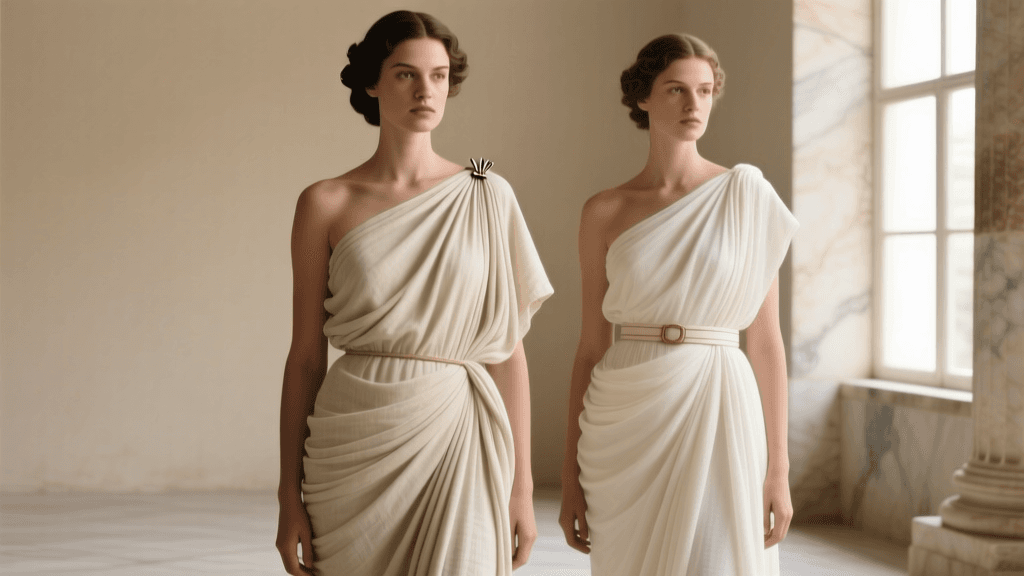
The Doric chiton, often referred to in its heavier woolen form as the peplos, is the older and more austere of the two styles. It consists of a single, large rectangular piece of fabric. The top edge is folded down to create an overfold (the apoptygma), which cascades over the chest and back. It is fastened at the shoulders with heavy pins or brooches (fibulae) and belted at the waist. The Doric style relies on heavy, structured fabrics—typically wool or a heavyweight linen—that hold sharp, sculptural folds, mimicking the fluting of Doric columns.
The Ionic Chiton
In contrast, the Ionic chiton is characterized by its lighter, more voluminous drape. Made from fine, lightweight linen or even imported silk in later periods, the Ionic chiton features multiple fastening points along the arms, creating the illusion of sleeves. Rather than a single overfold, the fabric is gathered and pinned continuously from the shoulder down to the elbow. This style requires significantly more fabric and relies on the fluid, liquid drape of high-thread-count linen to achieve its elegant, cascading effect.
The Roman Stola: Matronly Elegance and Structure
While Greek dress influenced Roman fashion heavily, the Romans developed their own distinct sartorial codes, particularly for women. The stola was the traditional, legally protected garment of the Roman matron (a married female citizen). As detailed in the Roman Dress archives, the stola was worn over a basic under-tunic (the tunica intima) and served as a powerful visual marker of social status and modesty.
The defining feature of the stola was the instita—a decorative, often brightly colored or embroidered border that ran along the bottom hem and sometimes the V-neckline. The stola was typically sleeveless, featuring shoulder straps or thin ties, and was gathered tightly beneath the bust with a high belt. This high-waisted blousing created a distinct silhouette that differentiated the respectable Roman matron from unmarried women or those of lower social standing, who wore only the basic tunica. In 2026, historical textile guilds have placed a heavy emphasis on recreating the instita using period-accurate tablet weaving and natural dye techniques, moving away from modern machine-embroidered trims.
2026 Sourcing Guide: Authentic Linens and Wools
The success of any classical drape relies entirely on the behavior of the fabric. Modern cotton-polyester blends lack the necessary weight, memory, and fluidity to hold a classical fold. As of 2026, the gold standard for sourcing historical textiles is the European Flax certification, which guarantees traceability, sustainable retting processes, and the absence of synthetic warp threads.
- For the Doric Chiton: Source a medium-to-heavyweight linen (180–220 GSM) or a lightweight tropical wool. The fabric must have enough 'bite' to hold the overfold in place without slipping. Look for 'half-bleached' or natural oatmeal colors, as stark, chemical white was rare for everyday wear.
- For the Ionic Chiton: You require a fine, lightweight linen (120–150 GSM) with a high thread count. The fabric should be fluid and almost translucent when held to the light, allowing for the complex, multi-point shoulder pinning.
- For the Roman Stola: A medium-weight linen or fine wool in deep, naturally dyed colors. Madder root (for reds and terracottas) and weld (for yellows) are the most historically accurate choices for the main body, while the instita border can feature Tyrian purple substitutes derived from madder and indigo overdyes.
When purchasing from heritage mills in 2026, always request a 'drape test' video or sample swatch. The fabric must exhibit a bias stretch; classical garments were often woven to specific dimensions and draped on the bias to allow for movement and clinging folds, a technique brilliantly documented in the Metropolitan Museum of Art's Greek and Roman collection.
Step-by-Step Draping: The Doric Chiton
Creating a Doric chiton requires no sewing, only precise measuring and strategic pinning. Follow these steps for an authentic, museum-grade drape:
- Calculate Dimensions: The width of your fabric should be your total wingspan (fingertip to fingertip) plus 12 inches. The height should be the distance from your shoulder to the floor, plus 12 inches for the waist blousing (kolpos), plus the depth of your desired overfold (usually 12 to 18 inches).
- Create the Overfold: Lay the fabric flat. Fold the top edge down to the desired depth of the apoptygma. This folded section will hang over your chest and back.
- Wrap the Body: Wrap the fabric around your body, starting under one arm. Bring the two edges together at the opposite shoulder.
- Pin the Shoulders: Gather the front and back layers (including the overfold) at the shoulders, roughly halfway between your neck and the edge of your shoulder. Secure them with heavy, historically accurate bronze or iron fibulae. Do not use modern safety pins, as they lack the weight and visual authenticity required for 2026 reenactment standards.
- Belt and Blouse: Tie a woven wool or leather belt tightly around your natural waist. Pull the fabric up and over the belt to create the kolpos—the bloused pouch of fabric that hangs over the belt. This pouch was historically used to carry small items and adds the necessary volume to the silhouette.
Comparative Guide to Classical Garments
| Garment | Primary Fabric | Fastening Method | Historical Era | Key Structural Feature |
|---|---|---|---|---|
| Doric Chiton (Peplos) | Heavy Wool / Medium Linen | Shoulder Fibulae (Pins) | Archaic/Classical Greece | The Apoptygma (Overfold) |
| Ionic Chiton | Fine, Lightweight Linen | Multiple Sleeve Pins | Classical/Hellenistic Greece | Illusion of Sleeves / Fluid Drape |
| Roman Stola | Medium Linen / Fine Wool | Shoulder Straps / V-Pins | Roman Republic / Empire | The Instita (Decorative Hem) |
| Roman Toga | Heavy White Wool | Complex Draping (No Pins) | Roman Republic / Empire | The Sinus (Deep Chest Fold) |
Hardware and Accessories: Fibulae and Belts
The hardware used to secure these garments is just as critical as the textile itself. In 2026, the market for historically accurate replica hardware has matured significantly. Avoid cast pewter or zinc-alloy brooches, which look dull and lack the structural integrity to hold heavy wool. Instead, seek out artisans who forge fibulae from bronze, brass, or iron using traditional lost-wax casting or hand-forging techniques. The 'bow' fibula and the 'disc' fibula are the most appropriate choices for Greek and early Roman dress.
Belts should be constructed from woven wool tablet-weave bands or thin, supple leather. For the Roman stola, the belt is hidden beneath the bloused fabric, but for the Greek chiton, the belt is often visible and can feature intricate geometric or meander (Greek key) patterns woven directly into the band. By adhering to these strict material and construction guidelines, modern practitioners can achieve a level of historical authenticity that honors the profound legacy of European classical dress.