Renaissance Kirtle and Gown Sourcing Guide for 2026
Introduction to Renaissance Dress in 2026
The landscape of historical costuming and European folk dress revival has evolved dramatically by 2026. Enthusiasts of Medieval and Renaissance clothing are no longer satisfied with theatrical approximations; today's reenactors, living historians, and cultural preservationists demand rigorous material authenticity. According to the Metropolitan Museum of Art's overview of Renaissance fashion, the 16th century was defined by a complex layering system that communicated social status, wealth, and regional identity. In this comprehensive guide, we explore how to accurately source, draft, and construct a Tudor-era kirtle and overgown using the best materials and techniques available in the current market.
The Foundation: Smock, Partlet, and Kirtle
The foundation of any 16th-century English Renaissance wardrobe begins with the smock and the kirtle. The smock, constructed from high-quality, bleached linen, serves as the primary barrier between the body and the heavier outer garments. In 2026, historical costumers heavily favor long-staple linens woven in Eastern Europe, which offer the necessary breathability and durability for long summer reenactment events. The kirtle acts as the primary support garment. Unlike the heavily corseted silhouettes of later centuries, the Tudor kirtle relies on stiffened interlining rather than rigid boning to achieve its characteristic conical torso. Modern makers are increasingly turning to densely woven hemp canvas and layered wool felt for interlining, moving away from modern cotton duck which lacks historical precedent and breathes poorly.
Smocks and Partlets
Beyond the basic smock, the partlet is an essential accessory for the 16th-century English woman. Worn over the smock but beneath the kirtle, the partlet fills in the square neckline of the gown, providing modesty and an additional layer of warmth. In 2026, the most prized partlets are made of sheer linen lawn or fine silk organza, often embroidered with blackwork or drawnwork. Blackwork embroidery, characterized by its geometric, reversible patterns worked in dark silk on white linen, has experienced a massive revival among historical needleworkers this year. Sourcing high-count, even-weave linen (32 to 40 count) is critical for achieving the crisp, precise look required for authentic Tudor blackwork.
Sourcing Authentic Fabrics in 2026
Procuring historically accurate textiles remains the most significant hurdle for Renaissance clothing enthusiasts. The global textile market in 2026 has seen a welcome surge in artisanal mills reviving period-accurate weaving techniques. When building a kirtle and gown, your primary materials will be wool for the outer layers and linen for the linings and undergarments. According to the Royal Collection Trust's analysis of Tudor and Stuart fashion, the visual weight and drape of wool broadcloth were essential to achieving the correct silhouette of the era. Modern synthetic blends simply cannot replicate the way natural wool fibers felt, drape, and self-clean.
2026 Fabric Cost and Supplier Comparison
| Fabric Type | Historical Use | 2026 Avg. Cost per Yard | Top 2026 Supplier |
|---|---|---|---|
| Heavyweight Linen (6-7 oz) | Smocks, Partlets, Kirtle Linings | $28 - $35 | Sartor Bohemia |
| Wool Broadcloth | Kirtles, Overgowns, Cloaks | $45 - $60 | Burnley & Trowbridge |
| Silk Damask / Brocade | Noble Overgowns, Foreparts | $120 - $180 | Reconstructing History |
| Hemp Canvas | Kirtle Interlining, Stiffening | $22 - $28 | Historical Textiles Co. |
Drafting and Tailoring the Kirtle Bodice
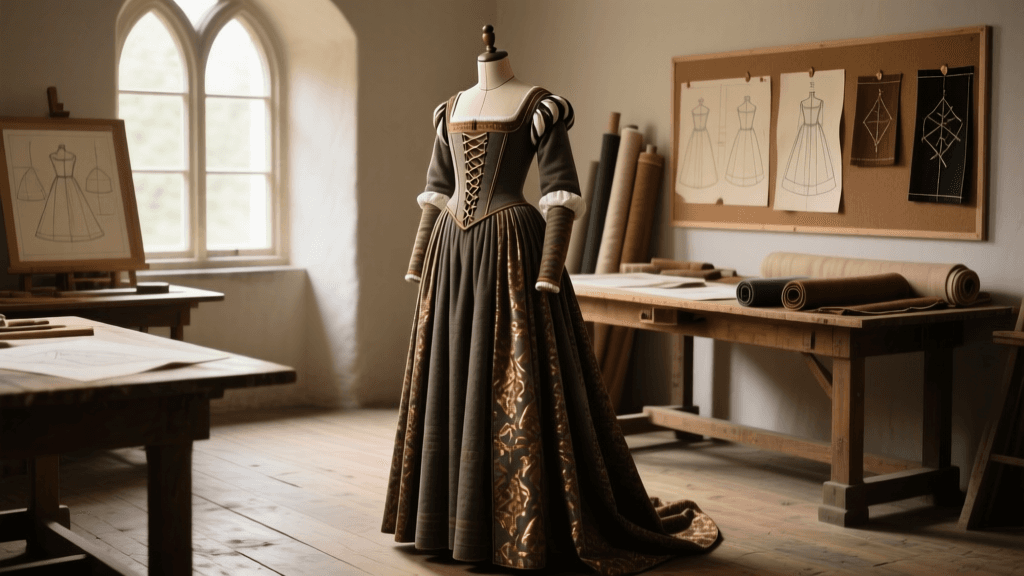
Drafting a kirtle bodice in 2026 benefits from modern digital pattern-making tools, but the physical construction remains deeply rooted in historical hand-sewing techniques. The bodice must be flat-patterned to fit the wearer's torso tightly, providing bust support through compression and the stiffness of the interlining. A crucial technique for the kirtle bodice is the use of a curved front seam. While many commercial patterns offer a straight center front, extant garments and historical tailoring manuals suggest that a slight curve accommodates the bust more naturally, preventing the dreaded 'uniboob' effect often seen in amateur Renaissance costumes.
When stitching the outer wool layer to the interlining, pad-stitching is highly recommended. This technique, which involves making thousands of small, diagonal running stitches, marries the two layers together permanently. It allows the bodice to mold to the wearer's body heat over time, creating a custom, supportive fit that modern zip-ties or steel boning cannot replicate. The armholes and neckline are finished by turning the outer fabric and lining inward and whipping them together, ensuring a clean edge that resists fraying during heavy use.
The Overgown: Sleeves, Foreparts, and Cartridge Pleating
The overgown, often worn open at the front to reveal a contrasting kirtle or a decorated forepart, requires a massive amount of fabric. The skirts of the 1540s and 1550s are characterized by deep, tubular folds known as cartridge pleats. Cartridge pleating allows several yards of heavy wool or silk to be compressed into a small waistband without adding excessive bulk at the waistline. In 2026, makers utilize specialized pleating boards and heavy-duty waxed linen threads to ensure the pleats hold their tubular shape. The top edge of the skirt is folded over multiple times to create a thick, rigid header. Running stitches are then worked in parallel rows, and when pulled tight, the fabric naturally folds into perfect, uniform tubes.
Modular Sleeves and Foreparts
Sleeves in the mid-16th century were often detachable, tied to the bodice with laces known as 'points.' This modularity allowed the wearer to change the look of their gown without needing an entirely new garment. The upper sleeve was typically voluminous, often slashed to reveal a contrasting silk or linen lining underneath. Creating authentic slashes requires pinking shears and careful hemming to prevent the wool from fraying over time. Additionally, the 'forepart'—a decorated panel of fabric pinned or stitched to the front of the kirtle skirt—provided a canvas for displaying immense wealth. Today, costumers are utilizing digital embroidery machines programmed with historical blackwork and couched goldwork patterns to recreate these lavish foreparts efficiently, while still maintaining visual authenticity from a distance.
Hardware, Fastenings, and Finishing Touches
No Renaissance garment is complete without historically accurate hardware. In 2026, the availability of museum-quality reproduction hardware has expanded significantly, allowing for unprecedented accuracy. For the kirtle bodice, spiral lacing is the most historically accurate method of closure. Unlike modern criss-cross lacing, spiral lacing uses a single lace threaded through offset holes, which allows for tighter, more even tensioning across the torso. Hooks and eyes are essential for closing the overgown. Modern stamped brass hooks are too flimsy and visually incorrect. Instead, seek out cast bronze or forged iron hooks from specialized historical jewelers.
Aglets—the metal tips at the end of laces—were often highly decorative in the Renaissance. Today's 3D-printing and micro-casting technologies allow independent artisans to produce stunning, museum-grade aglets in brass and silver that perfectly mimic the extant pieces housed in institutions like the Victoria and Albert Museum. Finishing the gown with proper silk ribbons, woven metal lace, and historically accurate pewter or brass buttons elevates the garment from a simple costume to a true piece of wearable history.
Conclusion
Constructing a Medieval and Renaissance wardrobe in 2026 is a rewarding pursuit that bridges the gap between historical research and tangible craftsmanship. By investing in period-accurate textiles like wool broadcloth and heavyweight linen, and by mastering traditional tailoring techniques such as pad-stitching and cartridge pleating, you can create garments that are not only visually stunning but structurally authentic. Whether you are preparing for the upcoming summer reenactment season or contributing to a living history museum, this guide ensures your Renaissance kirtle and gown will stand the test of time, honoring the rich textile traditions of European folk dress.