Recreating Iconic Hanfu of Famous Chinese Historical Figures

The Allure of Historical Hanfu: Wearing China's Legacy
The modern Hanfu movement has transcended mere cosplay, evolving into a profound reconnection with Chinese cultural heritage. For enthusiasts and historians alike, the ultimate sartorial goal is often to recreate the iconic outfits worn by famous historical figures. From the commanding presence of China's only female emperor to the romantic, flowing robes of legendary poets, these garments are not just clothes; they are wearable history. However, translating ancient court paintings and museum artifacts into functional, modern wardrobes requires an understanding of historical textiles, precise tailoring, and practical styling techniques.
According to the Metropolitan Museum of Art's Asian Art collection, extant garments from the Ming and Qing dynasties provide crucial structural blueprints for modern reconstructions, revealing the complex layering and hidden tailoring secrets of ancient artisans. Today, we explore how to accurately and comfortably recreate the iconic looks of Wu Zetian, Li Bai, and Yang Guifei, complete with actionable sourcing advice, fabric substitutions, and measurement guides.
Wu Zetian: The Power of the Tang Dynasty Qixiong Ruqun
Wu Zetian, the only woman to ever rule China as an emperor in her own right, favored the opulent and structurally daring aesthetics of the High Tang dynasty. Her iconic silhouette is defined by the Qixiong Ruqun (chest-high skirt), a garment that visually elongates the lower body while projecting an aura of supreme authority and feminine grace.
Historical Context and Modern Adaptation
The traditional Tang chest-high skirt was tied above the bust, secured by wide silk sashes. While historically stunning, modern wearers often face the practical challenge of the skirt slipping down. To recreate Wu Zetian's commanding look without constant adjustments, modern Hanfu tailors have integrated hidden structural elements.
- The Anti-Slip Solution: Apply a strip of medical-grade silicone grip tape (available at most pharmacies for under $10) along the inner top hem of the skirt. This creates friction against the undergarment, keeping the heavy silk securely in place.
- Fabric Selection: Historically, Tang royalty wore heavy, stiffened silks. For a modern equivalent that offers the same regal drape without the suffocating weight, opt for 19-momme silk charmeuse or a high-density polyester-silk blend. Avoid lightweight chiffon, as it lacks the structural integrity required to hold the wide, pleated Tang silhouette.
- Color Palette: Wu Zetian's wardrobe was rich in imperial colors. Seek out deep crimson, ochre yellow, and peony pink, often adorned with woven gold threads (Zhuanghua).
Li Bai & Su Shi: The Scholar's Lanshan and Daopao
While emperors and consorts wore heavy silks, the literati of the Tang and Song dynasties, such as the legendary poet Li Bai and the polymath Su Shi, favored garments that reflected their philosophical ideals: modesty, intellect, and a connection to nature. Their iconic garment is the Lanshan (a scholar's robe with a distinctive black hem) and the later Ming dynasty Daopao (Taoist robe).
Crafting the Literati Aesthetic
The scholar's aesthetic relies heavily on the concept of Fenggu (wind and bone), meaning the garment must move elegantly with the wind while maintaining a structured, upright posture. The preservation of the natural fibers used in these garments is a testament to China's long history of textile mastery, a legacy recognized by UNESCO's Intangible Cultural Heritage list for its sericulture and silk craftsmanship.
- Fabric Substitutes: To capture the rustic elegance of a Song dynasty scholar, avoid shiny silks. Instead, invest in washed linen or a cotton-linen blend (55% linen, 45% cotton). These fabrics offer a matte finish, breathe well in summer, and develop a beautiful, lived-in drape over time.
- The Cross-Collar Rule: The Jiao Ling You Ren (left lapel over right) rule is non-negotiable in Hanfu. Ensure your tailor or chosen brand aligns the collar precisely at the hollow of the throat, with the left side crossing over the right. A poorly aligned collar instantly breaks the historical illusion.
- Sleeve Proportions: Scholar robes feature Pipa (lute-shaped) sleeves. When measuring, your arm span (Tongxiu) should dictate the sleeve width. For an authentic Li Bai look, the sleeves should extend 3 to 4 inches past the fingertips when your arms are relaxed at your sides.
Yang Guifei: The Opulence of the Da Xiu Shan
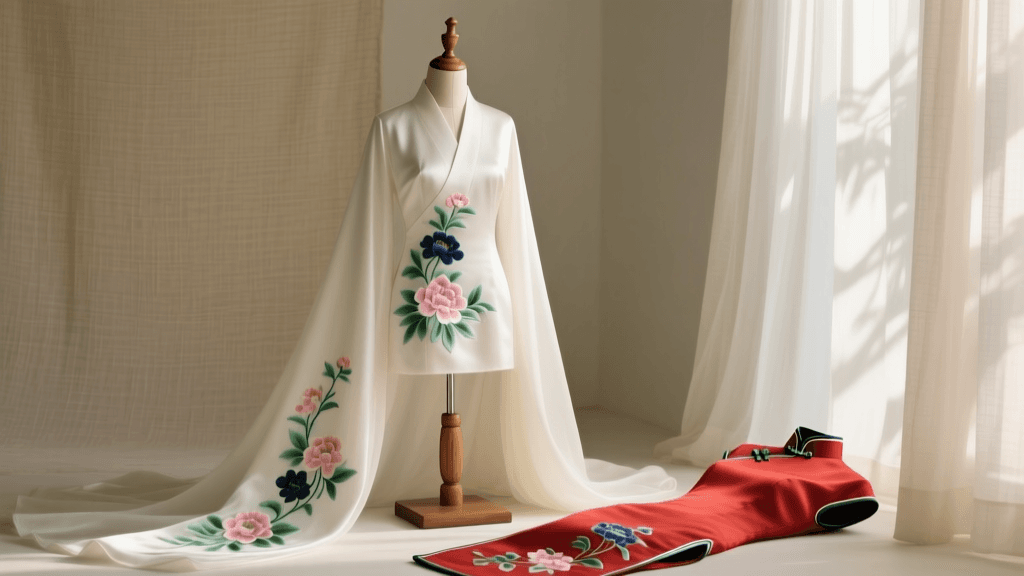
Yang Guifei, one of the Four Beauties of ancient China and the beloved consort of Emperor Xuanzong, is synonymous with the Da Xiu Shan (Grand-Sleeved Shirt). This formal court dress is characterized by its massive, trailing sleeves and intricate, layered shawls (Pibo).
Managing Weight and Drape
Recreating Yang Guifei's look is an exercise in managing heavy textiles. The Da Xiu Shan requires substantial fabric, which can cause shoulder fatigue if not properly tailored.
"When wearing grand court Hanfu, the weight of the sleeves must be distributed across the upper back and shoulders, not just the collarbone. Historical garments utilized hidden inner linings and weighted hems to pull the fabric backward, ensuring the wearer's posture remained upright and regal." — Textile Conservator Notes, Victoria and Albert Museum Asia Collections.
Actionable Tip: If commissioning a custom Da Xiu Shan, ask your tailor to add small, flat lead or steel drapery weights (about 20g each) into the bottom corners of the outer sleeves. This mimics the heavy gold embroidery of historical hems, forcing the sleeves to hang in perfect, dramatic vertical lines rather than bunching up at the elbows.
Practical Guide: Recreating Historical Looks Today
Below is a comprehensive comparison chart to help you plan your historical Hanfu project, balancing historical accuracy with modern wearability and budget.
| Historical Figure | Iconic Garment | Recommended Modern Fabric | Styling Challenge & Solution | Estimated Cost (USD) |
|---|---|---|---|---|
| Wu Zetian (Tang) | Qixiong Ruqun (Chest-High Skirt) | 19-Momme Silk Charmeuse or Heavy Chiffon | Slipping bodice. Solution: Inner silicone grip tape and structured bustier underneath. | $120 - $350 |
| Li Bai (Tang/Song) | Lanshan / Yuanlingpao (Round Collar) | Washed Linen or Cotton-Linen Blend | Collar gaping. Solution: Use hidden magnetic snaps along the inner lapel. | $80 - $200 |
| Yang Guifei (Tang) | Da Xiu Shan (Grand Court Robe) | Song Brocade (Songjin) or Jacquard Poly-Silk | Shoulder fatigue from heavy sleeves. Solution: Hem weights and wide inner shoulder padding. | $250 - $800+ |
| Ming Empresses | Mamianqun (Horse-Face Skirt) & Ao | Woven Gold (Zhuanghua) or Tissue Brocade | Skirt pleats losing shape. Solution: Steam-press pleats and store hanging with clip hangers. | $150 - $500 |
Sourcing and Tailoring: Where to Buy and How to Measure
Acquiring museum-quality Hanfu requires knowing where to look and how to provide exact measurements to overseas tailors. The market is generally divided into three tiers:
1. Brand Tiers and Sourcing
- Entry-Level ($40 - $90): Brands on Taobao and AliExpress offer mass-produced, historically inspired pieces. While fabrics are usually polyester, they are excellent for testing silhouettes. Look for shops with high return rates and video reviews.
- Mid-Tier Indie Brands ($120 - $300): Brands like Shisanyu and Tingyue Feng offer excellent historical accuracy, utilizing proper weaving techniques like jacquard and reliable cotton-linen blends. They release seasonal collections based on specific historical artifacts.
- High-End & Museum Replicas ($400 - $2,000+): Ming Hua Tang is the gold standard for Ming dynasty reconstructions. They utilize genuine Xiangyunsha (gambiered Canton gauze) and real gold-leaf threads. Garments are often made-to-order with a 3-to-6-month wait time.
2. The Essential Measurement Guide
Unlike Western clothing, Hanfu relies on flat-pattern cutting. Do not provide standard S/M/L sizes. You must provide the following measurements in centimeters to your tailor:
- Bust/Waist/Hips: Measure over the undergarments you intend to wear.
- Arm Span (Tongxiu): Measure from wrist bone to wrist bone with arms outstretched. This determines sleeve length and width.
- Skirt Length: Measure from your natural waist (or underbust for Tang styles) down to 2 centimeters above the floor while wearing your traditional embroidered shoes.
- Shoulder Width: Crucial for the Ao (jacket) styles of the Ming dynasty to ensure the drop-shoulder seam sits correctly on the upper arm.
Etiquette and Posture: Completing the Illusion
Wearing the garment is only half the battle; moving in it completes the historical immersion. The cut of Hanfu inherently restricts modern, rushed movements, forcing the wearer into a slower, more deliberate gait.
When greeting others in full Hanfu, the traditional Zuoyi (for men/scholars) or Wanfu (for women) is essential. For the scholar's Lanshan, stack your left hand over your right fist, raise them to chest level, and bow slightly from the waist, keeping your back straight. For women in a Tang Ruqun, place your hands slightly to the left of your waist, bend the knees softly, and lower your head gracefully. Mastering these micro-movements ensures that your historical tribute is not just visually accurate, but culturally resonant.