Buying Authentic Silk Kimono Online: 2026 Buyer Guide
The State of Online Kimono Shopping in 2026
The digital landscape for acquiring traditional Japanese garments has evolved significantly by 2026. With the rise of specialized cross-border logistics, AI-driven translation tools on Japanese e-commerce sites, and direct-to-consumer shipping initiatives, international buyers now have unprecedented access to authentic silk kimono. However, this accessibility also brings a surge in mass-produced, synthetic replicas marketed deceptively as "silk-like" or "crepe silk." For collectors, practitioners, and fashion enthusiasts, knowing where to shop and how to verify authenticity is paramount.
Whether you are searching for a pristine vintage furisode for a coming-of-age ceremony, a subdued tsukesage for tea ceremonies, or a highly collectible Nishijin-ori obi, the online marketplace is vast. This guide breaks down the top platforms for buying authentic silk kimono in 2026, comparing major Japanese e-commerce giants with specialized vintage dealers and independent Kyoto-based boutiques.
Top Online Marketplaces for Authentic Silk Kimono
Rakuten Global: The E-Commerce Giant
In early 2026, Rakuten overhauled its global logistics network, making it one of the most reliable platforms for purchasing new and vintage kimono directly from Japan. Rakuten hosts hundreds of established brick-and-mortar kimono shops from Tokyo, Kyoto, and Kanazawa that have transitioned to digital storefronts. The platform's built-in translation and consolidated shipping services (Rakuten Global Express) allow buyers to purchase from multiple vendors and ship them in a single box, drastically reducing international freight costs.
When shopping on Rakuten, look for shops designated as "Official Kyoto Craft Members." These vendors are legally bound to sell authentic, traditionally woven textiles. Prices for new, hand-painted Yuzen silk kimono typically start around $800 USD, while machine-woven silk komon can be found for $150 to $300 USD.
Ichiroya: The Gold Standard for Vintage
For antique and vintage silk, Ichiroya remains the undisputed leader in 2026. Based in Osaka, this specialized dealer has spent decades curating estate-sale kimono. What sets Ichiroya apart is their rigorous, transparent grading system. Every garment is inspected for silk degradation, hidden stains, and structural weakness. Their A-rank items are in pristine, unworn condition, while C-rank items are sold explicitly for upcycling or textile study.
Ichiroya's 2026 interface includes high-resolution macro photography, allowing buyers to inspect the weave of the silk and the penetration of the dye. Their pricing is highly competitive, with beautiful vintage Taisho-era (1912-1926) meisen silk kimono often available for under $120 USD.
Independent Kyoto Dealers (Shopify & Etsy)
A major trend in 2026 is the rise of micro-dealers in Kyoto's historic Nishijin weaving district launching independent Shopify stores and Etsy shops. These are often second or third-generation weavers and dyers bypassing traditional wholesale distributors to sell directly to Western enthusiasts. Searching for specific terms like "hand-painted Kyo-Yuzen" or "vintage Nishijin obi" on Etsy will yield incredible results. While shipping times can be longer due to independent fulfillment, the authenticity and direct support of traditional artisans make this a highly rewarding avenue.
2026 Marketplace Comparison Chart
| Marketplace | Best For | Price Range (USD) | Authenticity Guarantee | Avg. Shipping Time |
|---|---|---|---|---|
| Rakuten Global | New silk, official craft shops | $150 - $2,500+ | High (Vendor dependent) | 7-12 Days |
| Ichiroya | Vintage, antique, estate silk | $40 - $800 | Very High (In-house graded) | 5-9 Days |
| Etsy / Shopify | Direct artisan, upcycled, rare obi | $80 - $1,500 | Moderate (Requires buyer knowledge) | 10-20 Days |
| Yahoo! Auctions JP | Bargain hunting, bulk lots | $10 - $500 | Low (Sold as-is) | 10-15 Days (via Proxy) |
How to Verify Silk Authenticity Online
Without the ability to perform a physical "burn test" or feel the textile, verifying silk authenticity online requires a keen eye for photographic evidence. According to the Victoria and Albert Museum's comprehensive guide on kimono construction, traditional Japanese dyeing and weaving methods leave distinct visual signatures that modern synthetic printing cannot replicate.
- The Dye Penetration Test (Yuzen): Genuine hand-painted Kyo-Yuzen or Kaga-Yuzen silk features dye that penetrates entirely through the fabric. Ask the seller for a photo of the inside of the garment. If the vibrant exterior pattern is stark white or faded on the interior, it is a modern digital print on synthetic or blended fabric.
- The Slub Test (Tsumugi): Tsumugi is a highly prized pongee silk known for its matte finish and textured "slubs" (uneven threads). Authentic Oshima Tsumugi or Yuki Tsumugi will show these irregularities even in macro photos. Synthetic imitations are uniformly smooth.
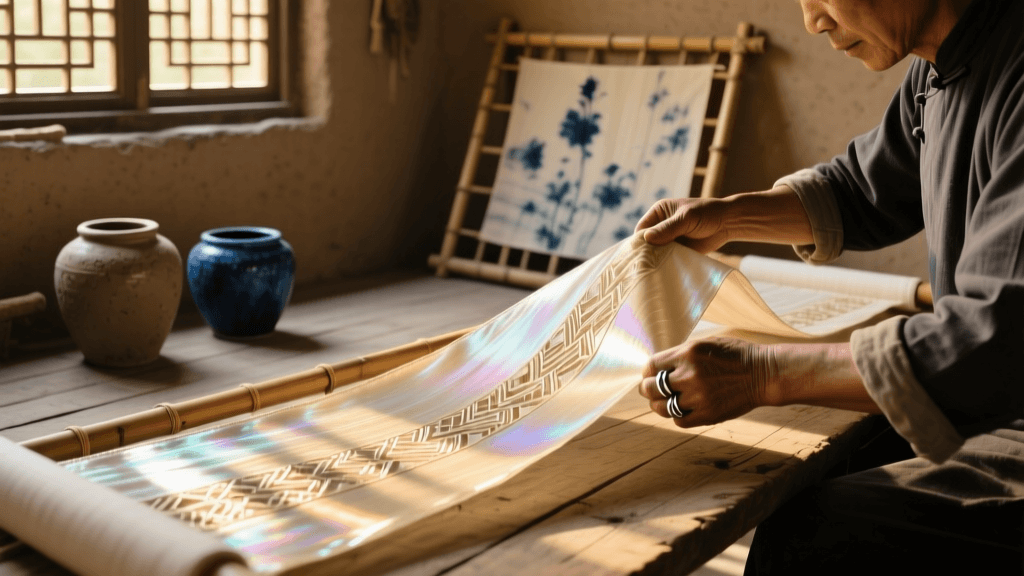
- The Weave Back (Nishijin-ori): For brocade obi, authentic Nishijin weaving will show a complex, albeit slightly messy, interlacing of threads on the reverse side. Fused or embroidered synthetic obi will show a flat backing or uniform machine stitching.
Sizing and Measurements for 2026 Buyers
Kimono sizing does not follow Western S/M/L conventions. Instead, garments are tailored to specific body metrics. When browsing online listings in 2026, you will primarily encounter two measurements:
- Yuki (裄 - Center Back to Wrist): This is the most critical measurement. It is measured from the center of the back seam, across the shoulder, down to the wrist. To find your ideal Yuki, measure from your C7 vertebra (the prominent bone at the base of your neck) over your shoulder to your wrist bone, then add 2 centimeters for traditional drape.
- Mitake (身丈 - Back Length): Measured from the base of the collar to the bottom hem. For a traditional ankle-length fit, the Mitake should be roughly equal to your total height minus 10 to 15 centimeters, depending on how much fold (ohashori) you prefer at the waist.
Many specialized online retailers in 2026 now include automatic metric-to-imperial conversion toggles and visual sizing guides to help international buyers avoid costly tailoring mistakes.
Shipping, Customs, and Import Duties
Cross-border e-commerce regulations have tightened globally, and understanding import duties is essential for kimono shoppers. When importing textiles into the United States, the de minimis threshold remains at $800 USD in 2026, meaning most single kimono purchases will clear customs without additional duties. However, European buyers must navigate the IOSS (Import One-Stop Shop) system, where VAT is often collected at the point of sale by major platforms like Rakuten and Etsy.
For those utilizing Japanese proxy buying services to access domestic-only auctions, it is vital to review the Japan Customs official guidelines regarding export declarations. Ensure your proxy service accurately declares the garment as "Vintage Clothing" or "Silk Textile" rather than generic "Merchandise," as this prevents unnecessary delays and ensures proper handling of delicate, century-old silk fibers by international couriers.
Final Thoughts on Building Your Collection
Shopping for authentic silk kimono online in 2026 is a rewarding pursuit that connects you directly with centuries of Asian textile heritage. By leveraging the consolidated logistics of Rakuten, the expert curation of Ichiroya, and the artisan connections found on independent platforms, you can build a stunning, authentic collection. Always prioritize vendors who provide macro-photography, transparent defect reporting, and clear measurements, ensuring that the garment you receive honors the master weavers and dyers who created it.