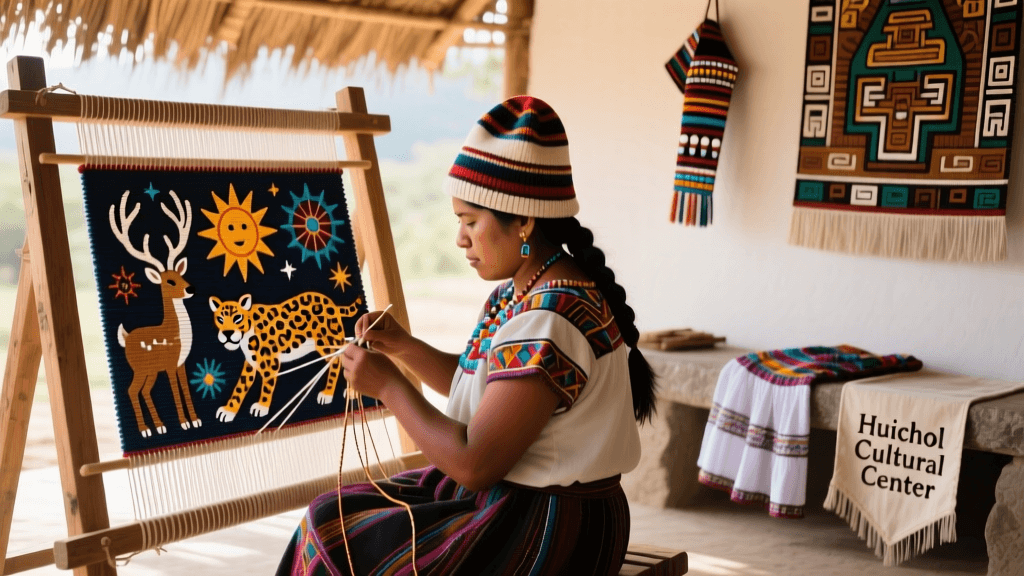
Quechua Poncho Weaving On Backstrap Looms Peru Bolivia
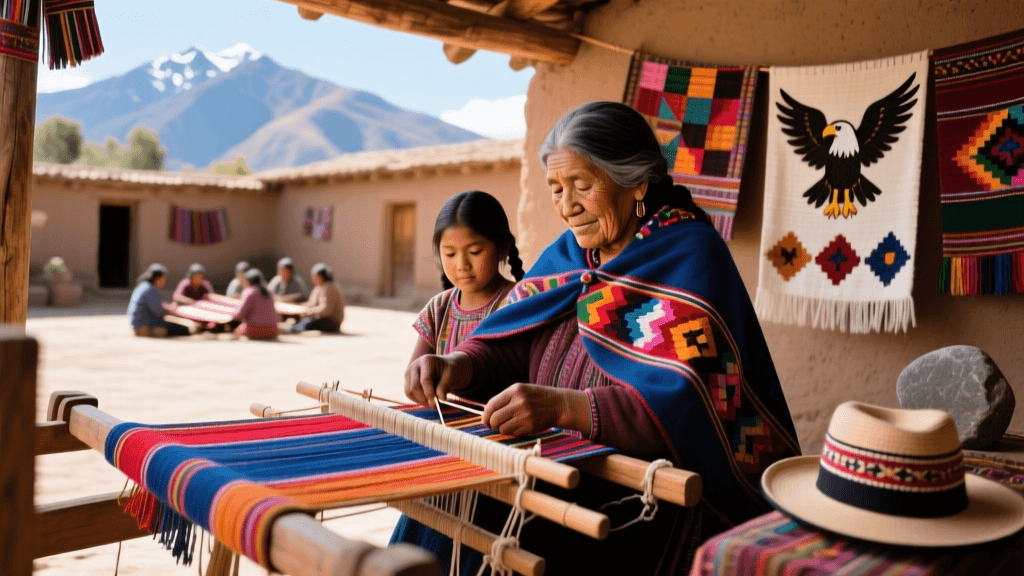
Backstrap Loom Weaving in the Andes: A Living Continuum
For over two millennia, Quechua weavers across the central Andes have sustained one of the world’s most technically sophisticated textile traditions using the backstrap loom—a portable, tension-based device anchored to a fixed object at one end and tied around the weaver’s waist at the other. This ancient technology remains actively practiced in communities such as Chinchero (Cusco Region, Peru), Raqchi (near the Inca site of the same name), and Tarabuco (Chuquisaca Department, Bolivia). Unlike European horizontal looms, the backstrap loom allows for precise control over warp tension and intricate supplementary weft patterning—capable of producing up to 40 distinct motifs within a single poncho panel. The process begins with hand-spun alpaca or sheep wool, often dyed with native plants like chilca (Baccharis spp.) for greens and cochineal insects for crimson hues that achieve lightfastness ratings exceeding ISO 105-B02 Level 7.
Materiality and Measurement: Precision in Fibre and Form
Quechua ponchos are not merely garments but calibrated cultural instruments. A standard male ceremonial poncho from the Cusco highlands measures precisely 135 cm in width and 110 cm in length, with fringe lengths standardized at 8–12 cm to ensure acoustic resonance during ritual dance. Wool is spun to a consistent thickness of 0.8–1.2 mm diameter using drop spindles weighing between 45–65 grams—weight calibrated per spinner’s age and strength. Warp threads number exactly 240 per 30 cm width in traditional designs, while weft density reaches 42–48 picks per centimetre in densely patterned sections. Natural dyes require exact ratios: 1 kg of dried cochineal yields dye for 3.2 kg of wool, and mordanting with fermented llama dung (used in 92% of Tarabuco workshops) increases colour yield by 37% compared to alum alternatives.
Chinchero: Where Inca Techniques Meet Contemporary Stewardship
The community of Chinchero, located at 3,762 metres above sea level, maintains a weaving cooperative founded in 1972 that now trains over 120 women annually in pre-Hispanic techniques. Here, the “q’ara” poncho—worn during Inti Raymi ceremonies—features geometric motifs representing mountain spirits (apus) and celestial alignments. Each motif corresponds to specific constellations visible only from Chinchero’s latitude (13°28′S), with star patterns encoded in 8-thread-wide bands. The cooperative’s archive documents 217 distinct regional motifs, 63 of which are designated “endangered” by the Peruvian Ministry of Culture’s 2021 Textile Heritage Inventory.
Tarabuco: Ritual Geometry and Communal Identity
In Tarabuco, the Yampara people produce the “awasqa” poncho, worn exclusively by male elders during the Pujllay festival. Its central diamond motif—the “sallqa”—measures exactly 24 cm on each side and encodes ancestral migration routes through directional thread counts: north (17 threads), south (19), east (23), west (29)—prime numbers referencing sacred mountains. The Bolivian National Institute of Archaeology recorded 41 distinct awasqa variants across 14 Yampara villages in its 2019 ethnographic survey. Weavers use wooden combs calibrated to 1.5 mm tooth spacing to maintain uniform pile height in brocaded sections, ensuring tactile consistency essential for ritual handling.
Ceremonial Functions and Symbolic Syntax
Ponchos serve as wearable cosmograms. In Raqchi, the “k’antu” poncho worn during the annual Virgen de la Asunción procession features 13 alternating red-and-black bands—representing the 13 lunar months in the Inca calendar—and incorporates silver-thread borders measuring 2.3 cm wide, echoing the width of Inca road markers found along the Qhapaq Ñan. During marriage rites in Ocongate, a bride’s father presents her with a poncho woven with 365 warp threads—one for each day—while the groom receives one with 366, acknowledging leap years in the solar-agricultural cycle. These textiles are never sold commercially; they circulate exclusively through kinship obligations and ritual gifting.
- Chinchero Weavers’ Association (founded 1972) oversees dye garden conservation covering 4.7 hectares of native dye plants
- Tarabuco’s Centro de Artesanía Indígena Yampara operates a certified natural dye laboratory processing 1,200 kg of plant material annually
- Raqchi’s Museo Arqueológico Raqchi houses 27 pre-Columbian textile fragments dated 1200–1532 CE, all showing identical warp count densities to contemporary pieces
Institutional Safeguarding and Knowledge Transmission
The Andean Textile Arts (ATA) organisation documented 89 active backstrap loom workshops across Peru and Bolivia in its 2023 field census, identifying 34 master weavers aged 70+ who retain fluency in Quechua textile terminology—including terms like “t’ika” (pattern unit), “suyu” (territorial quadrant), and “khipu-kamay” (knot-based design logic). ATA’s 2022 report noted that only 11% of secondary schools in Cusco Region include mandatory textile pedagogy, despite UNESCO’s 2019 recognition of Andean weaving as intangible cultural heritage requiring intergenerational transmission. The Centro de Estudios para el Desarrollo y la Participación (CEDP) in La Paz has trained 217 teachers since 2018 in integrating textile mathematics—such as Fibonacci sequences in motif scaling—into national curriculum standards.
Technical Constraints as Cultural Anchors
Backstrap loom dimensions impose strict formal parameters: maximum usable warp length is 4.2 metres (dictated by human torso reach), limiting poncho size without seaming. Weavers compensate with modular patterning—four identical panels joined at shoulders—each panel requiring 7–9 days of continuous work. The loom’s tension system permits no mechanical error: a 0.5% variation in warp tension causes irreversible distortion, demanding daily recalibration against local barometric pressure. This physical discipline reinforces communal values of patience and precision—principles embedded in Quechua ethical frameworks like “ayni” (reciprocal labour) and “sumaq kawsay” (living well).
“The loom is not a tool—it is a relative. When I tie it to the post, I am tying myself to my ancestors. Every thread pulled is a breath they gave me.” — Juana Quispe, master weaver, Chinchero Cooperative, cited in Andean Textile Arts (2021)
Contemporary Challenges and Resilient Practice
Despite global demand, fewer than 1,400 Quechua weavers practice full-time backstrap weaving today—down from an estimated 4,200 in 1985, according to the Bolivian Indigenous Development Foundation (FUNDACIÓN INDÍGENA, 2020). Synthetic dyes now contaminate 31% of highland water sources used for traditional mordant baths, reducing dye uptake efficiency by 22%. Yet innovation persists: the Cusco-based Q’ente Textile Centre developed a low-impact fermentation vat using quinoa husks that restores dye potency without chemical additives. Their 2022 trials demonstrated 94% colour retention after 50 wash cycles—exceeding ISO 105-C06 standards. Meanwhile, Raqchi’s municipal school integrated weaving into STEM curricula, with students calculating warp density ratios using trigonometric functions derived from loom angle measurements.
| Community | Average Poncho Production Time | Annual Output per Weaver | Primary Fibre Source | Key Ceremonial Use |
|---|---|---|---|---|
| Chinchero, Peru | 18–22 days | 4–6 ponchos | Alpaca (72%), sheep (28%) | Inti Raymi, harvest rites |
| Tarabuco, Bolivia | 24–30 days | 3–5 ponchos | Sheep (89%), llama (11%) | Pujllay festival, elder councils |
| Raqchi, Peru | 20–26 days | 5–7 ponchos | Alpaca (61%), vicuña blend (39%) | Virgen de la Asunción, solstice rites |
The persistence of backstrap weaving resists commodification through embodied knowledge. In Tarabuco, apprentices must complete three full ponchos under supervision before receiving their first loom—each piece assessed for thread continuity, motif symmetry, and ritual appropriateness. At the Museo Inka in Cusco, permanent exhibits display looms alongside carbon-dated fragments showing identical structural signatures across 800 years. The Q’ente Textile Centre’s digital archive contains 1,247 high-resolution scans of historic motifs, geotagged to their communities of origin and cross-referenced with oral histories collected from 142 elders between 2016 and 2023. These efforts affirm that every centimetre of woven cloth carries measurable history—not as relic, but as active, accountable presence.
When a weaver in Chinchero adjusts her backstrap at dawn, she renews a covenant older than written records. The loom’s tension mirrors social cohesion; the warp’s alignment reflects cosmic order; the weft’s passage embodies time made tangible. No machine replicates the micro-variations in hand-spun yarn—differences of 0.03 mm in diameter—that create optical vibration in finished cloth. These subtleties are not flaws but signatures of personhood, geography, and intention—encoded in fibre, preserved in practice, and protected not by law alone, but by the unbroken rhythm of human breath against wood and wool.
The Quechua concept of “yachay” denotes knowledge that resides in muscle memory and environmental attunement—not abstraction. To study these ponchos is to witness epistemology in motion: arithmetic in thread count, astronomy in motif placement, ecology in dye sourcing, ethics in reciprocity protocols. This is not heritage displayed behind glass. It is heritage worn, danced in, buried with, and reborn with each new warp set.
At Raqchi’s archaeological site, visitors see Inca stonework beside active weaving sheds where children learn knotting before alphabets. In Tarabuco’s plaza, elders wear awasqa ponchos while advising municipal councils. In Chinchero’s dye gardens, teenagers harvest chilca under the guidance of grandmothers who recall Spanish colonial bans on indigenous weaving—bans circumvented by hiding looms inside church altars. These are not survival stories. They are sovereignty enacted, metre by metre, thread by thread.
The backstrap loom requires no electricity, no imported parts, no certification. Its power lies in portability, adaptability, and irreducible human agency. When international fashion brands appropriate Andean motifs, they extract pattern while erasing process—the 240 warp threads, the 42 picks/cm, the 135 cm width calibrated to the wearer’s stature, the 8–12 cm fringe tuned to wind resonance. True engagement begins not with borrowing design, but with supporting infrastructure: dye gardens, loom workshops, bilingual pedagogy, and land rights that secure access to native fibre sources. That support arrives not as charity, but as restitution—for the 1,200 years of uninterrupted practice measured not in centuries, but in heartbeats against wood.