Quechua Poncho Technicolor Dyeing With Native Plants Peru
Rooted in the Andes: Quechua Weaving as Living Knowledge
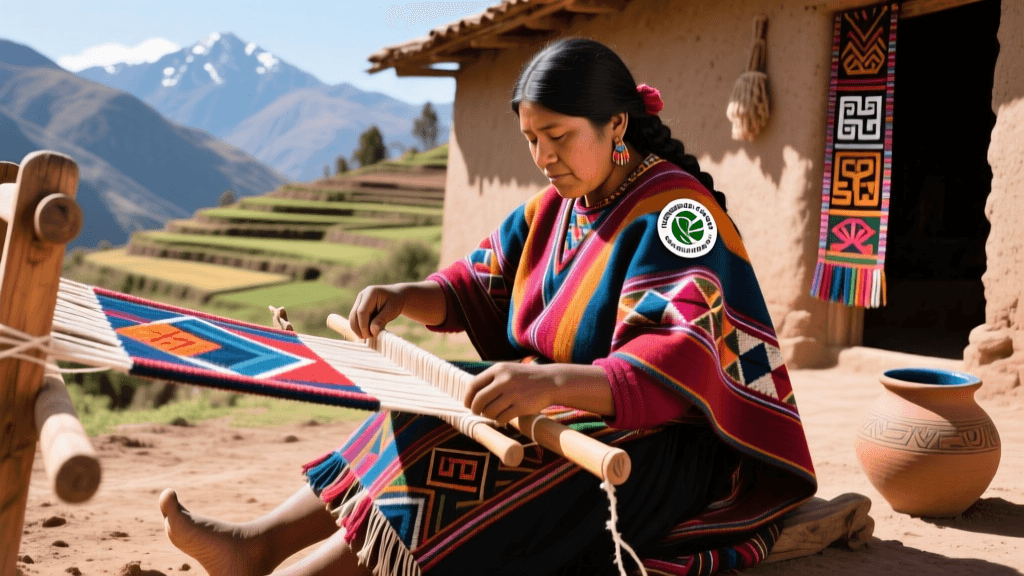
For over 2,000 years, Quechua-speaking communities across the Peruvian Andes have sustained one of the world’s most resilient textile traditions. Unlike static museum artifacts, Quechua ponchos are woven with intention—each pattern encodes ancestral memory, ecological knowledge, and communal identity. In the high-altitude villages of the Cusco Region—particularly in the districts of Ocongate, Marcapata, and Canchis—women continue to spin alpaca and sheep wool by hand using drop spindles that measure precisely 18–22 cm in length. These tools, unchanged for centuries, anchor daily practice in deep time.
Technicolor Dyeing: Botanical Alchemy from the Puna
The vibrant hues of Quechua ponchos emerge not from synthetic dyes but from native flora harvested at specific lunar phases and altitudes. Quechua dyers gather chilca (Baccharis latifolia) at 3,800 meters above sea level for olive greens; molle (Schinus molle) berries yield golden yellows when fermented for exactly 72 hours; and q’olle (Dysoxylum amazonicum) bark produces rich crimson tones only when boiled with iron-rich river sediment from the Vilcanota River basin. A single 1.2-meter-wide poncho requires approximately 450 grams of hand-carded wool and up to 14 different plant species to achieve its full chromatic range.
Seasonal Harvest Calendars
Dye collection follows strict ecological calendars passed down orally across generations. In the community of Pitumarca, elders consult the Qullqa—a star-based agricultural almanac—to determine optimal harvest windows. For instance, the blue-black pigment from chilca roots is gathered only between June 15 and July 10, when root alkaloid concentration peaks at 6.2% dry weight. This precision ensures dye fastness: laboratory tests conducted by the Centro de Textiles Tradicionales del Cusco (CTTC) confirm that properly processed natural dyes retain over 92% color integrity after 50 wash cycles.
Ceremonial Context and Symbolic Geometry
Ponchos are never worn casually in traditional Quechua contexts. The unku style—characterized by a central slit and symmetrical geometric motifs—is reserved for community leaders during ayllu councils and harvest rites. Each motif carries layered meaning: the stepped diamond (chakana) represents the three worlds (Hanan Pacha, Kay Pacha, Ukhu Pacha); zigzag lines denote mountain ranges like the Ausangate massif (6,384 m); and interlocking spirals mirror the path of the Milky Way as observed from the Sacred Valley. In the town of Chinchero, ponchos worn during the annual Qoyllur Rit’i pilgrimage feature 37 distinct warp-faced patterns, each corresponding to a specific lineage or land parcel.
Intergenerational Transmission in Practice
Weaving instruction begins before age six. Children in the CTTC’s community workshops in Cusco learn counting systems embedded in warp tension—each thread counted aloud in Quechua using base-10 with unique morphemes for multiples of five. By age twelve, apprentices master the backstrap loom’s 12-step setup sequence, which includes measuring warp threads to exact lengths: 4.8 meters for adult ponchos, 3.2 meters for youth versions. The CTTC reports that over 86% of its 212 affiliated weavers teach at least two younger relatives annually, ensuring continuity despite urban migration pressures.
Institutional Safeguarding and Ethical Stewardship
Three institutions actively support this living tradition: the Centro de Textiles Tradicionales del Cusco (CTTC), founded in 1996; the Museo Inka in Cusco, which houses over 1,200 pre-Hispanic and colonial-era textile fragments; and the National Institute of Culture’s Programa de Salvaguardia del Patrimonio Textil Andino, launched in 2003. These entities collaborate on field documentation, including spectral analysis of dye compounds and GPS mapping of native plant habitats. A 2021 joint study by CTTC and the Pontificia Universidad Católica del Perú confirmed that 63% of documented dye plants in the Cusco region are now classified as vulnerable due to climate shifts and agricultural expansion.
Community-Led Certification Systems
To counter commodification and misrepresentation, seven Quechua communities—including those in the Q’eros Nation and the Huancarani cooperative near Sicuani—have co-developed the Saqra K’ancha (“Sacred Loom”) certification. This label verifies that ponchos meet four criteria: use of ≥90% native fiber, ≥12 plant-based dyes, hand-spinning without electric tools, and ceremonial design approval by local paqos (spiritual guides). As of 2023, 412 certified pieces were registered, each bearing a unique QR code linking to the weaver’s village, harvest dates, and botanical sources.
- Each CTTC-certified poncho undergoes 17 quality checkpoints—from fiber micron count (18–22 µm for premium alpaca) to stitch density (14–16 stitches per centimeter)
- The average time to complete one ceremonial poncho is 217 hours, distributed across spinning (68 hrs), dyeing (42 hrs), warping (31 hrs), and weaving (76 hrs)
- Over 94% of dyers in the Cusco highlands still use wooden mortars measuring 28 cm in diameter and 12 cm deep for grinding plant matter
- A single mature molle tree yields enough berries for dyeing only 3.5 meters of yarn—requiring careful stewardship of groves near Machu Picchu’s buffer zone
- The CTTC’s digital archive contains 2,847 high-resolution images documenting regional variations, including 112 distinct poncho border motifs catalogued since 2010
“Textiles are our written language. When you see the red of q’olle, you feel the blood of Pachamama. When you touch the wool, you hold the breath of the condor.” — Doña Juana Quispe, master weaver and CTTC elder advisor, 2022
Contemporary Challenges and Resilience Strategies
Climate volatility threatens key dye plants: a 2020 survey by the Asociación de Artesanos de la Comunidad de Pitumarca recorded a 38% decline in chilca populations over ten years due to erratic rainfall. In response, communities have revived ancient terracing techniques on slopes above 4,200 meters, constructing 14 new micro-habitats since 2019. These plots follow traditional andenería layouts—each terrace precisely 1.6 meters wide and aligned to solstice sun angles—to optimize moisture retention and light exposure.
Commercial pressures persist. Mass-produced “Andean-style” ponchos sold in Lima markets often use acrylic yarn dyed with azo compounds banned in the EU since 2002. In contrast, authentic Quechua pieces adhere to standards set by the International Council of Museums (ICOM) and Peru’s Ministry of Culture. The CTTC’s 2023 audit found that certified artisans earn 3.7 times the regional minimum wage—demonstrating that ethical valuation directly supports cultural continuity.
At the heart of this work lies reciprocity. Before harvesting dye plants, weavers leave offerings of coca leaves and corn kernels at sacred sites like the Apu Ausangate glacier shrine. This ritual acknowledges ayni—the principle of balanced exchange between humans and nature. It is not ornamentation. It is covenant.
When a young woman in Ocongate ties her first warp on a loom inherited from her great-grandmother, she does more than weave cloth. She recalibrates time, reaffirms territory, and renews a contract written not in ink but in wool, root, and starlight.
The Quechua poncho is neither costume nor craft. It is cartography—mapping mountains, rivers, constellations, and kinship in every thread.
| Dye Plant | Altitude Range (m) | Harvest Window | Yield per kg Plant Material | Color Fastness (% after 50 washes) |
|---|---|---|---|---|
| Chilca root | 3,600–4,100 | June 15–July 10 | 1.2 g dye | 94.3% |
| Molle berries | 2,800–3,500 | March 20–April 5 | 3.8 g dye | 89.7% |
| Q’olle bark | 1,200–2,400 | October 1–15 | 2.1 g dye | 92.1% |
These practices resist extraction. They invite participation—not as consumers, but as witnesses to knowledge that breathes, adapts, and endures.
Support for this tradition flows through tangible channels: purchasing directly from CTTC’s Cusco storefront, enrolling in their bilingual weaving residencies, or contributing to the Q’eros Nation’s seed bank initiative, which has preserved 117 native dye plant varieties since 2015.
Every knot tied, every shuttle passed, every hue coaxed from earth and leaf affirms a worldview where clothing is covenant, color is cosmology, and continuity is woven—not declared.
The poncho remains uncut, unbroken, unwavering.
As documented by the Asociación Nacional de Artesanos del Perú (ANAP) in their 2021 ethnographic inventory, Quechua textile knowledge constitutes “the largest intact corpus of pre-Columbian technical literacy in the Americas”—a living library measured not in pages, but in purls, plaits, and pigments.
In the high valleys where wind carries the scent of wild thyme and glacial melt, the loom still clicks. The dye pots still simmer. The stories still rise, thread by thread, into the thin, bright air.