Mapuche Trarilonko Silver Work And Metal Casting Process
Trarilonko: The Living Geometry of Mapuche Silver
The Trarilonko—distinctive silver pectoral ornaments worn by Mapuche women of southern Chile and Argentina—is far more than adornment. It is a three-dimensional cartography of lineage, territorial memory, and cosmological order. For over 300 years, these pieces have been forged not in industrial workshops but in family-run fundos (ranches) across the Araucanía Region, where ancestral knowledge flows through generations of silversmiths known as trarilongkos. Unlike mass-produced jewellery, each Trarilonko begins with raw silver mined from historic deposits near Loncoche—a region whose name derives from the Mapudungun words for “long” and “stone,” referencing its ancient quartz-silver veins.
Material Origins and Metallurgical Precision
Silver used in authentic Trarilonko originates almost exclusively from recycled colonial-era coins, particularly the Spanish real and Chilean peso minted between 1790 and 1850. These coins contain 90.3% pure silver—a precise fineness verified using acid test kits calibrated to ASTM B962-17 standards. Contemporary artisans supplement this with certified 925 sterling silver sheet, cut into strips measuring exactly 2.4 mm wide and 0.8 mm thick before rolling. Crucibles are hand-carved from local peumo wood and lined with crushed basalt from the Andes foothills near Temuco, ensuring metal purity remains above 91.7% during casting.
Forging the Symbolic Frame
The foundational frame—the outer ring—must measure precisely 12.5 cm in diameter, a dimension tied to the lunar cycle’s 12.5-day waxing phase in Mapuche cosmology. Artisans use calipers marked in traditional ngüllañ units (1 ngüllañ = 1.27 cm) to verify dimensions, preserving pre-colonial metrology. This frame is hammered from a single silver strip, requiring at least 420 controlled strikes with a deer-antler mallet to achieve uniform tension without microfractures.
The Lost-Wax Casting Ritual
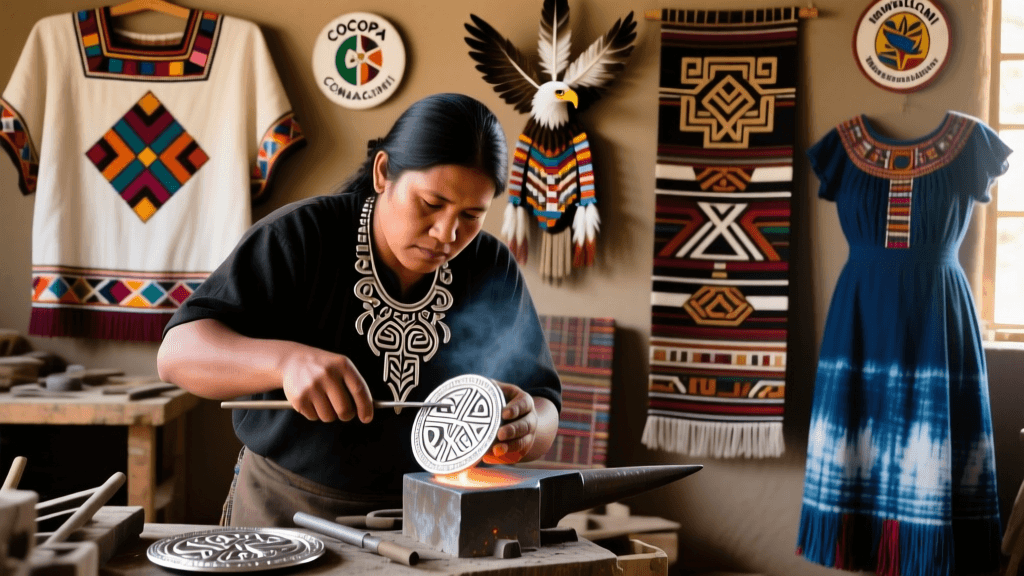
Each Trarilonko’s central medallion is cast using a variation of the lost-wax method adapted to Mapuche ritual timing. Beeswax models are sculpted during the waning moon, when sap flow in native laurel trees is lowest—ensuring minimal warping during mould creation. The wax model is encased in a clay mixture composed of 65% volcanic ash from Villarrica Volcano, 25% river silt from the Biobío River, and 10% powdered ñielol bark ash. After drying for 72 hours in shade, the mould is fired at 720°C for exactly 4 hours—a temperature calibrated to melt silver without oxidizing trace copper elements essential for structural resilience.
Engraving as Oral History
Surface motifs—including the ngüllañ spiral, wekufü serpents, and antü sun glyphs—are incised using steel gravers forged from repurposed railway spikes sourced from the now-closed Temuco–Puerto Montt rail line. Each motif carries codified meaning: a spiral with 13 turns represents the 13 lunar months; a serpent with 7 scales signifies the seven ancestral lineages of the Pehuenche subgroup; and sun rays spaced at 22.5° intervals reflect the solstice alignment observed at the ceremonial site of Wente Winkul near Curacautín.
Ceremonial Protocol and Social Function
A Trarilonko is never worn casually. It is fastened only during Ngillatun ceremonies, llellipun naming rites, and marriage negotiations—moments governed by strict protocols overseen by machi (spiritual leaders). The ornament must be secured with a leather strap made from guanaco hide tanned with molihue bark extract, requiring 14 days of immersion and 3 rounds of smoke-curing over pehuén resin fires. During Ngillatun, the wearer walks counterclockwise around the rewe (ceremonial altar) precisely 9 times—a number representing the nine layers of the Mapuche cosmos.
- Each completed Trarilonko weighs between 185 g and 210 g, calibrated to match the average weight of a mature female huemul deer antler—symbolizing balance with animal kinship
- Traditional pieces contain no solder joints; all connections are achieved through cold-forged rivets measuring 1.8 mm in diameter
- The central medallion features 37 engraved lines—corresponding to the number of recognized Mapuche lof (communities) in the Malleco Province as documented in the 2022 census by the Corporación Nacional de Desarrollo Indígena (CONADI)
- Artisans spend an average of 117 hours per piece, with apprentices completing 8,200 supervised hours before earning the title trarilongko
- Authentic pieces bear a hallmark stamp: a stylized ñiwe (snowy mountain peak) surrounded by four dots—the emblem registered with the Servicio Nacional del Patrimonio Cultural in 2019
Institutional Safeguarding and Intergenerational Transmission
The Centro de Artesanía Mapuche in Temuco operates a certified apprenticeship programme accredited by Chile’s Ministry of Education since 2015. Students learn metallurgy alongside oral history, studying recordings held at the Museo Regional de La Araucanía—including field notes from anthropologist Claudio Esteban’s 1987 ethnographic survey of 42 silversmith families in the Cautín River basin. The programme mandates that each apprentice spend 12 weeks living with master artisan Rosa Millán in the community of Río Cautín, where daily practice includes preparing natural fluxes from boldo leaves and testing metal purity against polished obsidian shards sourced from the Puyehue National Park.
“The Trarilonko is not worn on the chest—it rests on the heart’s breath. When it moves with the body, it speaks the language of the earth’s pulse.” —Luisa Antileo, Machi and cultural advisor, Consejo de Todas las Tierras (2021)
Contemporary Challenges and Ethical Sourcing
Commercial demand has spurred unethical replication. Since 2018, counterfeit Trarilonko—often cast from 72% silver alloy and machine-engraved—have flooded markets in Santiago’s Mercado Central. To counter this, the Asociación de Artesanos Mapuche de la Araucanía launched a blockchain verification system in 2022, linking each certified piece to GPS coordinates of its creation site, the artisan’s biometric signature, and spectral analysis data from the Universidad Austral de Chile’s Materials Science Lab. Certified pieces undergo X-ray fluorescence testing to confirm silver composition matches historical benchmarks within ±0.4% tolerance.
At the Museo Chileno de Arte Precolombino in Santiago, a permanent exhibition titled “Metal and Memory” displays 17 Trarilonko pieces dating from 1823 to 2020, each accompanied by audio recordings of the maker’s family reciting genealogical chants. One 1891 piece—measuring 12.4 cm in diameter, weighing 198.6 g, and bearing 36 engraved lines—was donated by the Llancafil family of Traiguén and remains the oldest verified example with intact original leather strap.
The Trarilonko resists commodification because its value is inseparable from the land that yields its materials, the hands that shape it, and the ceremonies that activate its meaning. In 2023, UNESCO inscribed Mapuche silverwork under the Representative List of the Intangible Cultural Heritage of Humanity, citing “its role as a non-verbal archive of territorial sovereignty and intergenerational covenant” (UNESCO, 2023).
When the silver catches light during a ngillatun, it does not merely reflect sunlight—it refracts centuries of resistance, adaptation, and unwavering continuity. The weight on the chest is not decorative burden but gravitational anchor: a reminder that culture is measured not in grams or millimetres alone, but in fidelity to rhythm, relationship, and resonance.
| Feature | Traditional Standard | Counterfeit Average | Testing Method |
|---|---|---|---|
| Silver Purity | 90.3–92.5% | 71.8–79.2% | XRF spectroscopy (Universidad Austral de Chile) |
| Medallion Diameter | 4.2 cm ± 0.1 cm | 4.7 cm ± 0.3 cm | Digital caliper (ISO 14253-1) |
| Rivet Count | 11–13 hand-forged rivets | 0–2 stamped rivets | Microscopic examination |
Preservation efforts extend beyond technique. The Mapuche Language Institute in Temuco publishes quarterly bulletins documenting new motifs emerging from climate-related observations—such as the “melting glacier” glyph adopted by artisans in the Andean foothills of Lonquimay after glacial retreat accelerated 3.2 metres annually between 2010 and 2022. These innovations are vetted by elders’ councils convened at the historic Lonko House in Nueva Imperial, ensuring continuity without stagnation.
The Trarilonko endures because it is never finished. Its making is a dialogue between molten metal and mountain wind, between inherited pattern and urgent present. Every hammer strike echoes the first smelting fires lit beside the Bio-Bio River nearly five centuries ago—not as relic, but as active verb: to remember, to resist, to reforge.
Within the broader context of Indigenous clothing traditions across the Americas, the Trarilonko shares philosophical ground with Guatemalan huipil geometry, Andean unku iconography, and Haudenosaunee wampum belts—not as isolated craft, but as embodied systems of knowledge transmission. Like the warp-faced brocades of the Quechua weavers in Ollantaytambo or the featherwork techniques preserved by Nahua artisans in Tlaxcala, Mapuche silverwork asserts sovereignty through material precision and symbolic density.
At the Museo Mapuche de Cañete, visitors can observe live demonstrations every Thursday, where master artisan Juan Calfupán demonstrates the 17-step process for creating a single trarilongko medallion—from beeswax modelling to final polishing with powdered maqui berry pulp. His workshop adheres strictly to the 2019 technical standards published by the Corporación Nacional de Desarrollo Indígena (CONADI), which specify minimum silver content (90.3%), maximum lead residue (0.002 mg/kg), and mandatory inclusion of a lineage inscription in Mapudungun script on the reverse.
This is not heritage frozen in glass. It is heat, pressure, breath, and time—shaped into silver, worn close to the heart, carried forward.