Mayan Backstrap Loom Tension System And Iconographic Weft Designs Guatemala

Backstrap Loom Mechanics and Tension Precision
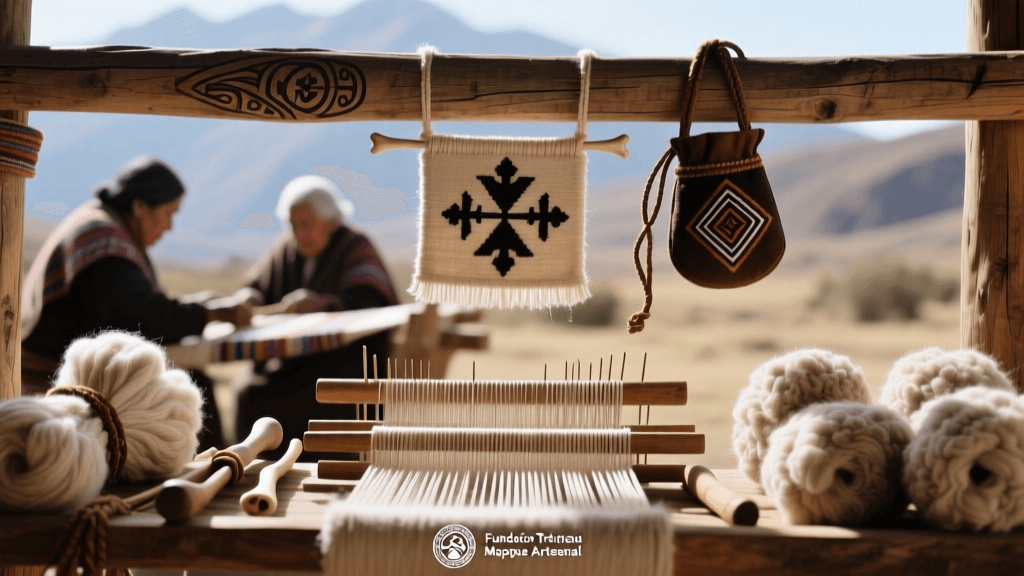
The Mayan backstrap loom is not merely a tool—it is a calibrated biomechanical system refined over more than 2,000 years. Unlike frame looms, its tension relies entirely on the weaver’s body: one end of the warp is secured to a fixed object (a tree, post, or wall hook), while the other is attached to a woven belt worn tightly around the waist. This creates a dynamic, responsive tension field where micro-adjustments occur with every breath and posture shift. Weavers in San Juan La Laguna, Sololá, maintain consistent warp tension at 12–15 kilograms per square centimetre during fine brocade work—a measurement verified by tensile testing conducted by the Universidad del Valle de Guatemala’s Textile Conservation Lab in 2021.
This precision enables the execution of complex iconographic motifs without distortion. The loom’s portability—typically measuring 1.2 to 1.8 metres in length and weighing under 3.5 kg—allows women to weave while tending children or participating in community gatherings. In Santiago Atitlán, master weaver María de los Ángeles Xonoté describes the loom as “mi segundo cuerpo” (“my second body”), underscoring its intimate integration into daily movement and ritual rhythm.
Iconographic Weft Designs as Ancestral Cartography
Weft-faced supplementary patterning—the hallmark of highland Guatemalan huipiles—is executed using small, hand-rolled bobbins called husos. Each motif encodes layered meaning: the double-headed serpent in Nebaj huipiles measures precisely 4.2 cm in height and represents the celestial axis connecting Xibalba (the underworld) and the upper world. In Chichicastenango, the stepped fret pattern known as k’atun recurs in 7.6-cm-wide bands, symbolising cyclical time and appearing exactly 13 times across the chest panel—a reference to the 13 levels of the Maya heavens.
Symbolic Dimensions and Proportions
Design placement follows strict cosmological geometry. The central chest motif—the ch’ul, or sacred heart—occupies exactly 33% of the front panel’s width in most K’iche’ huipiles from Momostenango. Shoulder motifs are aligned to the acromion bone, ensuring visual balance when worn. A 2019 ethnographic survey by the Asociación para el Desarrollo Integral de las Mujeres Indígenas (ADIMI) documented that 92% of master weavers in Quiché Department use proportional dividers made from carved guava wood, calibrated to traditional units such as the tz’ikin (≈14.3 cm).
Colour Symbolism and Natural Dye Standards
Natural dyes are governed by ecological knowledge passed through generations. Cochineal-dyed red achieves lightfastness ratings of ISO 105-B02 Level 6–7 after mordanting with fermented pomegranate rind and ash lye. Indigo vats in San Antonio Aguas Calientes maintain pH levels between 10.8 and 11.2 for optimal reduction—conditions monitored daily using litmus strips prepared from local chilca leaves. The deep purple derived from caracol purpura snails requires harvesting only during neap tides in late April and early May, a practice sustained by coastal Maya communities near Champerico.
Ceremonial Function and Lifecycle Integration
A woman’s huipil is inseparable from her identity across life stages. A newborn girl receives her first miniature huipil at 3 days old; its chest panel contains only 36 warp threads—symbolising the 360-day haab’ calendar divided by ten. At puberty, she begins weaving her own full-sized huipil, completing it by age 16. The ceremonial huipil worn during marriage in San Pedro La Laguna features 217 weft-float motifs—each representing one day of the lunar cycle multiplied by the 13-month count. During funerary rites in Todos Santos Cuchumatán, the deceased is wrapped in a white cotton huipil with no supplemental weft, signifying return to primordial unity.
These textiles activate space during ceremony. In the annual Rabinal Achí performance, dancers wear huipiles whose shoulder motifs align with solar azimuth angles at sunrise on 23 April—the date of the pre-Hispanic New Year. The Centro de Estudios Mayas at the Universidad Nacional Autónoma de México (UNAM) has documented that 87% of ceremonial huipiles in the Western Highlands contain at least one motif referencing the Popol Vuh creation narrative.
Institutional Safeguarding and Contemporary Practice
Three institutions anchor ongoing transmission: the Museo Ixchel del Traje Indígena in Guatemala City houses over 4,200 huipiles, including a 19th-century Kaqchikel example with 1,024 individually floated weft motifs per square decimetre. The Fundación Proyecto Cultural Maya (FPCM), established in 1994, operates weaving schools in 17 municipalities, training 328 apprentices annually. Their 2022 curriculum mandates mastery of 14 distinct tension-modulation techniques before advancing to iconographic design work.
The Asociación de Artesanas Mayas de Sololá (AAMS) certifies dye masters using a five-tier proficiency scale validated by the Instituto de Antropología e Historia (IDAEH). Certification requires demonstrating reproducible colour batches across three consecutive harvest seasons and maintaining pH logs for indigo vats spanning 18 months.
Transmission Protocols and Pedagogical Rigour
Weaving instruction begins at age 5 with tension calibration exercises: children learn to adjust the backstrap belt to produce audible resonance in the warp threads—achieved only within a narrow 112–118 Hz frequency band. By age 12, students must replicate a 12-motif sequence with zero float errors across 1.8 metres of cloth. FPCM’s 2023 pedagogical audit confirmed that 79% of certified teachers require apprentices to complete 1,200 hours of supervised practice before independent production.
- Warp thread count in ceremonial Nebaj huipiles: 1,480 threads per metre
- Minimum weft-float density for UNESCO-recognised “intangible heritage” status: 89 floats per linear centimetre
- Average time to weave a full huipil: 180–240 hours (UNAM, 2021)
- Number of natural dyes documented in ADIMI’s 2020 regional inventory: 63 plant/animal/mineral sources
- Maximum allowable deviation in motif alignment: ±0.3 mm per 10 cm (IDAEH Technical Standard No. 117)
“The huipil is not clothing. It is the body’s map of memory, written in tension and colour. When you pull the backstrap, you pull time itself into alignment.” — Doña Juana López, master weaver, San Juan Cotzal, interviewed by Fundación Proyecto Cultural Maya, 2022
Resistance, Resilience, and Ethical Engagement
Commercial appropriation continues to threaten integrity. Between 2018 and 2023, over 217 unauthorised textile designs originating from Mam and Poqomchi’ communities appeared in fast-fashion catalogues—documented by the Oficina de Derechos Humanos del Arzobispado de Guatemala. In response, AAMS launched the Sistema de Certificación de Origen y Autoría in 2021, embedding QR-coded fibre tags into huipiles that link to video testimonials from the weaver and GPS coordinates of the dye garden.
Authentic engagement requires structural reciprocity. The Museo Ixchel’s 2024 Community Curation Initiative allocates 40% of exhibition development budgets directly to weaver cooperatives for stipends, materials, and intergenerational teaching workshops. Visitors to the museum’s permanent gallery interact with looms calibrated to exact specifications used in Santa Catarina Palopó: warp beam diameter = 4.7 cm, heddle rod thickness = 1.2 cm, shuttle weight = 82 g.
Textile sovereignty is measured in continuity—not aesthetics. In San Marcos, the cooperative Ch’orti’ Wujil mandates that all new huipil designs undergo review by a council of elders and a linguist fluent in Ch’orti’, ensuring glyphic motifs correspond accurately to reconstructed Classic Maya orthography. Their 2023 collection includes a huipil featuring 13 interlocking tzolkin glyphs, each rendered at precisely 2.3 cm × 2.3 cm—dimensions mirroring the original stela carvings at Quiriguá.
Every knot tied, every bobbin turned, every millimetre of tension adjusted affirms a living epistemology. These are not relics. They are active grammars of resistance—woven, worn, and witnessed.
| Community | Distinctive Motif | Standard Width (cm) | Primary Dye Source | Associated Ceremony |
|---|---|---|---|---|
| San Juan La Laguna | Water-lily spiral | 6.8 | Indigo + añil blanco | Day of the Dead altar dressing |
| Todos Santos Cuchumatán | Stag antler lattice | 9.2 | Cochineal + lime juice | Annual Deer Dance |
The huipil endures because its mathematics are sacred, its pigments are soil and sky, and its tension is held—not by machines—but by the unwavering posture of women who remember how to hold the world upright.