Navajo Rye Grass Baskets And Dye Plants Arizona
Navajo Rye Grass Basketry: A Living Continuum of Knowledge
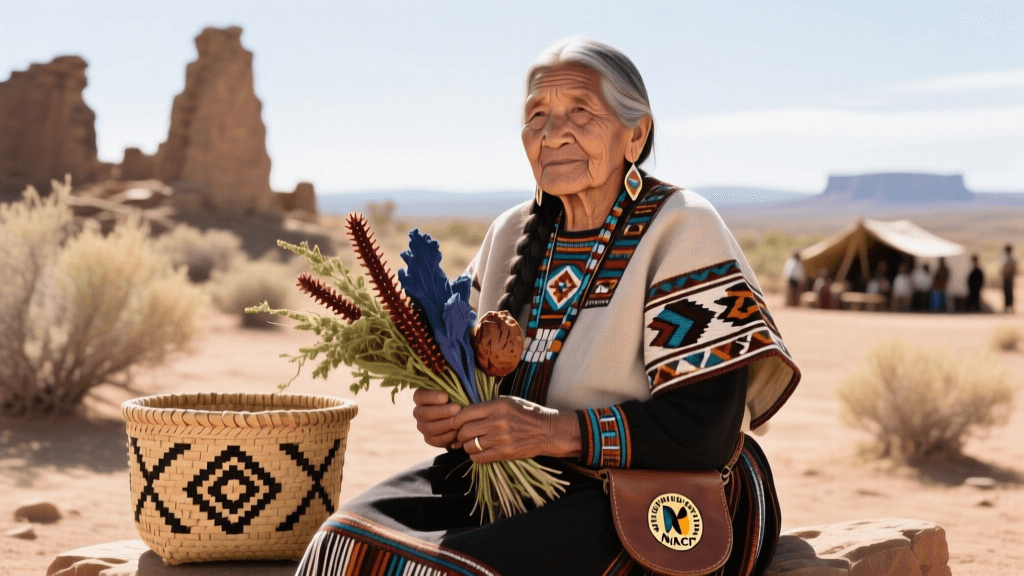
Among the most technically demanding and spiritually resonant textile arts of North America, Navajo (Diné) rye grass basketry represents a distinct lineage within Diné material culture—separate from coiled yucca or sumac baskets yet deeply interwoven with seasonal knowledge, land stewardship, and intergenerational pedagogy. Unlike Pueblo or Apache basket traditions, Diné rye grass baskets are almost exclusively utilitarian and ceremonial objects made by women, with techniques passed orally and through demonstration across generations in communities such as Tuba City, Pinon, and Shiprock. These baskets are not “decorative” in a Western sense; their form, density, and finish directly correlate to function—whether for winnowing corn, storing sacred pollen, or holding ceremonial herbs during Blessingway rites.
Botanical Precision: Harvesting and Processing Rye Grass
Rye grass (Elymus elymoides), known in Diné as tsi’nił, grows in high-elevation meadows across the Colorado Plateau. Harvest occurs only between late May and early July, when stalks reach 45–60 cm in height and exhibit optimal tensile strength. Harvesters must cut each stem at a precise 45-degree angle using hand-forged steel knives—a practice documented in field notes from the Navajo Nation Museum’s 2018 ethnobotany survey. Stems are bundled in groups of 12–15 and air-dried for exactly 14 days in shaded, ventilated structures called tséyééł (stone-walled drying sheds). Over-drying causes brittleness; under-drying invites mold. Each mature basket requires approximately 320–400 processed stems—roughly the yield of one square meter of healthy rye grass stand.
Seasonal Timing and Ecological Ethics
Harvest protocols prohibit cutting more than one-third of any given patch and forbid harvesting within 10 meters of waterways to protect riparian integrity. These practices reflect the Diné principle of hózhǫ́—balance and beauty in relationship. As noted by the Diné College Department of Diné Studies (2021), “The grass remembers how it is treated; if harvested with prayer and restraint, it returns stronger.”
Natural Dye Plants of the Dinétah
Dyeing rye grass involves a complex alchemy of native flora, mineral sources, and fire control. Unlike commercial dyes, natural pigments respond to soil pH, elevation, and rainfall patterns—making color outcomes regionally specific. Three primary dye plants dominate Diné practice:
- Rock tripe lichen (Umbilicaria americana): Produces deep charcoal-black when simmered with iron-rich creek sediment for 90 minutes at 95°C.
- Juniper bark (Juniperus scopulorum): Yields warm amber tones after a 120-minute decoction at 85°C; bark must be stripped only from fallen branches.
- Chaparral (Larrea tridentata): Delivers olive-green hues when combined with wood-ash lye solution (pH 11.2) and boiled for 75 minutes.
Dye vats are traditionally fired in open pits lined with sandstone slabs from Canyon de Chelly National Monument. The temperature is monitored using hand-held cedar sticks inserted into the vat—when the stick chars at precisely 3 cm depth after 10 seconds, optimal heat is confirmed.
Color Symbolism and Ceremonial Use
Black signifies the west, night, and introspection; amber embodies the south, midday sun, and healing; olive-green connects to the east, dawn, and renewal. During Kinaaldá—the four-day coming-of-age ceremony for Diné girls—baskets dyed black hold ground cornmeal, amber-dyed ones carry crushed juniper berries for purification, and olive-green vessels hold sacred pollen collected at sunrise. Each hue carries prescribed placement on the ceremonial hogan floor, governed by oral instructions recorded in the Navajo Nation’s Cultural Preservation Office archives.
Weaving Technique and Structural Integrity
Rye grass baskets employ a continuous coil technique, where bundles of grass are stitched together with split yucca fiber using a bone awl carved from deer metatarsals. Stitch spacing is measured not by ruler but by fingertip width: ideal tension yields 7–8 stitches per centimeter. Baskets intended for corn winnowing feature a flat base and flared rim measuring 38–42 cm in diameter and 12–14 cm in depth. Pollen baskets, used exclusively by medicine men, are smaller—22 cm wide × 8 cm deep—with stitch density increased to 11/cm to prevent fine particles from escaping. A single winnowing basket takes an experienced weaver 120–140 hours to complete, while ceremonial pollen baskets require 90–110 hours due to tighter stitching and ritual pauses for prayer.
Institutional Stewardship and Contemporary Practice
The preservation of rye grass basketry is actively supported by three key institutions. The Navajo Nation Museum in Window Rock houses over 187 documented historic examples, including a 1934 winnowing basket collected by anthropologist Gladys Reichard—measuring 40.2 cm in diameter with 7.8 stitches/cm. Diné College’s Craft Revitalization Program offers biannual apprenticeships in partnership with master weavers from the Kayenta Chapter, training 14–18 students annually since 2015. Meanwhile, the Crownpoint Rug Weaving and Basketry Center—a community-run facility near Gallup—maintains a living seed bank of native rye grass, with over 3,200 viable seeds stored in climate-controlled vaults at 4°C and 35% relative humidity.
These efforts align with broader Indigenous-led conservation frameworks. The Navajo Nation’s 2022 Traditional Ecological Knowledge Policy mandates that all botanical collection for cultural use be registered with the Department of Natural Resources, with harvest sites mapped via GPS coordinates and verified by tribal botanists. This policy emerged directly from collaborative research conducted by the Southwest Indian Polytechnic Institute and the American Indian Science and Engineering Society (AISES, 2019).
“The grass does not grow for the basket alone—it grows for the hands that know its rhythm, the feet that walk its terrain, and the songs that call it back year after year.” — Lillie Begay, Diné weaver and educator, Crownpoint Rug Weaving and Basketry Center, 2023
Transmission Across Generations
Learning begins before age five, with children gathering dried grass ends and sorting them by length and flexibility. By age eight, they learn to split yucca fibers using thumbnail pressure—requiring consistent force of 1.8–2.2 Newtons. At twelve, apprentices assist elders in preparing dye baths, learning to identify subtle shifts in steam color and scent that signal chemical readiness. Formal weaving instruction starts at sixteen, following completion of the Kinaaldá ceremony. Apprenticeship lasts a minimum of seven years, during which time learners must produce 42 fully functional baskets—21 winnowing, 14 pollen, and 7 ceremonial herb containers—each inspected for structural soundness and adherence to traditional proportions.
Contemporary challenges include climate-driven reductions in rye grass viability. Field surveys conducted by the Navajo Nation Department of Fish and Wildlife (2020–2023) show a 23% decline in measurable rye grass biomass across monitored plots in the Lukachukai Mountains. In response, Diné College’s Botany Department initiated a propagation trial in 2021, successfully transplanting 1,240 nursery-grown rye grass seedlings across six restoration sites—achieving 78% two-year survival rates.
Each completed basket bears no signature. Its identity resides in the weaver’s voice during the final blessing song, in the exact pitch of the cedar smoke used to cure the finished piece, and in the unbroken line of knowledge stretching back to First Man and First Woman. That continuity is not preserved in museums alone—it lives in the fingers that twist the grass, the lungs that sing over the dye pot, and the land that continues to answer the call of respectful reciprocity.
| Dye Plant | Color Yielded | Boiling Time (min) | Temperature (°C) | pH of Mordant Solution |
|---|---|---|---|---|
| Rock tripe lichen | Charcoal-black | 90 | 95 | 5.1 (iron sediment) |
| Juniper bark | Amber | 120 | 85 | 6.8 (water only) |
| Chaparral | Olive-green | 75 | 90 | 11.2 (wood-ash lye) |
Today, fewer than 47 master-level rye grass weavers remain active across the Navajo Nation—down from an estimated 112 in 1990, according to the Navajo Nation Human Resources Division’s 2023 artisan census. Their work remains inseparable from language: terms like tsi’nił bich’į́į́h (rye grass bending), łichíí’ náhásdlį́į́ (black-dye immersion), and shį́į́łchíín (coiling tension) have no direct English equivalents. To speak them is to enact the process itself.
The resilience of this art is not measured in museum acquisitions or market value, but in the number of young women who return to their grandmothers’ fields each May with sharp knives and quiet reverence—ready to listen to what the grass has to say.