Decoding Qing Dynasty Court Attire: Rank Badges & Colors
Introduction to Qing Court Sartorial Hierarchy
The Qing Dynasty (1644–1912) represents one of the most highly regulated and visually complex periods in the history of Chinese textiles. Governed by the Manchu elite, the empire established a rigid sartorial hierarchy that dictated every thread, color, and motif worn by the imperial family, civil servants, and military generals. Understanding Qing court attire requires more than an appreciation for exquisite craftsmanship; it demands a fluency in the visual language of power, rank, and cosmic symbolism. According to the Metropolitan Museum of Art, the Qing court's dress codes were meticulously documented in the Huangchao Liqi Tushi (Illustrated Precedents for the Ritual Paraphernalia of the Dynasty), ensuring that clothing served as an immediate, legible map of the empire's social strata.
The Language of Color in Imperial China
In imperial China, color was never merely an aesthetic choice; it was a deeply philosophical and political tool rooted in the Five Elements theory (Wuxing) and cosmic balance. During the Qing Dynasty, the emperor held the exclusive right to wear minghuang (bright yellow), a color symbolizing the center of the universe and the earth element. The heir apparent wore xinghuang (apricot yellow), while imperial princes and high-ranking nobles were permitted jinhuang (golden yellow). Lower-ranking officials and commoners were strictly forbidden from using these shades, facing severe penalties for sartorial transgressions.
Blue, representing the heavens and the east, was widely used for official court robes, particularly for the winter solstice ceremonies at the Temple of Heaven. Red, symbolizing fire, the south, and prosperity, was reserved for joyous occasions and specific court functions. The strict enforcement of these color codes ensured that an individual's proximity to the throne was instantly recognizable from a distance, maintaining order in a court that could host thousands of attendees during major festivals.
Buzi (Rank Badges): Decoding the Animal Kingdom
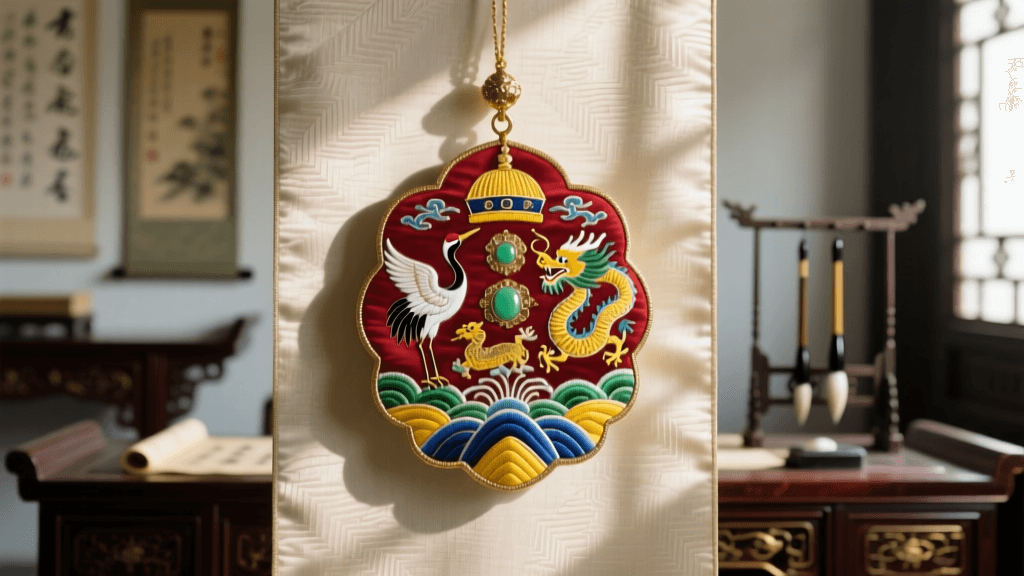
At the heart of the Qing official dress code was the buzi, or rank badge. These intricately embroidered squares were affixed to the front and back of the bufu (surcoat) worn over the main robe. While the preceding Ming Dynasty introduced rank badges, the Qing refined their iconography, strictly dividing motifs into birds for civil officials (representing literary elegance and virtue) and beasts for military officials (representing courage and martial prowess). The British Museum notes that these badges were not merely decorative; they were legally binding identifiers of an official's exact grade within the nine-tiered bureaucracy.
| Rank | Civil Official (Bird) | Military Official (Beast) |
|---|---|---|
| 1st | Red-crowned Crane | Qilin (Mythical Chimera) |
| 2nd | Golden Pheasant | Lion |
| 3rd | Peacock | Leopard |
| 4th | Wild Goose | Tiger |
| 5th | Silver Pheasant | Bear |
| 6th | Egret | Panther |
| 7th | Mandarin Duck | Rhinoceros |
| 8th | Quail | Rhinoceros (or Seal) |
| 9th | Paradise Flycatcher | Sea Horse |
The first-rank civil official's red-crowned crane symbolized longevity and high status, while the military's qilin represented benevolence and supreme martial authority. Interestingly, the empress and consorts also wore rank badges, but theirs featured mythical birds like the fenghuang (phoenix) or the golden pheasant, denoting their status within the inner court rather than the civil bureaucracy.
The Twelve Symbols of Sovereignty
Beyond the rank badges, the jifu (dragon robe) worn by the emperor and high nobility featured the Twelve Symbols of Sovereignty. These ancient motifs, revived and codified by the Qianlong Emperor, included the sun, moon, and stars (representing the heavens), the mountain (representing the earth), and the dragon (representing adaptability and imperial power). The placement of these symbols was strictly regulated; for instance, the sun and moon were always embroidered on the shoulders, symbolizing the emperor's role as the bearer of cosmic light, while the axe head symbolized the power of life and death over his subjects.
Practical Guide for Collectors and Enthusiasts
For modern collectors, antique dealers, and costume historians, acquiring and authenticating Qing Dynasty textiles requires specific, actionable knowledge. The market for buzi and dragon robes is robust, but it is fraught with late 19th-century theatrical reproductions and modern fakes.
Measurements and Authentication
Authentic Qing civil and military rank badges typically measure between 11 and 11.5 inches (28 to 29 cm) square. Badges meant for women (wives of officials) were often slightly smaller or designed in mirrored pairs to accommodate the front-opening surcoats. When examining a piece, measure the embroidered area, not the frayed backing. Look for traditional materials: high-ranking badges utilized kesi (silk tapestry weave) or intricate Peking knot embroidery. Gold thread was created by wrapping flattened gold leaf around a silk core. If the gold thread appears overly bright, uniform, or metallic under a jeweler's loupe, it is likely a post-1920s synthetic replacement. Authentic gold couching should show slight tarnishing and irregularities in the wrapping. Furthermore, top-ranking officials often incorporated peacock feather thread and seed pearls into their badges to display wealth and imperial favor.
Market Costs and Auction Timing
The cost of acquiring authentic Qing textiles varies wildly based on condition, rank, and technique. A fragmented, low-ranking (8th or 9th) military badge might fetch $300 to $600 at auction. Conversely, a pristine, first-rank civil crane badge executed in kesi with peacock feather thread can command $15,000 to $30,000. Complete bufu surcoats with original badges routinely sell between $5,000 and $25,000. For the best acquisition opportunities, time your purchases around the major Asian Art auction weeks in New York, London, and Hong Kong, which typically occur in March and September. Houses like Sotheby's and Christie's release their catalogs a month prior, allowing ample time for provenance research and condition report requests.
Preservation and Storage
Once acquired, preservation is paramount. Qing silk is highly susceptible to light damage and desiccation. Store textiles flat in acid-free, archival-quality tissue paper within a climate-controlled environment (ideally 65°F and 50% relative humidity). Never hang a heavy, antique surcoat on a standard hanger, as the weight of the gold embroidery will tear the fragile silk warp threads over time. The Smithsonian National Museum of Asian Art recommends consulting specialized textile conservators for any mounting or framing, ensuring that no adhesives or acidic mats come into contact with the fibers. To combat pests like carpet beetles and silverfish, utilize freezing techniques for quarantine rather than chemical pesticides, which can permanently degrade historic dyes and weaken silk proteins.
Conclusion
The sartorial codes of the Qing Dynasty offer a fascinating window into a society where power, philosophy, and aesthetics were inextricably woven together. By understanding the strict color hierarchies and the intricate animal symbolism of the buzi, collectors and historians can look past the shimmering silk and gold thread to read the true story of imperial China's social fabric. Whether you are bidding at an international auction house or studying museum archives, recognizing these codes transforms a beautiful garment into a legible historical document.