Decoding Qing Dynasty Court Robes: Rank Badges & Color Codes
Introduction to Qing Dynasty Sumptuary Laws
The Qing Dynasty (1644–1911) represents one of the most highly regulated periods of sartorial history in Asia. To maintain strict social order and reinforce the divine right of the Manchu rulers, the imperial court implemented exhaustive sumptuary laws. These laws dictated every aspect of an official's wardrobe, from the cut of the silk robe to the precise number of claws on an embroidered dragon. For modern historians, textile collectors, and traditional garment enthusiasts, understanding these visual codes is essential. Clothing was not merely decorative; it was a wearable resume and a strict indicator of one's exact proximity to the Emperor. As noted by The Metropolitan Museum of Art, the Qing court maintained a rigid sartorial hierarchy that left absolutely no room for ambiguity regarding an individual's civil or military rank.
The Imperial Color Palette: Who Could Wear What?
Color was the first and most immediate indicator of status in the Qing court. The imperial dye houses strictly controlled the production of specific hues, and wearing a color above one's station was considered an act of treason, punishable by severe penalties.
- Ming Huang (Bright Yellow): Reserved exclusively for the Emperor, the Empress, and the Empress Dowager. This vibrant, sun-like hue symbolized the center of the universe and the ultimate earthly authority.
- Xing Huang (Apricot Yellow): Designated solely for the Crown Prince. It is slightly warmer and more orange-toned than Bright Yellow.
- Jin Huang (Golden Yellow): Permitted for Imperial Princes of the first degree and their consorts.
- Shi Qing (Stone Blue) and Dark Blue: The standard colors for the vast majority of court officials, ranging from the highest ministers to the lowest-ranking magistrates.
Actionable Advice for Collectors: When authenticating a Qing dynasty robe, examine the dye composition. Synthetic aniline dyes were introduced to China via European trade routes around the 1860s. If you are evaluating a robe claimed to be from the Kangxi period (1654–1722) but it features harsh, vibrant magentas or synthetic purples, it is either a later alteration, a theatrical reproduction, or an outright forgery. Authentic early-to-mid Qing pieces rely on natural plant and mineral dyes, such as safflower for reds and indigo for blues, which age with a distinct, mellow patina.
Hat Finials (Dingzi): The Jewel of Authority
Before even looking at the robes, a Qing official's rank was broadcast from the top of his head. The court hat was topped with a finial knob (dingzi), crafted from specific gemstones or metals corresponding to the nine ranks of the imperial bureaucracy.
- 1st Rank: Red Coral
- 2nd Rank: Red Coral (with a slightly different carving or base)
- 3rd Rank: Sapphire or Blue Glass
- 4th Rank: Lapis Lazuli or Dark Blue Glass
- 5th Rank: Crystal or Clear Glass
- 6th Rank: Opaque White Glass or Shell
According to research from the Smithsonian National Museum of Asian Art, the transition from Ming to Qing headwear was a deliberate political move by the Manchu rulers to enforce visual conformity among the conquered Han Chinese populace, making the hat finial a critical piece of political symbolism.
Mandarin Squares (Buzi): The Ultimate Rank Indicator
The most famous and highly collected elements of Qing official dress are the Buzi, commonly known in the West as Mandarin Squares. These intricately embroidered badges were worn on the front and back of the outer surcoat (bufu). Civil officials wore birds to symbolize literary elegance and administrative grace, while military officials wore beasts to represent courage, strength, and martial prowess.
Below is the definitive chart of the nine ranks for both civil and military officials during the Qing Dynasty:
| Rank | Civil Official (Bird Motif) | Military Official (Beast Motif) |
|---|---|---|
| 1st | Crane | Qilin (Mythical Chimera) |
| 2nd | Golden Pheasant | Lion |
| 3rd | Peacock | Leopard |
| 4th | Wild Goose | Tiger |
| 5th | Silver Pheasant | Bear |
| 6th | Egret | Panther |
| 7th | Mandarin Duck | Rhinoceros |
| 8th | Quail | Rhinoceros |
| 9th | Paradise Flycatcher | Sea Horse (Mythical Water Horse) |
Actionable Advice for Costumers and Replicas: If you are commissioning or creating a historical replica of a Qing surcoat, accuracy in the Buzi dimensions is paramount. Authentic Qing dynasty badges typically measure between 11 and 12 inches (28–30 cm) square. Furthermore, the front badge was almost always split down the middle to accommodate the center opening of the coat, while the back badge was woven or embroidered as a single, continuous square. Modern theatrical adaptations frequently ignore this split-front rule, instantly marking a garment as historically inaccurate.
Dragon Symbolism: The Five-Clawed Long vs. The Four-Clawed Mang
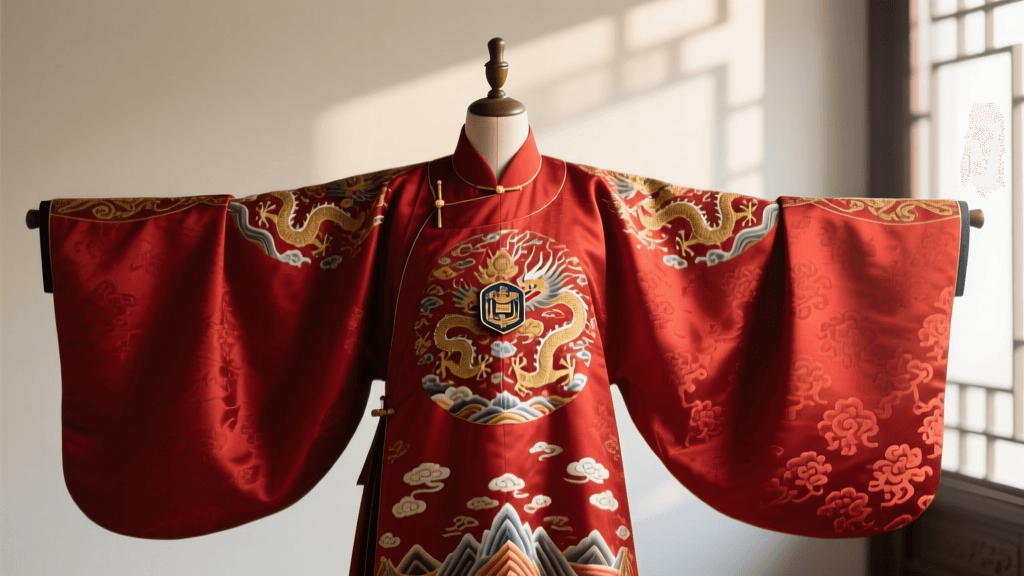
The dragon is the paramount symbol of Chinese imperial power, but not all dragons are created equal. The Emperor claimed exclusive rights to the Long, a dragon depicted with exactly five claws on each foot. Imperial princes and high-ranking nobles were permitted to wear the Mang, a four-clawed dragon that is visually similar but legally distinct.
The Victoria and Albert Museum houses extensive examples of these textiles, highlighting the intricate kesi (silk tapestry) and couching techniques used to render the metallic threads of the dragon scales. The number of dragons on a robe also mattered. The Emperor's ceremonial chaofu featured nine dragons (representing the supreme yang number), strategically placed so that no matter the angle of approach, an observer would always see five dragons—symbolizing the Emperor's central command over the four corners of the earth.
A Practical Guide for Textile Collectors
Collecting Qing dynasty court textiles is a rewarding but complex endeavor. The market is flooded with late-19th-century theatrical reproductions and modern tourist-trade copies. Here is how to navigate the market with actionable precision:
1. Examine the Metallic Threads
Authentic Qing robes utilized real gold and silver. Artisans flattened gold wire and wrapped it around a silk or cotton core thread, a technique known as couching. Over a century, genuine silver threads will oxidize and turn a dull, dark grey or black. Modern replicas use synthetic metallic yarns (like Lurex) or plastic-coated foils that remain unnaturally bright or flake off in tiny, geometric plastic shards.
2. Assess the Silk Degradation
Weighted silk, a practice that became common in the late 19th and early 20th centuries, involves treating silk with metallic salts to make it feel heavier and drape better. Unfortunately, these salts cause the silk to become highly acidic and brittle over time. If a late-Qing robe shatters or cracks along the fold lines when gently handled, it is likely suffering from silk weighting degradation. Store these pieces flat, interleaved with acid-free tissue paper, and never hang them, as the weight of the garment will tear the weakened fibers.
3. Understand Market Valuations
Valuations vary wildly based on rank, condition, and technique. A standard 9th-rank military badge (Sea Horse) in fair condition might fetch between $300 and $600 at auction. Conversely, a pristine, 1st-rank civil badge (Crane) featuring complex kesi weaving and genuine peacock feather thread accents can easily command $5,000 to $15,000 or more. Full court robes (jifu or chaofu) belonging to high-ranking officials, complete with verified provenance, regularly exceed $20,000 at major international auction houses.
Conclusion
The garments of the Qing Dynasty are masterclasses in visual communication. Through strict color codes, precise animal motifs, and meticulous claw counts, the empire wove its bureaucratic hierarchy directly into the fabric of its society. For today's collectors, historians, and traditional garment makers, mastering these codes is not just an academic exercise—it is the key to preserving and accurately interpreting one of Asia's most magnificent sartorial legacies.