Preserving China's Intangible Textile Heritage: Yunjin and Su Xiu
The Living Threads of History: China's Intangible Textile Heritage
When we discuss traditional Chinese garments, such as the elegantly flowing Hanfu or the structured silhouettes of Ming Dynasty robes, the conversation often centers on cut, drape, and historical accuracy. However, the true soul of these garments lies in the textiles themselves. China's intangible cultural heritage encompasses centuries-old crafting techniques that transform raw silk into masterpieces of wearable art. As fast fashion and mechanized looms dominate the modern market, the artisans preserving these ancient methods are fighting to keep their heritage alive.
For collectors, historians, and enthusiasts of Asian traditions, understanding the distinction between mass-produced imitations and genuine intangible heritage crafts is essential. This guide delves into two of China's most prestigious textile arts: Nanjing Yunjin (Cloud Brocade) and Suzhou Embroidery (Su Xiu), offering actionable advice on how to identify, evaluate, and ethically source these extraordinary textiles.
Nanjing Yunjin: The Pinnacle of Imperial Silk Weaving
Originating in Nanjing over 1,600 years ago, Yunjin (meaning 'cloud brocade') earned its name due to its vibrant, cloud-like patterns and luxurious sheen. During the Ming and Qing dynasties, Yunjin was strictly reserved for imperial use, most notably for the weaving of dragon robes. In 2009, the UNESCO Representative List of the Intangible Cultural Heritage of Humanity recognized the Nanjing Yunjin brocade weaving technique, cementing its status as a global cultural treasure.
The Artisan's Loom and Technique
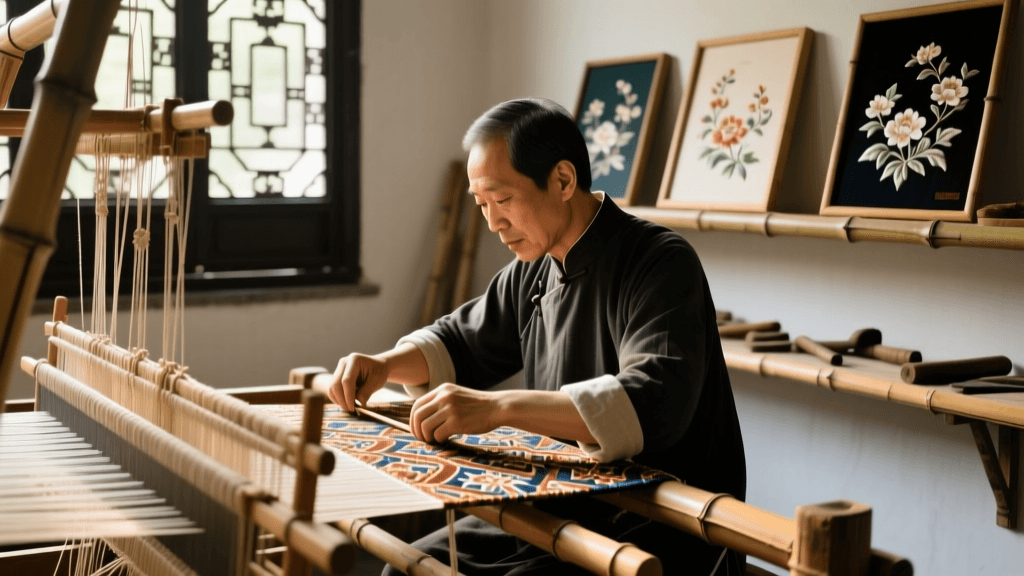
Authentic Yunjin cannot be replicated by modern machines. It requires a massive traditional wooden drawloom that measures an imposing 5.6 meters in length and 4 meters in height. The weaving process demands the synchronized effort of two master artisans: the 'puller' who sits atop the loom managing the complex warp threads, and the 'weaver' who sits below, passing the shuttles and beating the weft into place.
What sets Yunjin apart is its material composition. Artisans weave not only dyed silk but also threads wrapped in real gold leaf, silver, and even iridescent peacock feather yarns. The traditional technique of 'digging the warp and weaving the weft' allows for complex, multi-colored patterns that are seamlessly integrated into the fabric without carrying loose threads on the back.
Actionable Guide: Identifying and Sourcing Authentic Yunjin
If you are looking to acquire genuine Yunjin for a Hanfu collection, museum archive, or private display, you must know what to look for:
- Examine the Reverse Side: Hand-woven Yunjin using the traditional technique will have a relatively clean back, with colors changing precisely where the pattern dictates. Machine-made brocades often carry long, continuous 'float' threads across the back of the fabric.
- Test the Metallic Threads: Authentic Yunjin uses genuine gold foil wrapped around a silk or cotton core. It will not tarnish or oxidize like modern metallic plastics or synthetic Lurex threads. The gold should have a soft, deep luster rather than a harsh, reflective glare.
- Assess the Price and Weight: Genuine Yunjin is incredibly dense and heavy. A hand-woven silk scarf (approximately 170cm x 20cm) crafted by a certified artisan typically ranges from $800 to $2,500 USD. Larger panels or fabric lengths for a full Hanfu skirt can easily exceed $10,000 USD. If a vendor offers 'Yunjin' for under $100, it is undoubtedly machine-made jacquard.
Suzhou Embroidery (Su Xiu): Painting with Silk Threads
While Yunjin represents the zenith of weaving, Su Xiu represents the apex of needlework. Originating in the Suzhou region over 2,000 years ago, it is one of the four major styles of Chinese embroidery. As detailed in the Metropolitan Museum of Art's Heilbrunn Timeline of Art History regarding Silk in China, the region's long history of sericulture provided the perfect environment for embroidery to evolve from simple garment decoration to high fine art.
The Double-Sided Embroidery Technique
The most breathtaking innovation of Su Xiu is 'Shuangmian Xiu' (double-sided embroidery). Master artisans create pieces where both the front and back display perfect, identical images—sometimes even featuring different colors or entirely different subjects on each side (e.g., a tiger on the front, a leopard on the back). This requires the weaver to hide every single knot and thread end within the microscopic fibers of the silk itself.
The secret lies in thread splitting. A standard silk thread is composed of multiple filaments. A Su Xiu master will split a single thread into 2, 4, 8, 16, 32, or even 64 individual strands. The resulting filament is thinner than a human hair (under 0.05mm), allowing for imperceptible color gradients and photorealistic textures.
Actionable Guide: Evaluating Su Xiu Craftsmanship
When commissioning or purchasing Su Xiu pieces, whether as standalone art or as embellishments for formal Hanfu collars and cuffs, consider the following metrics:
- Stitch Density and Direction: Authentic Su Xiu follows the natural contours of the subject matter. The stitches should flow like brushstrokes in a traditional ink painting. Look for 'San Tao' (scattered套) stitching, where colors blend seamlessly without harsh lines.
- The 'Light Test': Hold the embroidery up to a light source. High-quality Su Xiu uses pure mulberry silk, which possesses a natural, prismatic sheen. Synthetic threads will look flat or overly glossy.
- Pricing Tiers: Small, single-sided embroidered patches (10cm x 10cm) made by apprentices may cost $150 to $400 USD. A medium-sized, double-sided screen created by a provincial-level master artisan will range from $15,000 to $50,000+ USD, reflecting the thousands of hours of labor involved.
Comparison Chart: Yunjin vs. Su Xiu
To help collectors and traditional garment makers choose the right textile for their specific needs, here is a structured comparison of these two intangible heritage crafts.
| Feature | Nanjing Yunjin (Cloud Brocade) | Suzhou Embroidery (Su Xiu) |
|---|---|---|
| Primary Technique | Drawloom weaving (warp and weft) | Needlework on pre-woven silk base |
| Key Materials | Silk, gold leaf, peacock feathers | Mulberry silk threads, fine needles |
| Production Time | 5-6 cm per day on the drawloom | Months to years per square foot |
| Best Garment Use | Outer robes, skirts, structural sashes | Collars, cuffs, standalone art panels |
| Durability | Highly durable, thick, and heavy | Delicate, requires careful handling |
| Entry Price (Authentic) | ~$800 USD (small accessories) | ~$150 USD (small single-sided patches) |
Supporting the Artisans: Ethical Sourcing and Preservation
The survival of these intangible heritage crafts relies heavily on ethical consumerism. The Victoria and Albert Museum's extensive Asian textile archives showcase the historical brilliance of these crafts, but keeping them alive today requires active financial support for the artisans who dedicate their lives to mastering them.
When sourcing these textiles, always look for official Intangible Cultural Heritage (ICH) certification tags issued by the Chinese Ministry of Culture and Tourism. Purchasing directly from recognized artisan cooperatives in Nanjing or Suzhou, or from verified galleries that transparently name the master weaver or embroiderer, ensures that your investment supports the continuation of the craft rather than mass-market exploitation.
Furthermore, proper care is vital. Yunjin should be stored flat or rolled on acid-free tubes to prevent the metallic threads from creasing and cracking. Su Xiu must be kept away from direct sunlight to prevent the delicate, split silk fibers from degrading. By understanding the profound technical skill and historical weight behind these textiles, collectors and Hanfu enthusiasts can play a direct role in preserving China's most exquisite sartorial traditions for future generations.