Decoding Hanfu Fashion and Textiles in Chinese Scroll Art
The Intersection of Ink, Silk, and Sartorial History
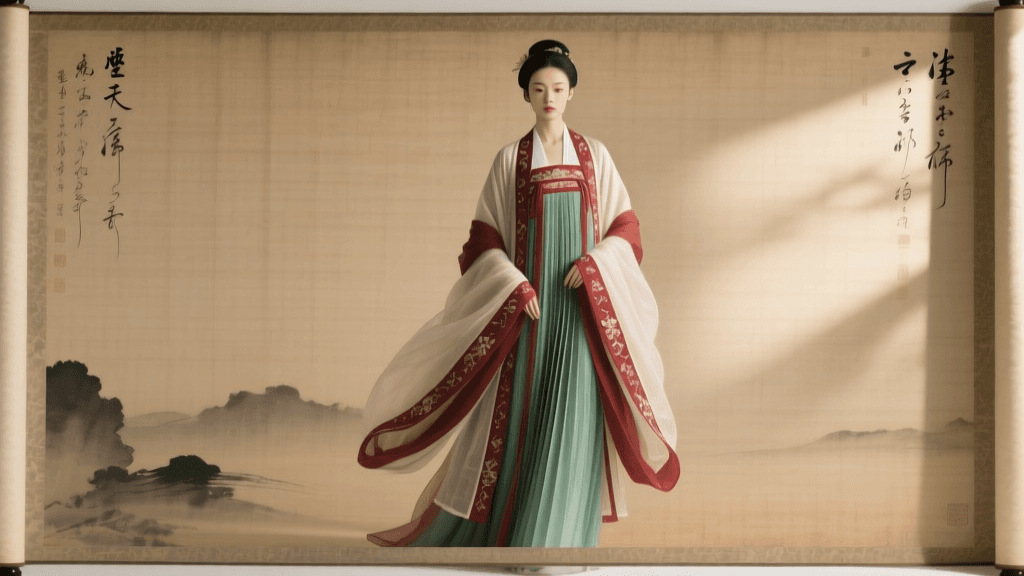
Chinese scroll paintings are not merely masterpieces of ink and pigment; they are meticulous historical archives of sartorial evolution. For modern hanfu enthusiasts, art historians, and textile artisans, handscrolls from the Tang, Song, and Ming dynasties offer an unparalleled blueprint for garment reconstruction. Unlike Western portraiture, which often idealized or altered clothing to fit contemporary aesthetic whims, traditional Chinese court painters were tasked with documenting the precise rituals, hierarchies, and material realities of their subjects. By studying the brushwork used to depict the drape of a sleeve or the stiffness of a collar, modern makers can reverse-engineer the exact fabric weights, weaving techniques, and structural layering of historical Asian traditions.
According to The Metropolitan Museum of Art's Heilbrunn Timeline of Art History, the Tang dynasty (618–907 CE) was a period of unprecedented cosmopolitan exchange, heavily reflected in the textiles and silhouettes captured in surviving artworks. Translating these 2D visual records into 3D wearable garments requires a deep understanding of textile physics, historical botany, and traditional tailoring geometry.
Key Scroll Masterpieces as Fashion Archives
Court Ladies Adorning Their Hair with Flowers
Attributed to the Tang dynasty painter Zhou Fang, this iconic handscroll is a masterclass in depicting the qixiong ruqun (chest-high skirt) and the translucent daoxiu (large-sleeved) robes. The artist's use of delicate, sweeping lines to render the outer gauze robes reveals a fabric that is incredibly lightweight, sheer, and fluid. Conversely, the underlayers and the high-waisted skirts are painted with thicker, more deliberate strokes, indicating a heavier, structured silk that holds its pleats.
Night Revels of Han Xizai
Created by Gu Hongzhong during the Five Dynasties period, this monumental scroll provides a candid look into the domestic life of the elite. The garments depicted here transition from formal court wear to relaxed, private lounging attire. The visual evidence highlights the layering of the ru (upper garment) and the intricate knotting of sashes. Researchers at The Palace Museum in Beijing frequently utilize such scrolls to study the precise placement of motifs and the structural integrity of historical collars and lapels.
Translating Brushstrokes to Fabric Weights: A Maker's Guide
One of the most common mistakes modern hanfu makers and wearers face is choosing the incorrect fabric weight, resulting in a garment that lacks the historical silhouette seen in scroll art. Silk weight is measured in momme (mm), where a higher number indicates a heavier, denser weave. By analyzing the way fabric interacts with the body and gravity in traditional paintings, we can deduce the exact momme required for authentic reproduction.
When a scroll depicts a sleeve that billows outward and holds a rigid, architectural shape, the artist is illustrating a heavy silk taffeta, damask, or brocade. When the fabric clings to the shoulders and cascades in liquid-like ripples, it represents silk chiffon, crepe de chine, or raw silk gauze. Below is an actionable guide to matching visual clues in scroll art with modern fabric equivalents.
| Dynasty / Style | Visual Clue in Scroll Art | Historical Fabric Type | Modern Equivalent & Weight | Best Use Case in Hanfu |
|---|---|---|---|---|
| Tang Court | Stiff, wide pleats; structured bodices | Silk Brocade / Heavy Taffeta | Silk Taffeta or Dupioni (19–30 momme) | Outer qixiong qun (skirts) and formal jackets |
| Tang Court | Sheer, floating sleeves; visible underlayers | Silk Gauze / Luo | Silk Chiffon or Organza (8–12 momme) | Daoxiu (outer sheer robes) and shawls |
| Song Literati | Soft, narrow folds; clinging drape | Silk Crepe / Thin Damask | Crepe de Chine or Charmeuse (16–19 momme) | Beizi (outer coats) and inner ru |
| Ming Official | Heavy, sweeping hems; opaque volume | Wool / Heavy Silk Blend | Wool Crepe or Heavy Linen (GSM 200+) | Winter aoqun and formal court robes |
Color Symbolism and Botanical Dyes in Pigment
The vibrant pigments used in Chinese scroll paintings—such as cinnabar for reds, malachite for greens, and azurite for blues—were derived from the same mineral and botanical sources used to dye historical textiles. To achieve true historical accuracy, modern enthusiasts should look beyond synthetic chemical dyes and seek out fabrics treated with traditional botanical dyes.
- Cinnabar Red (Zhu Sha): In paintings, this vibrant, slightly orange-leaning red denotes authority and joy. Modern makers can replicate this using madder root or safflower dyes, which yield a rich, colorfast red that ages beautifully.
- Indigo Blue (Dian Qing): The deep, layered blues seen in the robes of scholars in Ming dynasty scrolls are achieved through repeated dipping in fermented indigo vats. Look for artisans who use traditional resist-dyeing techniques to achieve the subtle variations in hue seen in ink washes.
- Pagoda Tree Yellow (Huai Huang): Used extensively in Song dynasty paintings to depict the understated elegance of literati women, this muted, earthy yellow is derived from the buds of the Japanese pagoda tree.
Sourcing these fabrics requires connecting with specialized intangible heritage artisans. Platforms and exhibitions documented by the Smithsonian National Museum of Asian Art often highlight the intersection of historical pigments and textile dyes, providing a network of verified artisans who still practice these ancient dyeing methods.
Proportions and the Geometry of Drape
Beyond fabric and color, scroll paintings are essential for understanding the geometry of traditional flat-cutting. Unlike Western tailoring, which relies on darts and curved seams to fit the body's contours, hanfu is constructed from rectangular panels of fabric. The drape and silhouette are achieved entirely through the ratio of the fabric's width to the wearer's body, and the precise placement of the sash.
For example, in depictions of the Song dynasty beizi, the side slits are painted exceptionally high, often reaching the armpit. This visual detail is crucial: it dictates that the modern reproduction must feature a side slit that begins at the underarm to allow for the characteristic fluid movement and layering over a camisole. Similarly, the sleeve width in Ming dynasty portraits often exceeds 60 centimeters at the cuff, requiring the maker to calculate the fabric yardage based on traditional bolt widths (typically around 60-70 cm historically) rather than modern wide-width fabrics, ensuring the seams fall exactly where they would have in antiquity.
"The brush does not merely paint the garment; it paints the gravity acting upon the silk. To wear hanfu is to inhabit the same physical space and gravitational reality as the subjects of our ancient scrolls." — Textile Conservation Department, Asian Art Archives
Actionable Steps for the Modern Enthusiast
To bridge the gap between 2D art and 3D fashion, follow these practical steps when commissioning or creating your next historical garment:
- Select a Reference Scroll: Choose a specific painting from a verified museum collection. Note the dynasty, the subject's social status, and the season implied by the layering.
- Calculate the Momme: Use the visual drape test. If the painted fabric obscures the body's outline entirely and holds sharp folds, purchase 19+ momme silk. If it reveals the colors of the undergarments, opt for 8-12 momme gauze.
- Verify the Dye: Request botanical dye swatches from your tailor. Compare the swatches in natural sunlight against high-resolution digital scans of the scroll painting to ensure the undertones match.
- Respect the Bolt Width: Instruct your maker to use traditional geometric cutting methods, avoiding modern serging or curved armholes, to preserve the authentic tension and drape seen in the artwork.
By treating ancient Chinese scroll art not just as aesthetic inspiration, but as a rigorous technical manual, we ensure that the profound legacy of Asian traditional garments continues to be worn, understood, and celebrated with uncompromising accuracy.