Kimono Travel Guide 2026: Packing, Transport & On-The-Go Tips
The Evolution of Kimono Travel in 2026
As global interest in traditional Japanese fashion continues to surge in 2026, traveling with a kimono has transitioned from a daunting logistical challenge to an accessible pursuit for cultural enthusiasts and international designers alike. Whether you are attending a summer matsuri in Kyoto, participating in a tea ceremony in London, or simply transporting a vintage silk garment to a conservation specialist, the mechanics of moving traditional Asian garments require specialized knowledge. The delicate nature of silk crepe (chirimen), the structural rigidity of brocade obi sashes, and the vulnerability of metallic threads (kinran) demand a packing strategy that respects the textile's heritage while leveraging modern 2026 travel technology.
According to the Victoria and Albert Museum's textile conservation guidelines, improper folding and exposure to fluctuating humidity are the primary causes of permanent creasing and fiber degradation in historic and modern silk garments. In this comprehensive guide, we explore the most effective methods for packing, transporting, and maintaining your kimono on the go, ensuring your traditional garments arrive at your destination in pristine, ready-to-wear condition.
Essential 2026 Packing Arsenal for Traditional Garments
The days of relying solely on bulky wooden storage boxes (tansu) or flimsy plastic dry-cleaning bags are over. The 2026 travel landscape requires lightweight, breathable, and crush-proof solutions that comply with strict international airline weight restrictions. Building the right packing arsenal is the first step toward stress-free kimono transport.
Modern Tatoushi Alternatives
Traditionally, kimono are stored in large paper envelopes called tatoushi. However, standard paper can become acidic over time and offers zero water resistance during transit. In 2026, the gold standard for garment wrapping is acid-free, breathable Tyvek sheets. Tyvek provides a moisture barrier against accidental spills in your luggage while allowing the silk fibers to breathe, preventing the trapped condensation that leads to mildew.
Rigid Garment Folders and Compression
For carry-on luggage, aerospace-grade aluminum or high-density EVA foam garment folders are essential. These folders feature built-in straps that secure the folded kimono without applying excessive pressure to the seams. Unlike vacuum compression bags—which crush the three-dimensional texture of embroidered silk and are strictly forbidden for traditional garments—modern rigid folders maintain a micro-climate of air around the textile, protecting it from the crushing weight of other luggage items.
Mastering the Hon-Datami Fold for Transit
The foundation of kimono transport is the hon-datami (standard folding) method. This technique aligns the garment's seams to prevent stress on the silk threads and ensures the piece folds into a neat, uniform rectangle. When preparing for travel in 2026, mastering this fold is non-negotiable.
- Align the Seams: Lay the kimono flat, face down. Align the okumi (front panels) and the side seams perfectly. Misaligned seams will result in diagonal creases that are nearly impossible to remove without professional steaming.
- Fold the Sleeves: Fold the left sleeve back over the body of the kimono, aligning its edge with the center seam. Repeat with the right sleeve, tucking it slightly under to create a uniform width.
- Fold the Body: Fold the garment in half lengthwise along the center back seam. This protects the delicate exterior fabric by keeping it on the inside of the fold.
- The Travel Roll vs. The Tri-Fold: Traditionally, the kimono is folded into thirds. However, for long-haul flights in 2026, many textile experts recommend a loose 'roll' method for chirimen (crepe silk) to prevent hard, permanent crease lines. If rolling, place a core of acid-free tissue paper inside the roll to maintain its cylindrical shape and prevent crushing.
Once folded or rolled, immediately wrap the garment in your Tyvek sheets and secure it with a silk ribbon or cotton tie. Never use rubber bands or synthetic clips, which can react with silk dyes and leave permanent marks.
Transporting Delicate Accessories: Obi, Zori, and Kanzashi
A kimono is incomplete without its accessories, yet these items often present the greatest packing challenges. The obi (sash) is heavily woven, often with metallic threads, and can easily snap or fray if folded incorrectly.
- The Obi: Never fold a maru-obi or fukuro-obi sharply. Instead, fold it loosely in a figure-eight pattern or roll it around a padded core. Store it in a dedicated EVA hard-shell case to prevent it from being crushed by the kimono.
- Zori and Geta (Footwear): Traditional footwear features materials like tatami, leather, and velvet that are highly susceptible to mold in humid cargo holds. Pack your zori in breathable mesh shoe bags with a small silica gel desiccant packet to absorb ambient moisture.
- Kanzashi (Hairpins) and Obijime (Cords): Utilize a hard-shell travel organizer with individual velvet-lined compartments. This prevents the delicate tortoiseshell, lacquer, or metal components from scratching each other during turbulent flights.
2026 Travel Gear Comparison: Steamers and Humidity Control
Choosing the right on-the-go maintenance tools is critical for preserving your garment's silhouette and fabric integrity. Below is a comparison of the top-rated kimono travel gear for 2026.
| 2026 Travel Gear | Primary Use | Weight/Dimensions | Key Feature |
|---|---|---|---|
| Panasonic Smart Steamer Pro | Wrinkle release & sanitization | 650g / 15x10cm | UV-C light & 15s heat-up |
| Boveda 69% Humidity Pack | Moisture control in luggage | 60g / 13x9cm | 2-way reverse osmosis membrane |
| EVA Hard-Shell Obi Case | Protecting brocade sashes | 300g / 30x30x10cm | Crush-proof & acid-free lining |
| Tyvek Acid-Free Sheets | Garment wrapping (tatoushi) | 150g / 120x80cm | Tear-resistant & breathable |
On-the-Go Wrinkle Release and Emergency Care
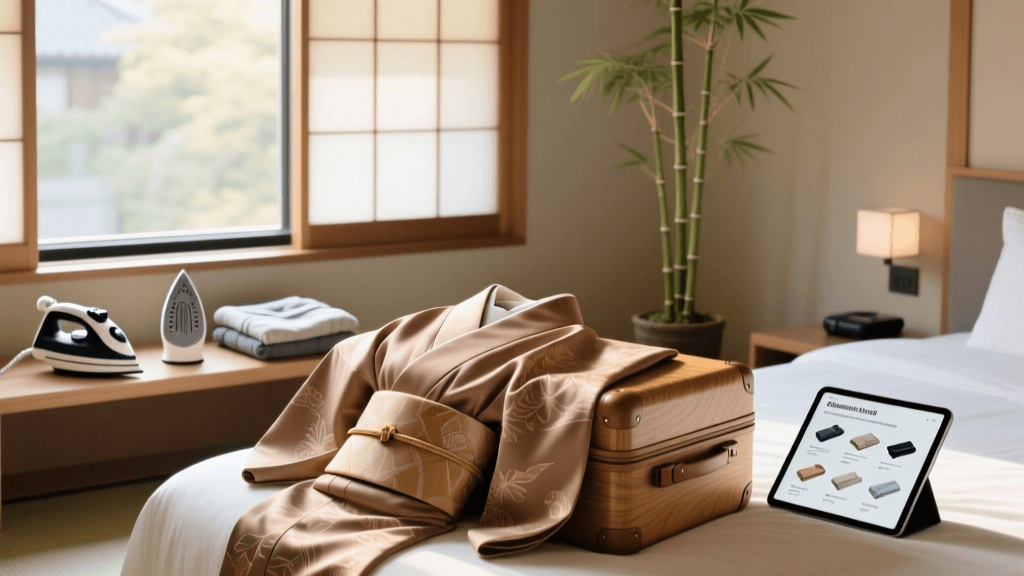
Even with meticulous packing, minor creases may appear upon arrival. Under no circumstances should you use a standard hotel iron on a silk kimono; the direct heat and heavy pressure will scorch the fibers and flatten the intricate weaves. In 2026, portable smart steamers are the ultimate solution for on-the-go garment care.
The latest generation of handheld steamers features precise temperature controls tailored for delicate protein fibers like silk. When steaming a kimono, hang it on a wide, padded hanger (never a wire hanger, which will distort the shoulder seams). Hold the steamer at least five centimeters away from the fabric, allowing the vapor to penetrate the fibers and relax the creases. For stubborn wrinkles, use the 'hover' technique: direct the steam at the crease, then gently pull the fabric taut with your free hand while it is still warm and damp, allowing it to air dry in the stretched position.
If you find yourself without a steamer, the classic 'shower steam' method remains a viable emergency backup. Hang the kimono in the bathroom while running a hot shower, ensuring the garment is far enough away to avoid direct water splashes. The ambient steam will gently release minor wrinkles over the course of 20 to 30 minutes.
Navigating Airport Security and Climate Shifts
Traveling internationally means subjecting your kimono to extreme environmental shifts. The cabin of a commercial aircraft typically maintains a humidity level of around 10 to 15 percent, which can cause silk fibers to become brittle. Conversely, arriving in Tokyo during the rainy season (tsuyu) introduces humidity levels exceeding 80 percent, creating a high risk for mold and dye bleeding.
To combat these shifts, incorporate 2-way humidity control packs, such as Boveda, directly into your garment folder. These packs utilize a semi-permeable membrane to release or absorb moisture, maintaining a stable micro-climate of around 50 to 60 percent humidity inside your luggage, regardless of the external environment.
When navigating airport security, be prepared for X-ray screening. The Japan National Tourism Organization advises travelers to be mindful of cultural artifacts during transit. While X-ray machines will not harm silk textiles, the heavy lead lining of some security bins can snag delicate embroidery. Always keep your kimono inside its Tyvek wrap and rigid folder when placing it on the security belt, and politely request a manual inspection if you are carrying highly fragile antique kanzashi or metallic obi that you prefer not to send through the scanner.
Conclusion: Preserving Tradition on the Move
Traveling with a kimono in 2026 is a beautiful synthesis of honoring ancient Asian traditions and embracing modern textile science. By investing in acid-free wrapping materials, mastering the hon-datami fold, and utilizing smart climate-control gear, you ensure that these magnificent garments continue to be worn, shared, and celebrated across the globe. Whether you are walking the historic streets of Higashiyama or attending a cultural gala in Paris, proper preparation guarantees that your kimono will drape flawlessly, telling its story for generations to come.