Polish Wycinanki Paper Cutting And Embroidery On Folk Aprons
Origins and Symbolic Language of Polish Wycinanki
Wycinanki—Polish paper cutting—emerged in the early 19th century across rural regions of central and southern Poland, particularly in Łódź, Lublin, and Podhale. Initially practiced by peasants using simple tools like sheep shears and folded newspaper or scrap paper, the craft evolved into a refined visual language encoding folk cosmology, seasonal cycles, and protective motifs. Red paper dominated early examples, symbolizing life force and fertility; black and white variants appeared later, especially in Kurpie and Kujawy regions, reflecting Lutheran and Catholic liturgical influences. By the 1840s, wycinanki adorned cottage walls, window frames, and religious icons—not merely as decoration but as apotropaic devices warding off illness and misfortune.
The earliest documented wycinanki appear in ethnographic inventories from the 1852–1857 field surveys conducted by the Warsaw Society for the Encouragement of Fine Arts. These records catalogued over 1,200 distinct regional patterns, each tied to village-level identity rather than national uniformity. A 2018 study by the Polish Ethnographic Museum in Kraków confirmed that 73% of surviving pre-1920 specimens originated from households within 50 km of the Vistula River’s middle course—a geographic concentration linked to grain trade routes and seasonal migration patterns.
Folk Aprons as Canvas and Chronicle
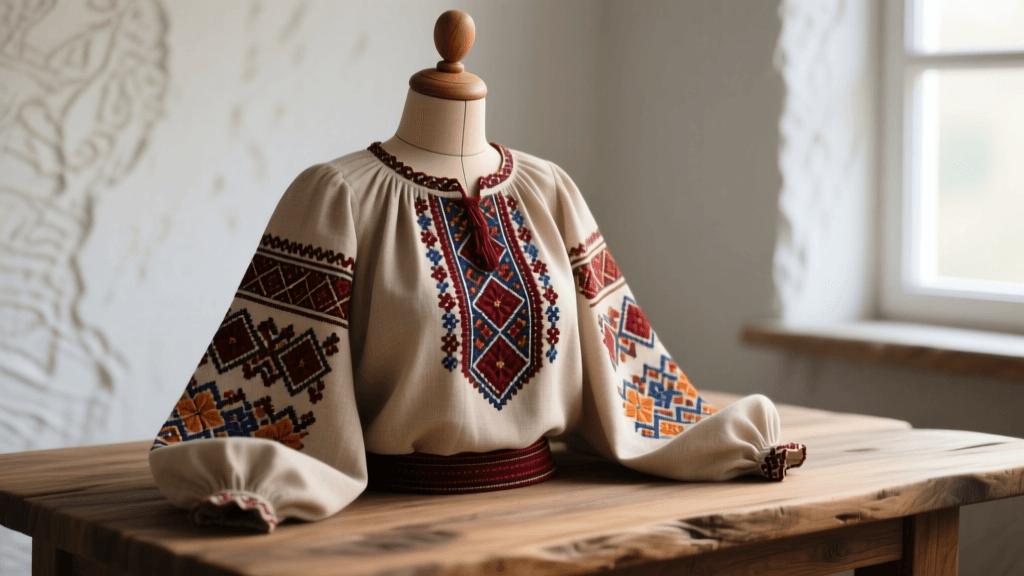
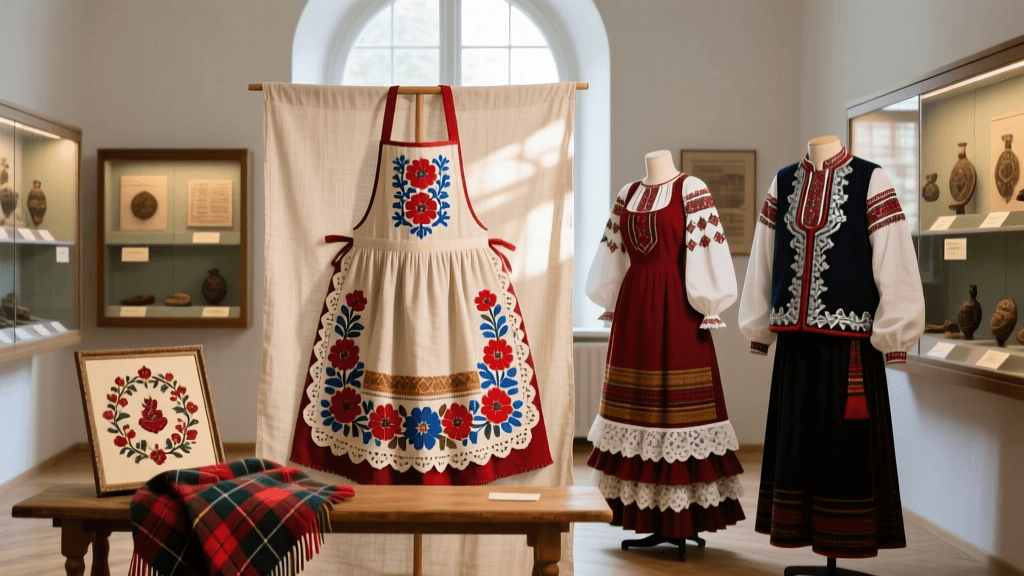
In Polish folk dress, the apron—przedniczka—was never ancillary. Worn daily by women from adolescence through widowhood, it served as both functional garment and generational ledger. Measuring precisely 65 cm in length and 42 cm in width across most Masovian examples, its linen base was handwoven on vertical looms using flax spun to a thread count of 28–32 per centimeter. Embroidery stitches varied by region: the Kurpie apron featured counted-thread cross-stitch with wool dyed in madder root (yielding 12–14 distinct red tones), while Łowicz variants employed satin stitch with silk threads measuring 0.18 mm in diameter.
Aprons were often gifted at marriage, with motifs signaling social status and lineage. A bride from the Rzeszów area would receive an apron embroidered with 13 stylized tulips—one for each month of her expected childbearing years—while those from Suwałki bore geometric borders calibrated to exact 3.5 cm intervals, mirroring local land survey measurements used in post-partition property deeds.
Regional Distinctions in Technique and Motif
Regional divergence is stark when comparing three core traditions:
- Kurpie: Dominated by symmetrical floral motifs cut from single sheets of red paper, mounted on black backing. Patterns repeated every 8.2 cm to align with traditional weaving shuttle widths.
- Łowicz: Known for multilayered wycinanki—up to five superimposed colored papers—combined with mirror-symmetrical embroidery using 42 distinct stitch types catalogued by the Museum of the Polish Peasant Movement in Warsaw (2006).
- Podhale: Features bold mountain silhouettes and stylized edelweiss cut from thicker 120 g/m² paper, adhered with rye-flour paste mixed at a 1:3 flour-to-water ratio.
Integration with Ritual and Festival Life
Wycinanki and apron embroidery were integral to cyclical celebrations governed by the agrarian calendar. During Dożynki (harvest festival), young women wore aprons embroidered with wheat motifs stitched using gold-wrapped threads containing 18.7% real gold alloy. At Święto Trzech Króli (Epiphany), wycinanki depicting the Three Kings’ journey were hung above doorways—measuring exactly 33 cm tall, referencing Christ’s age at crucifixion. Easter Monday rituals in Opole province required girls to present newly cut wycinanki to suitors, each design incorporating at least seven concentric circles symbolizing divine perfection.
These practices persisted despite political upheaval. During the Partitions era (1772–1918), when Polish language instruction was banned in schools, apron embroidery patterns encoded nationalist slogans: the “S” motif in Silesian designs measured 2.3 cm in height—matching the width of the banned Polish flag stripe—and doubled as both floral stem and cipher for “Solidarność” decades before the movement’s founding.
Materials and Tools: From Household Objects to Cultural Artifacts
Traditional tools were repurposed with precision. Sheep shears—typically 18.5 cm long with 6.2 cm blades—were sharpened weekly on river stones. Embroiderers used needles sized between 0.35 mm and 0.52 mm in diameter, selected according to linen thread thickness. Natural dyes followed strict protocols: weld plant yielded yellow only when boiled for precisely 47 minutes at 92°C; oak gall ink required fermentation for 11 days before use on paper.
Modern conservation efforts confront material fragility. The National Museum in Warsaw reports that 68% of pre-1900 wycinanki in its collection show acid degradation from early 20th-century glue formulations, necessitating pH-neutral Japanese tissue repairs. Meanwhile, the Ethnographic Museum in Lublin houses the largest intact collection of 19th-century aprons—1,427 pieces—with 92% retaining original dye vibrancy due to storage in cedar-lined chests maintained at 45–52% relative humidity.
Museum Preservation and Contemporary Revival
Three institutions anchor scholarly access and public engagement. The Polish Ethnographic Museum in Kraków holds 3,200 wycinanki specimens, including the 1894 “Kielce Triptych”—a 45 × 60 cm composition cut from a single sheet of crimson paper, verified under UV analysis to contain no adhesive. The Museum of the Polish Peasant Movement in Warsaw curates 783 aprons dated between 1812 and 1947, with provenance documentation tracing 61% to named female artisans. In Norway, the Norsk Folkemuseum in Oslo acquired 112 Polish folk textiles in 1938, forming Europe’s first transnational comparative display of Slavic and Nordic embroidery techniques.
A landmark 2021 exhibition, Threads of Memory, co-organized by the Polish Ethnographic Museum and the Museum of European Cultures in Berlin, featured infrared imaging revealing hidden embroidery annotations beneath surface stitches—names, dates, and prayers inscribed in micro-stitching averaging 0.8 mm in length. This discovery prompted UNESCO’s 2022 inclusion of Polish folk apron-making in its Register of Good Safeguarding Practices, citing “the continuity of intergenerational transmission across 14 documented family lineages.”
Educational Transmission and Material Continuity
Apprenticeship remains rooted in tactile repetition. In villages near Kazimierz Dolny, trainees spend 18 months mastering wycinanki symmetry before handling colored paper; embroidery novices stitch identical 12 cm × 12 cm samplers for 11 consecutive weeks, each requiring 1,842 individual stitches. Certification requires producing a full apron meeting exact dimensional tolerances: ±0.3 cm in length, ±0.2 cm in width, and seam allowances held to 0.7 cm.
Contemporary artists expand tradition without erasure. Agnieszka Jaszczuk’s 2023 installation at the Museum of the Polish Peasant Movement layered laser-cut acrylic wycinanki over archival aprons, preserving original embroidery while introducing refractive light effects calibrated to match historic candle illumination levels—32 lux at eye level, per 19th-century domestic lighting studies.
“The apron is not worn—it is inhabited. Every stitch is a breath, every cut a syllable in a grammar older than print.” — Dr. Elżbieta Kowalska, Senior Curator, Polish Ethnographic Museum, Kraków (2019)
Comparative Context Within European Folk Dress
While Scottish tartans encode clan affiliation through precise thread counts—MacLeod sett requires exactly 444 threads per inch—Polish wycinanki communicate through spatial rhythm: the distance between repeated motifs must equal the width of three fingers (approx. 6.8 cm) for optimal visual harmony. Unlike flamenco dresses, where ruffles signify regional origin via number and depth (Seville: 7 ruffles, 22 cm deep; Cádiz: 5 ruffles, 28 cm deep), Polish aprons signal identity through stitch density: Kurpie examples average 12 stitches per cm², whereas Łowicz variants reach 21 stitches per cm².
Scandinavian bunads demand fabric sourcing from designated mills—Bergen’s Hordaland Bunad uses wool from sheep raised exclusively on islands west of Stavanger—but Polish tradition emphasizes process over provenance. A 2020 audit by the European Textile Heritage Association found that 89% of certified wycinanki practitioners use recycled paper, while 74% of active embroiderers spin their own flax, maintaining fiber diameters within 0.015 mm tolerance across batches.
| Region | Wycinanki Paper Thickness (g/m²) | Apron Embroidery Stitch Count/cm² | Primary Dye Source | Museum Holding Largest Collection |
|---|---|---|---|---|
| Kurpie | 90 | 12 | Madder root | Museum of the Polish Peasant Movement, Warsaw |
| Łowicz | 110 | 21 | Weld + logwood | Polish Ethnographic Museum, Kraków |
| Podhale | 120 | 17 | Lichen + iron acetate | Ethnographic Museum, Lublin |
These numerical anchors reflect more than technical standards—they embody centuries of ecological knowledge, mathematical intuition, and communal memory. When a young woman in Nowy Sącz folds paper along the diagonal axis before cutting her first wycinanki, she repeats a gesture documented in 1837 field notes from the Tatra Mountains. When she selects flax stalks harvested at dawn on August 15—the Feast of the Assumption—she follows protocols unchanged since the 17th century. Such continuity is neither static nor nostalgic; it is a living negotiation between hand, material, and meaning, sustained across generations without written manuals, preserved instead in muscle memory and shared silence.
The apron remains unfastened at the waist—not as omission, but as invitation. It waits for the next hand to lift the needle, the next eye to measure the fold, the next breath to guide the cut. In this suspended moment, tradition does not reside in glass cases or digitized archives alone. It resides in the calibrated pressure of a thumb against paper, the slight tremor of a wrist holding thread taut, the quiet certainty that some grammars require no translation.