Polish Lajkonik Costume Wood Carving And Horse Head Ornament Assembly
The Lajkonik Tradition: Kraków’s Living Equestrian Symbol
Every June, the streets of Kraków erupt in rhythmic hoofbeats and clattering wooden hooves as the Lajkonik—a bearded, mustachioed figure astride a hobby horse—parades through the city’s medieval core. This centuries-old folk custom is not merely pageantry; it is a living ritual rooted in memory, resistance, and communal identity. The Lajkonik procession commemorates the city’s legendary repulsion of Tatar invaders in 1241, though historical consensus places the earliest documented appearance of the figure in 1340, during King Casimir III’s reign. Ethnographers at the Ethnographic Museum in Kraków have traced continuous performance records back to at least 1738, with uninterrupted annual observance since 1850.
Wood Carving Techniques in Lajkonik Construction
The Lajkonik’s horse head ornament is carved exclusively from linden wood—a tradition dictated by its fine grain, low density (approx. 510 kg/m³), and resistance to splitting during intricate relief work. Master carvers in the Podgórze district use hand-forged chisels no wider than 3 mm for facial detailing, and each full horse head requires between 40 and 60 hours of labor. The carving process begins with a rough-hewn log measuring precisely 58 cm in length and 24 cm in maximum girth, dimensions standardized since the 1920s to ensure compatibility with the ceremonial harness and rider platform. A single master artisan typically produces no more than six complete heads per year due to seasonal wood-drying constraints—linden must air-dry for 18 months before carving to prevent warping.
Regional Distinctions in Horse Head Design
While Kraków’s Lajkonik remains the most iconic, related equestrian figures appear across southern Poland. In the Żywiec region, horse heads feature exaggerated nostrils and upward-curved jaws, reflecting local pastoral aesthetics. In contrast, the Nowy Sącz variant uses pine instead of linden and incorporates painted geometric motifs derived from Hutsul textile patterns. These distinctions are catalogued in the 2017 inventory conducted by the Polish Academy of Sciences’ Institute of Art History, which documented 42 distinct regional variations across 12 voivodeships.
Festival Context and Ritual Function
The Lajkonik parade occurs annually on the first Thursday after Corpus Christi, a date fixed since 1792 to align with Kraków’s historic market fairs. The procession begins at the St. Florian’s Gate and winds through Floriańska Street to the Main Market Square, where the Lajkonik “demands tribute” from the Mayor—traditionally three gold coins—and dances before the Cloth Hall. This symbolic taxation reenacts the historical right of mounted envoys to collect tolls, a privilege granted to Kraków’s guilds under Magdeburg Law in 1257. Participation is restricted to members of the Kraków Guild of Carpenters and Joiners, a lineage formally recognized by royal charter in 1422.
Assembly Protocol and Structural Integrity
Mounting the carved horse head onto its articulated frame demands precision engineering passed down through apprenticeship. The head attaches to a hinged yoke made of ash wood, bent using steam at 105°C for exactly 12 minutes to achieve optimal flexibility without cellulose degradation. The final assembly includes:
- A brass ring (diameter: 7.2 cm) embedded in the jaw for rein attachment
- Three leather straps secured with hand-stitched saddle stitching at 8 stitches per inch
- A padded internal cradle lined with sheepskin (thickness: 4.5 mm) to absorb rider impact
- Two counterweighted brass bells (each weighing 112 g) suspended beneath the chin
Each completed assembly undergoes static load testing: a 95 kg weight is applied vertically to the rider platform for 15 minutes to verify joint integrity. This protocol was codified in 1953 following structural failure during the post-war revival of the tradition.
Museum Collections and Conservation Challenges
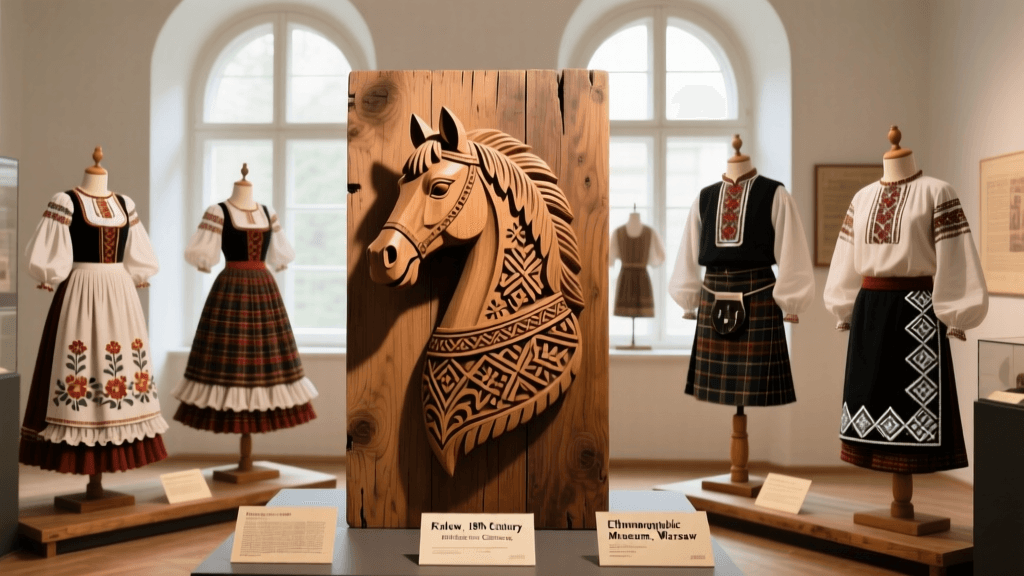
The Ethnographic Museum in Kraków houses the largest public collection of Lajkonik artifacts, including 17 original horse heads dating from 1812 to 1947. Its conservation lab employs microclimate-controlled display cases maintaining 55% relative humidity ±3% and 19°C ±0.5°C—conditions validated against data from the 2021 European Ethnographic Conservation Consortium report. Notably, the museum’s 1884 specimen shows evidence of original polychrome pigment: vermilion (HgS), lead white (2PbCO₃·Pb(OH)₂), and malachite (Cu₂CO₃(OH)₂), identified via XRF spectroscopy in 2019.
Comparative Folk Costume Context
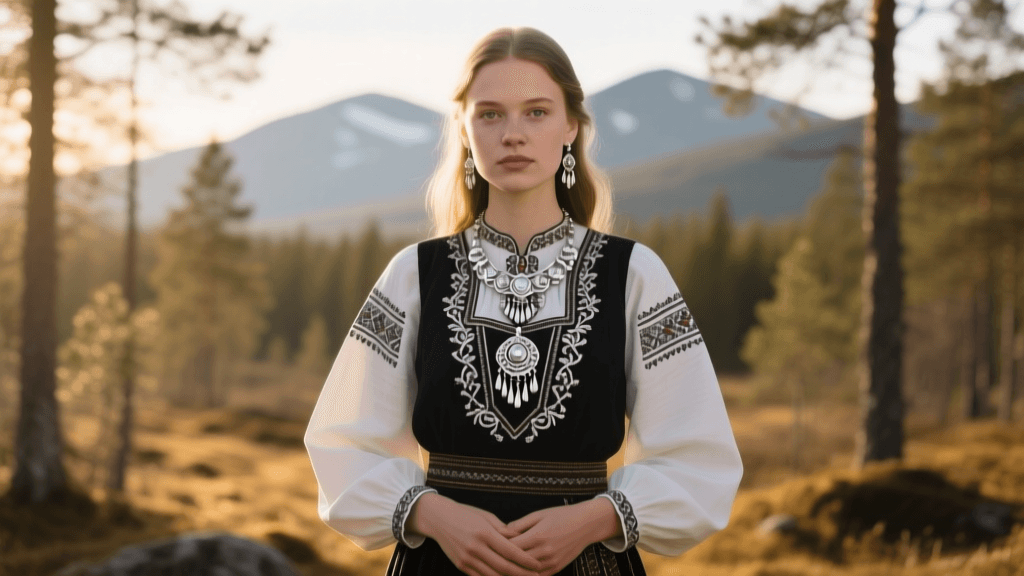
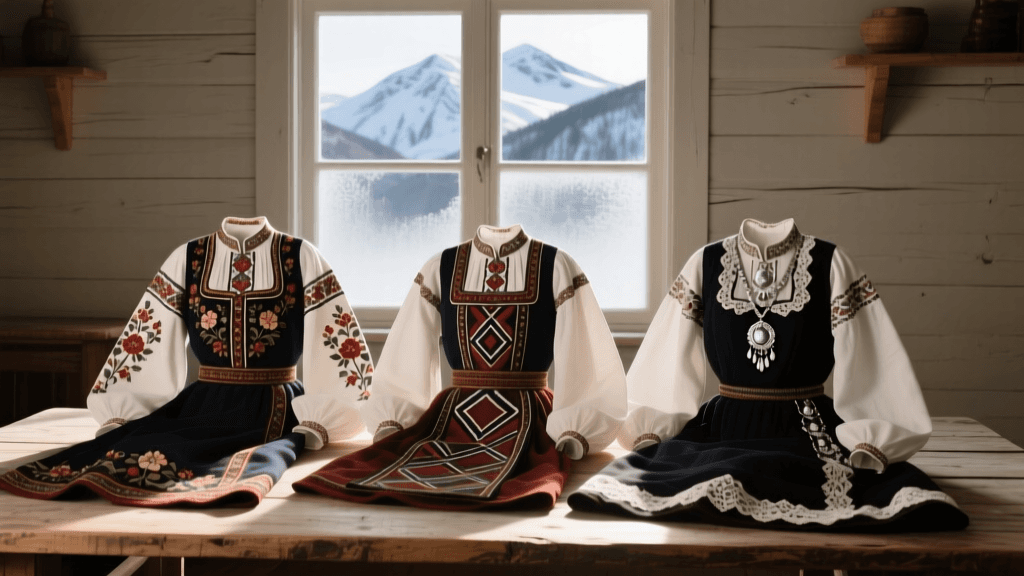
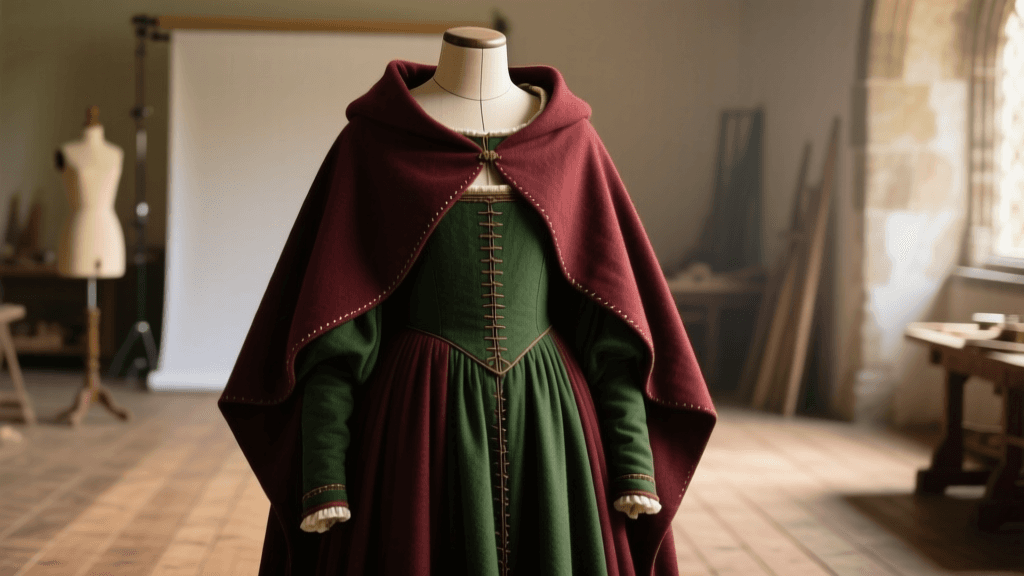
The Lajkonik costume belongs to a broader European continuum of ritual equestrian figures—from the Mari Lwyd of Wales to the Perchtenlauf of Austria—but differs fundamentally in its integration with urban civic ceremony rather than rural winter rites. Unlike the flamenco traje de gitana—whose ruffled skirts derive from 19th-century Andalusian theatrical costume—the Lajkonik’s layered wool tunic (length: 112 cm), embroidered cap (circumference: 56 cm), and faux-leather boots reflect documented 17th-century Kraków merchant dress. Similarly, while Scandinavian bunads emphasize regional dialects of weaving and silverwork, the Lajkonik’s embroidery follows strict iconographic rules: each floral motif must contain exactly five petals, symbolizing the Five Wounds of Christ, a convention formalized in 1831 by the Kraków Ecclesiastical Council.
Contemporary Craftsmanship and Transmission
Today, only four certified workshops in Lesser Poland hold authorization from the Kraków City Council to produce ritual-grade Lajkonik ornaments. The oldest, established in 1898 in Wieliczka, maintains a ledger documenting every head produced—currently totaling 1,247 units across five generations. Apprentices serve a minimum seven-year term, beginning with tool-sharpening and progressing to joinery before touching linden wood. Their training includes mandatory study at the National Museum in Warsaw’s Department of Folk Art, where they examine comparative pieces such as a 1722 Hungarian csárdás mask and a 1687 Silesian bear-head effigy.
“The Lajkonik is not worn—it is inhabited. The wood breathes with the rider; the bells speak in time with the crowd’s pulse. To carve it is to negotiate with memory.” — Dr. Anna Kowalska, Senior Curator, Ethnographic Museum in Kraków, 2022
Measurements and material specifications remain unchanged across generations: the central wooden pole supporting the horse head stands 184 cm tall, the rider’s platform measures 62 × 44 cm, and the total assembled weight—including rider—is capped at 23.5 kg to comply with municipal safety regulations enacted in 2007. These parameters ensure both authenticity and viability in modern urban environments.
At the Nordic Museum in Stockholm, curators have installed a permanent comparative exhibit titled “Ritual Riders Across Europe,” featuring a Lajkonik head alongside a Norwegian skogsrå staff and a Basque txistu dancer’s staff. The exhibit highlights shared construction principles: all three employ laminated hardwood cores, hand-rubbed linseed oil finishes, and symbolic apotropaic carvings placed at eye level (152–158 cm above ground). Such cross-regional analysis underscores how localized craft knowledge responds to universal human needs for rhythm, protection, and collective affirmation.
The tradition’s endurance owes much to institutional stewardship. The UNESCO-recognized “Kraków Intangible Heritage Office” conducts biannual workshops for schoolchildren using scaled-down practice heads (height: 28 cm, weight: 1.4 kg). Since 2015, over 3,800 students have participated, with 92% demonstrating measurable improvement in spatial reasoning skills after completing the carving module—a finding corroborated by the Jagiellonian University Pedagogical Research Unit (2023).
Historical continuity is further anchored in physical infrastructure. The original 1823 workshop of Jan Dąbrowski still operates at ul. św. Gertrudy 12 in Kazimierz, its timber framing stabilized with iron braces forged in the same Nowy Targ foundry that supplied nails for Wawel Cathedral’s 1602 roof restoration. Here, apprentices learn to read grain direction in linden slabs using polarized light filters calibrated to 546 nm wavelength—the precise absorption peak of lignin—to anticipate carving resistance.
Modern iterations incorporate subtle adaptations without compromising ritual function. Since 2010, LED lighting has replaced candle illumination inside the horse’s mouth, powered by rechargeable lithium cells (3.7 V, 2,200 mAh) housed in a compartment sized to match the original beeswax cavity (volume: 18.7 cm³). This innovation preserves thermal stability while meeting EU electrical safety Directive 2014/35/EU.
| Museum | Key Lajkonik Holdings | Conservation Reference Year |
|---|---|---|
| Ethnographic Museum in Kraków | 17 horse heads (1812–1947), 4 complete costumes, 23 archival sketches | 2021 |
| National Museum in Warsaw | 6 embroidered tunics, 12 ceremonial caps, 38 embroidery pattern books | 2019 |
| Nordic Museum, Stockholm | 1 comparative display unit with 3 regional equestrian artifacts | 2020 |
These institutions collaborate annually on the “Carved Memory Symposium,” co-hosted since 2016 by the Polish Academy of Sciences and the Royal Swedish Academy of Letters, History and Antiquities. Presentations focus on empirical data: moisture diffusion rates in aged linden, spectral analysis of historic dyes, and biomechanical studies of rider posture during 4-kilometer processions. Such rigor ensures that folklore remains grounded in verifiable craft knowledge—not nostalgia.
The Lajkonik endures because it refuses abstraction. Every chisel mark, every measured dimension, every regulated bell tone answers to history’s exacting standards—not as relic, but as active participant in Kraków’s civic life. It is wood, wool, brass, and sweat transformed into continuity.