Hanfu vs Xifu: Decoding Peking Opera & Kunqu Garments in 2026
The Intersection of History and Theater: Hanfu vs. Xifu
The intersection of historical Hanfu and traditional Chinese performing arts represents one of the most visually stunning aspects of Asian cultural heritage. As we navigate the cultural renaissance of 2026, the distinctions between everyday historical dress and theatrical costumes have become a focal point for enthusiasts, scholars, and performers alike. While the modern Hanfu movement has meticulously reconstructed garments from the Tang, Song, and Ming dynasties for daily wear and ceremonial use, the traditional stage costumes known as Xifu (戏服) offer a parallel, highly stylized universe of textile artistry.
Peking Opera (Jingju) and Kunqu, two of the most revered forms of Chinese theater, rely on these exaggerated, symbolic garments to communicate character, status, and emotion to the audience. According to Britannica's comprehensive guide to Peking Opera, the visual language of the stage is just as critical as the vocal performances, with every stitch, color, and accessory carrying profound narrative weight. Understanding the distinction between authentic historical Hanfu and theatrical Xifu is essential for any serious collector, performer, or cultural historian operating in today's landscape.
The Core Differences: Historical Hanfu vs. Theatrical Xifu
A common misconception among newcomers to traditional Asian garments is that Peking Opera and Kunqu costumes are exact historical replicas. In reality, Xifu is an amalgamation. While the foundational silhouettes are heavily based on Ming Dynasty Hanfu—specifically the robes of the scholar-official class and the imperial court—they have been dramatically altered for the stage. Theatrical garments prioritize movement, visual impact under bright stage lighting, and immediate character recognition over historical accuracy.
| Feature | Historical Hanfu | Theatrical Xifu (Opera) |
|---|---|---|
| Dynasty Accuracy | Strictly adheres to specific era patterns (e.g., Tang, Song, Ming) | Amalgamation, heavily stylized Ming Dynasty base regardless of play's era |
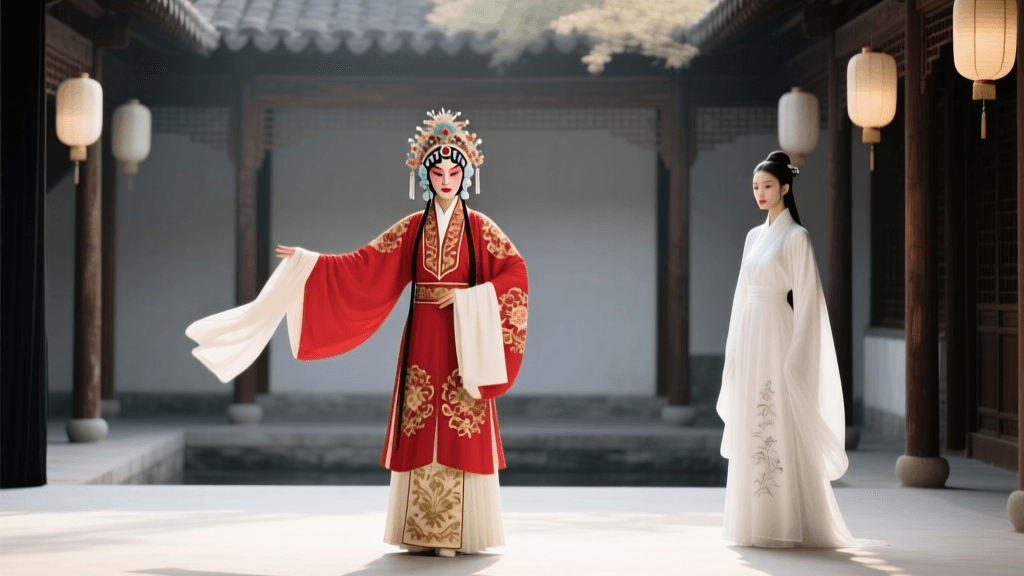
| Sleeves | Wide or narrow, historically accurate lengths for daily life | Extended with white silk "Water Sleeves" (Shuixiu) for expression |
| Colors & Patterns | Regulated by historical sumptuary laws and seasonal trends | Highly symbolic, indicating character archetype, personality, and rank |
| Material | Silk, linen, hemp, ramie depending on class and climate | Heavy silks, satin, brocade designed to catch stage lighting and hold shape |
Key Garments in Kunqu and Peking Opera
To truly appreciate the wardrobe of traditional Chinese performing arts, one must understand the core garments that define the stage. These pieces are masterclasses in embroidery and structural tailoring.
1. The Mang (Python Robe)
The Mang is the highest-ranking garment on stage, worn by emperors, generals, and top-tier officials. Despite its name, the "python" motif is essentially a five-clawed dragon, a symbol reserved for the emperor in actual Ming Dynasty history. On stage, the rules are slightly relaxed for dramatic effect, but the sheer weight and opulence of a hand-embroidered Mang robe are staggering. In 2026, a bespoke, hand-embroidered Mang utilizing traditional gold couching (panjin) techniques from Suzhou can cost upwards of $8,500 USD and take over a year to complete.
2. The Pei (Informal Robe)
Worn by nobility and high-ranking characters in casual or domestic settings, the Pei features a center-front opening and a crossed collar. It is slightly less rigid than the Mang and allows for more fluid movement. The embroidery on a Pei often features floral motifs, cranes, or subtle geometric patterns, reflecting the character's refined taste rather than their political power.
3. The Xuezi (Scholar's Robe)
The quintessential garment of Kunqu opera, the Xuezi is the uniform of the young scholar or the gentlewoman. It is characterized by its flowing, unlined silk construction and subtle, elegant embroidery at the cuffs and hem. The Xuezi is where the actor's physical grace shines, as the lightweight fabric responds to every subtle turn and gesture.
4. Shuixiu (Water Sleeves)
Perhaps the most iconic element of Chinese opera is the Shuixiu. These are long, flowing extensions of white silk attached to the cuffs of the inner garment. As documented by UNESCO's Intangible Cultural Heritage registry, the physical vocabulary of Kunqu relies heavily on these sleeves. Actors use them to simulate weeping, hiding their faces in shyness, pointing in anger, or mimicking the ripples of water. Mastering the flick, toss, and fold of the water sleeve takes years of rigorous physical training.
The 2026 Landscape: Sourcing and Studying Opera Garments
For modern practitioners, theater students, and high-end collectors, sourcing authentic Xifu in 2026 requires navigating a specialized network of artisans. The mass-produced, machine-embroidered costumes found on general e-commerce platforms are suitable for amateur school plays, but they lack the structural integrity and historical resonance required for professional performance or serious collection.
Bespoke Tailors in Beijing and Suzhou
The epicenter of high-quality Xifu production remains divided between Beijing and Suzhou. Beijing-based tailors, often operating in small ateliers near the historic Liulichang cultural street, specialize in the heavy, structured garments like the Mang and the elaborate headdresses (Fengguan). Meanwhile, Suzhou is the undisputed capital of the silk and embroidery used for the softer, more fluid garments like the Xuezi and the water sleeves.
If you are commissioning a piece in 2026, expect the following market realities:
- Consultation and Design: 2 to 4 weeks. Artisans will map out the specific character archetype (Sheng, Dan, Jing, or Chou) to ensure color and motif accuracy.
- Embroidery Phase: 3 to 9 months. High-end pieces use real gold and silver threads, alongside Suzhou's famous double-sided embroidery techniques.
- Pricing: A professional-grade, hand-embroidered Xuezi starts around $2,200 USD, while a full Mang ensemble with matching jade belts and headdresses can easily exceed $15,000 USD.
Garment Care: Preserving Theatrical Silks
Because Xifu garments are heavily structured and feature delicate metallic threads, they cannot be cleaned or stored like everyday historical Hanfu. Theatrical costumes are rarely washed; instead, they are meticulously aired out and spot-cleaned. In 2026, professional theatrical wardrobe masters recommend the following preservation techniques:
- Never Fold the Embroidery: Folding a Mang robe will crack the metallic couching threads. Garments must be stored flat in acid-free archival boxes or hung on custom-padded, wide-shoulder cedarwood hangers.
- Climate Control: Heavy brocades are highly susceptible to humidity fluctuations. Maintain a storage environment at 45-50% relative humidity to prevent the silk from dry-rotting or the metallic threads from tarnishing.
- Water Sleeve Maintenance: The white silk Shuixiu must be detached (if designed with snaps or ties) and gently hand-washed in cold water with a pH-neutral silk detergent after every performance to remove stage makeup and sweat oils.
Incorporating Theatrical Elements into Modern Hanfu Styling
An exciting trend in 2026 is the subtle integration of Xifu elements into modern, wearable Hanfu. While wearing a full stage Mang to a tea ceremony would be considered a major faux pas, avant-garde Hanfu designers are drawing inspiration from the theater. We are seeing the rise of the "opera-core" aesthetic, which features detachable, shortened water sleeves on everyday Ming-style Aoqun (jacket and skirt) sets, as well as the incorporation of dramatic, heavily embroidered cloud shoulders (Yunjian) over simpler base garments. This allows enthusiasts to pay homage to the performing arts without crossing the line into inappropriate costume wear.
Authoritative Resources for Further Study
For those looking to deepen their understanding of the textiles and history behind Chinese performing arts, several institutions offer unparalleled resources. The Metropolitan Museum of Art's Heilbrunn Timeline of Art History provides excellent context on the Ming Dynasty silhouettes that form the backbone of Xifu design. Additionally, studying the specific movement vocabularies of Kunqu will help you understand why these garments were cut and weighted the way they were, bridging the gap between static textile appreciation and dynamic performance art.
Whether you are a collector seeking a museum-grade Python robe, a performer refining your water sleeve technique, or a Hanfu enthusiast exploring the theatrical roots of your favorite silhouettes, the world of Xifu offers a profound, living connection to Asia's rich artistic heritage.