Hanfu in Peking Opera & Kunqu: 2026 Stage Costume Guide
The Intersection of Hanfu and Traditional Chinese Theater
When we discuss the renaissance of traditional Chinese clothing, the conversation often centers on historical accuracy and daily wear. However, the theatrical evolution of Hanfu within traditional performing arts—specifically Peking Opera (Jingju) and Kunqu—represents a fascinating, highly stylized branch of garment history. In 2026, as global interest in Asian traditional performing arts reaches new heights, understanding the distinction between historical Hanfu and stage Xifu (opera costumes) is essential for performers, collectors, and cultural enthusiasts alike.
Traditional Chinese theater relies heavily on visual storytelling. The garments worn by actors are not mere replicas of historical daily wear; they are amplified, symbolic, and engineered for dynamic movement. According to UNESCO's Intangible Cultural Heritage registry, Peking opera is a comprehensive art form where costume and makeup are just as critical as the vocal performance. Similarly, the older and more lyrical Kunqu opera utilizes garments that closely mirror the elegant, flowing silhouettes of the Ming Dynasty, albeit adapted for the stage.
Historical Hanfu vs. Stage Xifu: Understanding the Differences
To source or commission the correct garments in 2026, one must first understand the divergence between historical Hanfu and theatrical Xifu. Historical Hanfu adheres strictly to the textile regulations, silhouettes, and weaving techniques of specific dynasties (such as the Song or Ming). Stage Xifu, conversely, blends elements from multiple eras, heavily incorporating Qing Dynasty aesthetics, exaggerated proportions, and specialized performance features like water sleeves.
| Feature | Historical Hanfu (Ming/Song) | Peking Opera Xifu | Kunqu Stage Dress |
|---|---|---|---|
| Silhouette | Historically accurate, layered, modest proportions | Exaggerated, structured, heavily padded for stage presence | Elegant, flowing, closer to Ming historical cuts but elongated |
| Sleeves | Natural fabric length, sometimes with extended cuffs | Attached 'Water Sleeves' (Shuixiu) up to 90cm long | Long, delicate water sleeves emphasizing lyrical movement |
| Embroidery | Subtle, region-specific motifs, balanced negative space | Dense, high-contrast, metallic threads for visibility under stage lights | Refined Suzhou embroidery (Su Xiu), softer colors, poetic motifs |
| Movement | Designed for walking, sitting, and daily tasks | Engineered for acrobatics, martial arts, and broad gestures | Optimized for slow, deliberate, dance-like choreography |
The Four Pillars of Theatrical Hanfu
Whether you are studying theatrical design or commissioning a piece for a 2026 cultural showcase, recognizing the four primary categories of Xifu is crucial. These categories dictate the character's social status, gender, and role.
1. Mang (Python Robe)
Reserved for emperors, high-ranking officials, and nobility, the Mang is the most formal stage garment. It features a round collar, large lapels, and intricate python (four-clawed dragon) embroidery. In modern 2026 productions, bespoke Mang robes commissioned from Suzhou artisans can cost upwards of $3,500 USD due to the dense gold and silver couching techniques required.
2. Pei (Cloak)
The Pei
is a versatile, front-opening cloak worn by scholars, officials, and noblewomen in casual or semi-formal settings. It features a crossed collar and side slits for movement. Kunqu performances heavily utilize the Pei, often adorned with delicate plum blossom or orchid motifs to reflect the scholarly refinement of the characters.3. Xue (Informal Robe)
Worn by lower-status characters, servants, or as inner-chamber wear, the Xue is simpler and lacks the elaborate embroidery of the Mang or Pei. It is typically made of solid-colored silk or cotton, relying on the actor's movement and water sleeve techniques to convey emotion.
4. Kao (Armor)
The Kao is the theatrical armor worn by generals and warriors. Unlike historical Hanfu military armor, which was functional and heavy, the Kao is constructed from layered silk, velvet, and sequins, featuring four triangular flags attached to the back to signify command and amplify the actor's physical footprint during martial sequences.
Sourcing and Commissioning Stage-Ready Garments in 2026
The market for traditional theatrical garments has evolved significantly. As of 2026, the integration of AI-assisted pattern drafting with traditional hand-stitched finishing has revolutionized the commissioning process. However, the epicenter of high-quality Xifu and Kunqu dress remains the Jiangnan region, specifically Suzhou and Hangzhou.
Fabric Selection for Dynamic Movement
When commissioning a stage-ready Hanfu or Xifu piece, fabric weight and drape are paramount. For Kunqu, which emphasizes grace and fluidity, heavy silk crepe (Zhongzhou) and mulberry silk satin are the industry standards. These fabrics catch the stage lighting beautifully and provide the necessary weight to make water sleeves snap and flow correctly. For Peking Opera's more acrobatic roles, performers in 2026 are increasingly opting for silk-cotton blends that offer the sheen of silk with the breathability and tensile strength required for rigorous martial choreography.
Water Sleeves (Shuixiu) and Embroidery Techniques
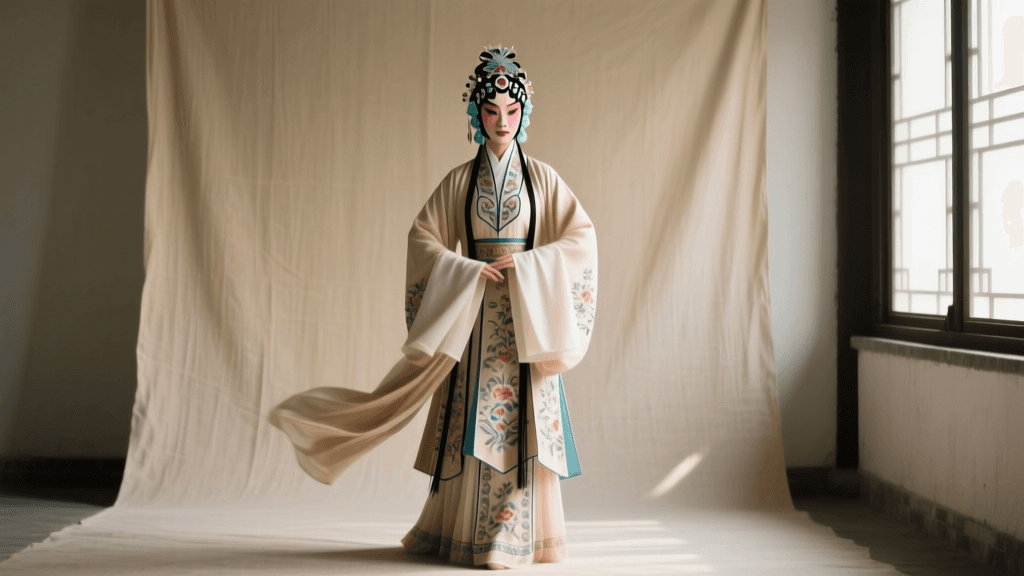
The water sleeve is the defining feature of theatrical Hanfu. Unlike historical garments where the sleeve is simply cut long, the Shuixiu is a separate piece of white silk or cotton stitched to the cuff of the main garment. For professional performers, the standard length in 2026 ranges from 60cm for martial roles to 90cm for lyrical, scholarly roles. The embroidery on the main cuff must stop exactly where the water sleeve begins, ensuring the white extension remains unblemished to mimic the flow of water.
Maintenance and Care for Theatrical Hanfu
Theatrical garments are significant investments and require meticulous care to preserve their structural integrity and metallic threads.
- Cleaning: Never machine wash or submerge heavily embroidered Xifu. In 2026, specialized theatrical dry cleaners in major cultural hubs use organic, low-impact solvents that prevent the tarnishing of gold and silver threads.
- Storage: Garments should never be hung on standard wire hangers, as the weight of the embroidery will tear the silk shoulders. Use padded, wide-shoulder wooden hangers.
- Environment: Store in breathable cotton garment bags within cedar-lined closets. Avoid plastic, which traps moisture and causes silk to rot. Include silica gel packets to control humidity, especially in coastal cities.
- Folding: If folding is necessary for travel, pad the folds with acid-free tissue paper to prevent permanent creasing in the stiff, embroidered panels.
The 2026 Revival: Kunqu's Influence on Modern Hanfu Fashion
One of the most exciting trends in 2026 is the bleed-over of Kunqu stage aesthetics into everyday Hanfu fashion. As noted by cultural historians tracking the enduring legacy of Kunqu opera, the art form's emphasis on poetic elegance has deeply influenced modern designers. Today's Hanfu enthusiasts are increasingly commissioning 'daily wear' Mamian skirts and cross-collared tops that feature the subdued, lyrical embroidery patterns traditionally reserved for Kunqu stages.
Furthermore, the Metropolitan Museum of Art's extensive archives on Chinese theatrical dress continue to inspire contemporary textile artists, bridging the gap between museum preservation and living, breathing performance art. Whether you are a performer seeking a historically informed Kunqu Pei, or a Hanfu enthusiast looking to incorporate theatrical elegance into your wardrobe, understanding the rich, stylized language of Xifu is the key to mastering the art of traditional Chinese dress.