Kimono Textile Trade Routes: 2026 Collector Guide
The Myth of Isolation: Kimonos on the Global Silk Road
When we envision the traditional Japanese kimono, it is easy to imagine an isolated, insular art form born entirely from the island nation's indigenous craftsmanship. However, as textile historians and collectors in 2026 well know, the kimono is actually a vibrant canvas of global exchange. For centuries, Japan's sartorial traditions were profoundly shaped by the Silk Road and the Maritime Spice Routes. From Persian arabesques woven into Kyoto brocades to Indian chintz repurposed for tea ceremony accoutrements, the garments of Japan tell a story of international commerce, cultural assimilation, and artistic adaptation. Today, tracing these historical imports has become one of the most exciting niches in the antique textile market.
The UNESCO Silk Roads Programme highlights how the overland and maritime networks facilitated not just the exchange of goods, but the transmission of artistic motifs and weaving technologies. For the modern collector, understanding these trade routes is essential for authenticating, valuing, and preserving antique kimonos. As of 2026, auction houses in Kyoto and online global marketplaces have seen a 15% surge in demand for verified "trade-route" textiles, driven by a new generation of collectors who value the cross-cultural narratives embedded in the warp and weft of these historic garments.
The Maritime Spice Route and the Birth of Sarasa
In the late 16th and early 17th centuries, Portuguese and Dutch merchants arrived on Japan's shores, bringing with them the riches of the Maritime Spice Route. Among the most prized commodities were Indian cotton chintz from the Coromandel Coast. Known in Japan as sarasa, these imported textiles featured vibrant, colorfast floral and geometric patterns achieved through complex mordant-dyeing techniques that Japanese artisans had not yet mastered. The Victoria and Albert Museum's comprehensive guide to Kimono history notes that these early imported cottons were so highly valued that they were rarely cut into full garments; instead, they were reserved for elite use.
By the Edo period, Japanese dyers began to reverse-engineer and adapt these Indian techniques, creating domestic sarasa. However, true imported Indian chintz remained a luxury item, primarily used to craft shifuku—the exquisite, protective drawstring bags used in the tea ceremony to store precious tea bowls. For a 2026 collector, identifying an authentic Edo-period imported sarasa shifuku requires examining the weave density and the specific madder-red and indigo-blue dye penetrations that were unique to 17th-century Indian coastal workshops. These pieces are highly sought after, often serving as the centerpiece of a historical textile collection.
Persian Motifs and the Overland Silk Road
While the maritime routes brought cotton, the overland Silk Road funneled silk, brocade techniques, and enduring motifs into Japan via China. One of the most prominent examples of this cultural transmission is the karakusa (arabesque) pattern. Originating in the Hellenistic and Persian worlds, this scrolling vine motif traveled through Central Asia, was absorbed into Chinese Tang dynasty art, and eventually arrived in Japan. By the Muromachi and Momoyama periods, karakusa was being woven into luxurious silk brocades (nishiki) used for Noh theater costumes and the obis of the aristocracy.
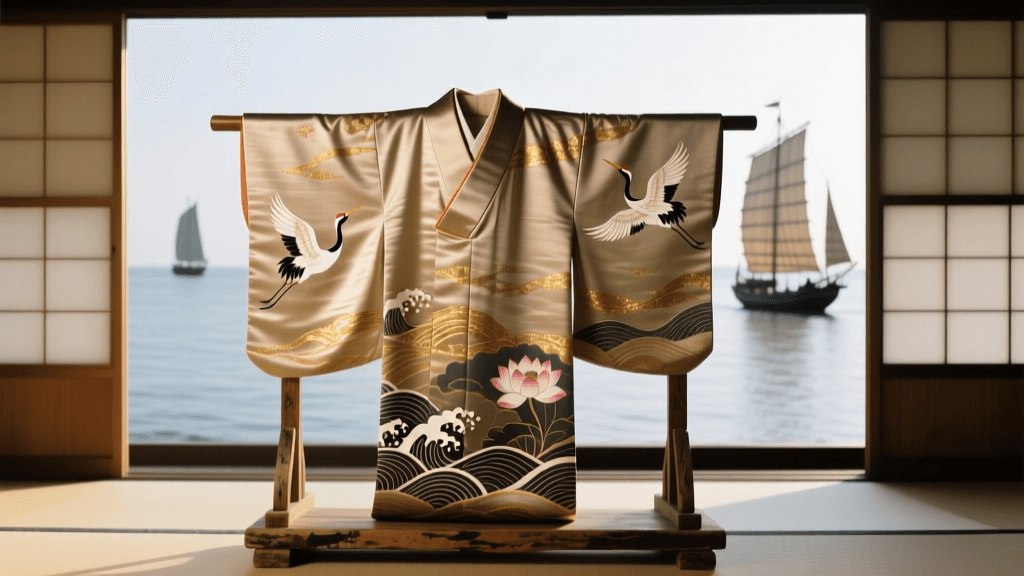
Another fascinating import is the tonbi (kite) or geometric star motifs found in early Japanese tapestries, which trace their lineage directly back to Persian Sasanian textiles. The Metropolitan Museum of Art's Heilbrunn Timeline on the Silk Road details how these motifs were adapted by Japanese weavers, who often combined foreign geometric precision with native naturalistic elements like cherry blossoms or cranes. In 2026, authenticating a Muromachi-era brocade involves looking for the specific metallic thread wrapping techniques (often using imported gold leaf on paper or lacquered substrates) that distinguish early Silk Road-influenced weaves from later, mass-produced Meiji-era reproductions.
The Meiji Era: European Synthetic Dyes and the Yuzen Revolution
The opening of Japan in the late 19th century triggered a massive influx of European imports, fundamentally altering kimono production. The most disruptive import was not a fabric, but a chemical: synthetic aniline dyes from France and Germany. Before this, Japanese yuzen dyers relied on organic, plant-based dyes like indigo, safflower, and madder, which were beautiful but limited in their vibrancy and prone to fading. The introduction of imported synthetic dyes allowed for the creation of "chemical colors" (kagaku iro), resulting in the bold, striking, and sometimes garish purples, magentas, and emerald greens that define late Meiji and Taisho era kimonos.
For contemporary collectors, Meiji-era kimonos featuring early aniline dyes represent a fascinating intersection of traditional Japanese resist-dyeing and Western industrial chemistry. However, these early synthetic imports are notorious for being fugitive; they can bleed or shatter the silk fibers if exposed to moisture or prolonged light. Recognizing the specific hue of early imported magenta—which often carries a distinct, slightly unnatural fluorescence compared to organic safflower red—is a key skill for appraisers in the 2026 antique market.
2026 Collector’s Market: Sourcing and Valuation
Navigating the antique kimono market in 2026 requires a keen eye for provenance and an understanding of current valuation metrics. Trade-route textiles are no longer just sold in local Kyoto flea markets; they are heavily featured in specialized international online auctions and curated vintage textile galleries. Below is a comparative valuation guide for trade-influenced kimonos and accessories based on early 2026 market data.
| Textile Type | Origin / Trade Route | Key Motifs & Features | 2026 Avg. Market Value (USD) |
|---|---|---|---|
| Edo Sarasa Shifuku | India / Maritime Spice Route | Coromandel Chintz, Madder Red Florals | $400 - $1,500 |
| Muromachi Nishiki Brocade | Persia & China / Silk Road | Karakusa Arabesque, Gold Leaf Threads | $1,200 - $3,500 |
| Meiji Aniline Yuzen | Europe / Global Maritime | Bold Botanicals, Synthetic Magenta/Purple | $350 - $950 |
| Taisho Meisen Silk | West / Global Silk Trade | Art Deco Geometrics, Kasuri Ikat Weave | $150 - $600 |
When sourcing these pieces, always request high-resolution macro photography of the selvedge and the dye penetration on the reverse side of the fabric. Authentic Edo-period imported sarasa will show deep, even dye penetration, whereas later domestic stenciled imitations often show a stark white reverse side. Furthermore, provenance documentation from recognized Japanese antique textile associations can increase a garment's 2026 market value by up to 30%.
Preservation of Historical Imports in 2026
Preserving garments that feature imported dyes and foreign weaving techniques requires specialized care, as the materials often age differently than native Japanese silks. The intersection of European aniline dyes and Japanese silk, for example, creates a highly acidic environment over time, leading to fiber degradation. In 2026, conservation standards have evolved significantly to address these specific vulnerabilities.
- Archival Enclosures: Never store trade-route textiles in standard plastic. Use 2026-certified, acid-free, unbuffered washi paper enclosures. Buffered paper (which contains calcium carbonate) can react adversely with the residual acids in early European synthetic dyes, causing color shifts.
- Climate Control: Indian cotton sarasa and silk brocades require different humidity levels. Maintain a strict environment of 50% relative humidity. Fluctuations can cause the metallic threads in Silk Road brocades to snap or tarnish.
- Light Exposure: Early aniline magentas and imported madder reds are highly photosensitive. Display garments using UV-filtering acrylic cases with LED lighting capped at 50 lux to prevent irreversible fading.
- Professional Cleaning: Avoid traditional arai-hari (washing and re-stretching) for garments with early synthetic dyes or fragile imported cottons. Consult a textile conservator who specializes in cross-cultural historical garments to perform localized, solvent-based spot cleaning.
Conclusion: Wearing the World
The kimono is far more than a static relic of Japanese history; it is a dynamic archive of global trade, diplomacy, and artistic cross-pollination. Whether you are bidding on a Muromachi brocade featuring Persian vines or carefully preserving a Meiji-era haori dyed with French anilines, you are acting as a custodian of the ancient trade routes. As the 2026 collector's market continues to recognize the immense historical value of these imported influences, understanding the journey of these textiles—from the bustling ports of the Coromandel Coast and the dusty trails of the Silk Road to the quiet tatami rooms of Kyoto—remains the ultimate key to appreciating the true, global soul of the kimono.