Japanese Traditional Uniforms: Keikogi and Samue Guide
The Philosophy of the 'Way' in Japanese Garments
In Japanese culture, the pursuit of mastery is often referred to as 'Do' (the Way), whether one is practicing martial arts (Budo), the tea ceremony (Chado), or calligraphy (Shodo). The garments worn during these disciplines are not mere clothing; they are physical manifestations of the practitioner's mindset, humility, and respect for tradition. Understanding the nuances of traditional Japanese uniforms—specifically the Keikogi used in martial arts and the Samue worn during tea ceremonies and artisan work—reveals a deep intersection of functionality, textile engineering, and spiritual philosophy.
According to The Metropolitan Museum of Art's historical overview of Japanese martial arts, the evolution of martial garments was deeply tied to the samurai class and the subsequent Edo-period codification of martial schools. Today, these garments have transcended their origins, becoming global symbols of discipline. This guide explores the construction, selection, and meticulous care required for these iconic uniforms.
Keikogi: The Armor of the Martial Artist
The term Keikogi translates to 'practice clothes.' It was developed in the late 19th century by Kano Jigoro, the founder of Judo, who needed a durable uniform that could withstand the rigorous grappling and throwing techniques of his new martial art. As Britannica's historical overview of Judo notes, the creation of the judogi standardized martial arts attire, eventually influencing the uniforms used in Karate, Kendo, and Aikido.
Fabric Weaves and Weight Metrics
Selecting the right Keikogi requires an understanding of fabric weaves and weights, which are typically measured in ounces per square yard (oz/yd²) or grams per square meter (g/m²).
- Single Weave (Hitoegi): Lightweight (8-10 oz / 270-340 g/m²). Ideal for Karate and Taekwondo, where high kicks and rapid, snapping movements require a breathable, unrestrictive fabric. It produces a sharp 'snap' sound when techniques are executed.
- Double Weave (Futaegi): Heavyweight (20-22 oz / 680-750 g/m²). The traditional choice for Judo. The thick, quilted cotton makes it difficult for opponents to grip and tear, while absorbing heavy impacts during throws.
- Gold Weave and Sashiko: Advanced weaves used in competitive Judo and Kendo. Sashiko (rice-grain stitching) provides immense tensile strength, while Gold Weave offers a balance between the lightweight feel of a single weave and the durability of a double weave.
The Rule of the Lapel (Eri)
A critical, non-negotiable rule in wearing the Keikogi (and all traditional Japanese garments) is that the left lapel must always cross over the right lapel. Crossing right-over-left is strictly reserved for dressing the deceased for burial. Ensuring the correct lapel alignment is a fundamental sign of respect in the dojo.
Samue and Chado: The Artisan and Tea Ceremony Garment
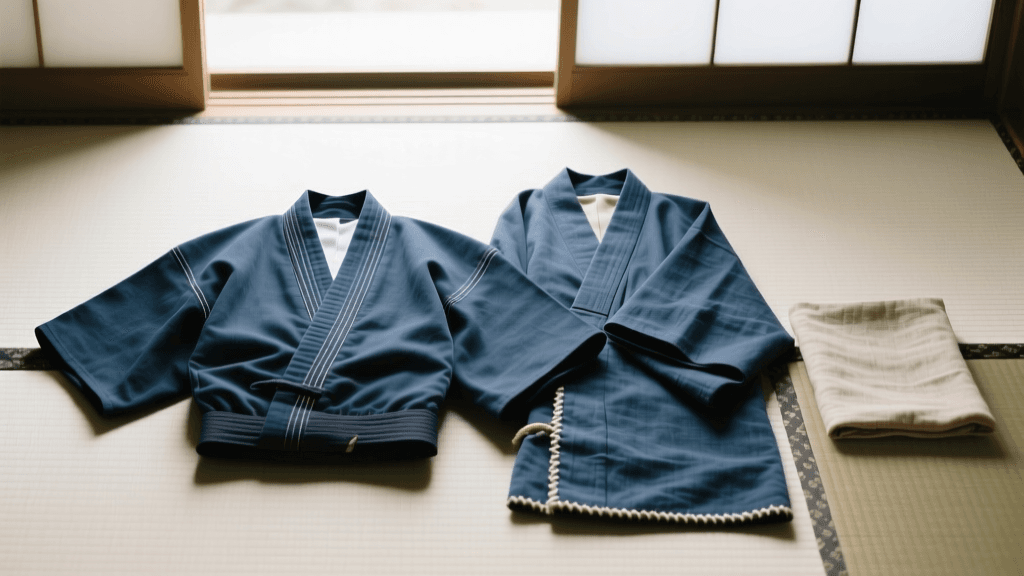
While the Keikogi is built for combat and physical exertion, the Samue is designed for mindful work and tranquility. Originally worn by Zen Buddhist monks for samu (physical labor and temple maintenance), the Samue has been adopted by artisans, woodworkers, and practitioners of the Japanese tea ceremony (Chado).
Design and Textile Choices
The Samue consists of a long-sleeved, wrap-around jacket and loose-fitting trousers that tie at the waist and ankles. Unlike the Kimono, which restricts stride length and requires complex obi tying, the Samue allows for deep kneeling (seiza) and fluid movements required when preparing and serving matcha. As detailed in Britannica's comprehensive guide to traditional Japanese dress, the evolution of Japanese workwear prioritized mobility while maintaining a dignified, structured silhouette.
Tea ceremony practitioners often select Samue made from Tsumugi (a slubbed, textured silk or cotton) or Wazarashi (traditional Japanese cotton that undergoes a weeks-long boiling process to remove impurities, resulting in an incredibly soft, breathable fabric). Earth tones—such as indigo (ai), charcoal (sumi), and matcha green—are preferred to reflect the Zen aesthetic of wabi-sabi (finding beauty in simplicity and imperfection).
Comparative Guide: Keikogi vs. Samue
Understanding the functional differences between these garments is essential for collectors and practitioners. Below is a structured comparison to aid in selection.
| Feature | Keikogi (Martial Arts) | Samue (Tea Ceremony / Artisan) |
|---|---|---|
| Primary Use | Combat, grappling, striking, physical conditioning | Tea preparation, meditation, artisan craft, temple work |
| Standard Fabric | Heavy bleached or unbleached cotton, canvas | Wazarashi cotton, Tsumugi silk, linen blends |
| Fastening | Lapel ties, secured by a heavy woven belt (Obi) | Lapel ties, secured by a simple cotton belt or drawstring |
| Weight | Heavy (up to 750 g/m²) | Light to Medium (150 - 300 g/m²) |
| Mobility Focus | Shoulder and hip flexibility for throws/kicks | Knee flexibility for kneeling (seiza) and bowing |
Practical Care and Maintenance
Traditional Japanese uniforms are investments. Proper care not only extends the life of the garment but is also considered an extension of the practitioner's discipline. A sloppy, wrinkled, or foul-smelling uniform reflects a lack of respect for the art.
Washing and Drying Protocols
Cotton garments, particularly heavy Keikogi, are prone to shrinkage. A raw, unwashed Judo jacket can shrink up to 10% in length and 5% in width if exposed to high heat.
- Temperature: Always wash in cold water (maximum 30°C or 86°F). Hot water breaks down cotton fibers and accelerates shrinkage.
- Detergent: Use a mild, neutral pH detergent. For white Judogi or Karategi, use an oxygen-based bleach. Never use chlorine bleach, as it degrades the cotton matrix, causing the fabric to tear easily during grappling.
- Drying: Air drying is mandatory. Hang the Keikogi on a thick, wooden hanger to support the heavy, wet shoulders. Never use a tumble dryer. For Samue, lay flat or hang in the shade; direct sunlight can cause natural dyes (like indigo) to fade unevenly.
The Art of Folding
In both the dojo and the tea room, how you store your garment is a ritual. The Keikogi should be folded symmetrically, with the sleeves tucked in to form a perfect rectangle, symbolizing order and mental clarity. The Samue is folded similarly, but with the trousers wrapped around the jacket to protect the delicate lapels. Storing these garments in a breathable cotton bag (rather than plastic, which traps moisture and invites mildew) is essential for long-term preservation.
Investment and Sourcing
When building a traditional wardrobe, quality dictates price. Entry-level, mass-produced Keikogi can be found for $40 to $60, but they often feature synthetic blends that trap heat and odor. A master-level, Japanese-woven Judo gi from brands like Mizuno or Shiba Shouten will cost between $180 and $350, offering decades of durability.
Similarly, authentic Samue made from genuine Kurume Wazarashi cotton or silk Tsumugi typically range from $90 to $250. Sourcing directly from specialized Japanese textile retailers ensures that the garments are constructed using traditional flat-felled seams, which prevent fraying and ensure the garment ages beautifully, developing a unique patina that tells the story of the wearer's dedication to their chosen 'Way'.