Qun Kua vs Xiu He Fu: Chinese Wedding Attire Guide
The Cultural Significance of Chinese Wedding Attire
In the rich tapestry of Asian traditions, few garments carry as much historical weight and visual splendor as traditional Chinese wedding attire. For modern brides navigating the intersection of ancient customs and contemporary aesthetics, the traditional tea ceremony (Cha Li) remains the emotional and cultural cornerstone of the wedding day. During this ceremony, the bride and groom serve tea to their elders, symbolizing respect, gratitude, and the formal merging of two families. The attire worn during this ritual is not merely decorative; it is a canvas of auspicious symbolism, meticulous craftsmanship, and regional heritage.
Today, brides primarily choose between two iconic silhouettes: the structured, heavily embroidered Qun Kua and the romantic, flowing Xiu He Fu. Understanding the nuances, history, and practical requirements of each is essential for any bride planning a traditional Chinese wedding. As highlighted by the Metropolitan Museum of Art's exploration of Chinese sartorial history, the use of metallic threads and auspicious motifs in ceremonial wear reflects centuries of evolving textile mastery and cultural storytelling.
Decoding the Qun Kua (裙褂): Cantonese Elegance
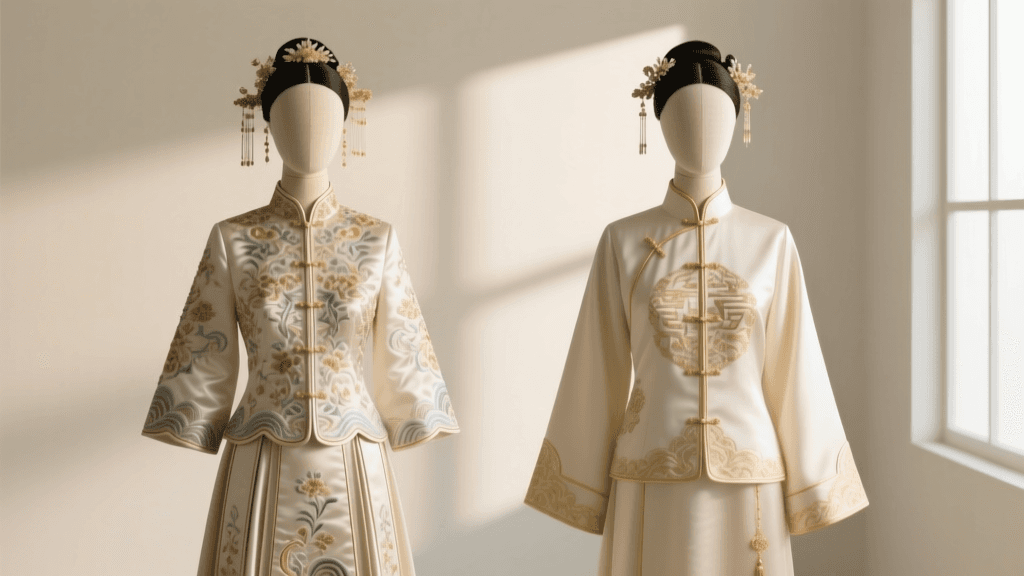
The Qun Kua (often simply referred to as a Kua) traces its roots to the Qing Dynasty and is deeply embedded in Cantonese (Yue) culture. It is a two-piece ensemble consisting of a tailored, mandarin-collared jacket (Gua) and a straight, pleated skirt (Kua). The defining feature of the Qun Kua is its extraordinary embroidery, traditionally executed using Yue Xiu (Cantonese embroidery) techniques with metallic gold and silver threads on a crimson silk base.
The Qun Kua is categorized by its embroidery density, which directly dictates its formality, weight, and price. The five traditional grades are:
- Xiao Wu Fu (小五福): Approximately 30% embroidery density. A lightweight, accessible option for brides on a budget or those preferring a softer drape.
- Zhong Wu Fu (中五福): Around 50% density. A balanced choice offering significant visual impact without excessive weight.
- Da Wu Fu (大五福): Roughly 70% density. Highly popular for weddings, featuring intricate motifs with the red silk still partially visible.
- Gua Huang (褂皇): The pinnacle of bridal Kua, boasting 100% embroidery density. The red silk base is entirely obscured by dense gold and silver metallic threads, creating a stiff, armor-like garment that gleams brilliantly.
- Xiao Huang (小皇): A rare, specialized variation incorporating unique colored silk threads alongside metallic ones, often customized for specific family lineages.
Because of the dense metallic threading, a high-quality Gua Huang can weigh upwards of 10 kilograms (22 lbs). Institutions like the Victoria and Albert Museum preserve historical examples of Qing-era ceremonial jackets, showcasing the staggering patience required for Panjin (gold-couching) embroidery techniques that define these garments.
The Rise of the Xiu He Fu (秀禾服): Romantic Hanfu Revival
While the Qun Kua is steeped in centuries of Cantonese tradition, the Xiu He Fu is a relatively modern creation that draws heavy inspiration from historical Hanfu and Qing-era Han Chinese clothing. The name 'Xiu He' was popularized in the early 2000s, derived from the character Xiuhe in the beloved television drama Orange Turned Red, where the lead actress wore a stylized version of this garment for her wedding scenes.
The Xiu He Fu is characterized by its romantic, forgiving silhouette. The jacket is typically looser, featuring wide, flared bell sleeves or layered horseshoe cuffs, while the skirt is a sweeping A-line or pleated design, often echoing the structure of the traditional Mamian Qun (horse-face skirt). Unlike the Qun Kua, which relies heavily on metallic gold and silver, the Xiu He Fu utilizes vibrant, multi-colored silk threads (often employing Su Xiu or Suzhou embroidery) to depict lush florals, birds, and mythical beasts. This results in a softer, more fluid garment that is highly favored by brides seeking a fairy-tale aesthetic or those desiring greater mobility during their wedding festivities.
Qun Kua vs. Xiu He Fu: A Structured Comparison
| Feature | Qun Kua (裙褂) | Xiu He Fu (秀禾服) |
|---|---|---|
| Cultural Origin | Cantonese / Southern China (Qing Dynasty roots) | Modern stylized Hanfu / Pan-Chinese revival |
| Silhouette | Straight, tailored jacket; straight pleated skirt | Relaxed, flared sleeves; sweeping A-line skirt |
| Embroidery Style | Dense metallic gold/silver (Yue Xiu) | Colorful silk threads, softer textures (Su Xiu) |
| Weight & Drape | Heavy, stiff, structured | Lightweight, fluid, romantic drape |
| Best Suited For | Formal tea ceremonies, traditionalist families | Photoshoots, outdoor ceremonies, modern brides |
Auspicious Motifs: Reading the Embroidery
Every stitch on a Chinese wedding garment carries profound meaning. When selecting your attire, understanding these motifs adds a layer of personal significance to your choice:
- The Dragon and Phoenix (Longfeng): The ultimate symbol of marital balance, representing the groom (dragon) and bride (phoenix) in perfect harmony.
- The Peony: Known as the king of flowers, it symbolizes wealth, honor, and prosperity.
- The Bat (Fu): A visual pun, as the word for bat sounds identical to the word for 'good fortune.' Five bats represent the Five Blessings (longevity, wealth, health, virtue, and a peaceful death).
- The Pomegranate: Bursting with seeds, it is a traditional wish for fertility and a household full of children.
The Practical Guide: Sourcing, Fitting, and Budgeting
Acquiring traditional Chinese wedding attire requires careful planning, precise measurements, and a clear budget. Contemporary cultural publications like Sixth Tone frequently document the modern revival of these garments, noting a massive surge in both bespoke commissions and high-end rental markets.
Timeline and Lead Times
If you opt for a bespoke Qun Kua, particularly a Da Wu Fu or Gua Huang, you must begin the process 12 to 18 months before your wedding. Master artisans in Guangdong or Suzhou may spend over 300 hours hand-stitching a single jacket. For a custom Xiu He Fu, allow 4 to 6 months. If you are renting, secure your reservation 3 to 4 months in advance, especially if your wedding falls during peak auspicious dates (such as the Autumn festival season or specific Lunar New Year dates).
Crucial Measurements
Unlike Western gowns that focus heavily on the bust and waist, traditional Chinese jackets require precise upper-body measurements to ensure the mandarin collar sits flush and the shoulder seams do not droop. You must provide:
- Shoulder Width: Measured exactly from the acromion bone to bone across the back.
- Sleeve Length: Measured from the shoulder seam down to the wrist bone (for Qun Kua) or mid-hand (for Xiu He Fu bell sleeves).
- Hollow-to-Hem: Crucial for the skirt. Measure from your natural waist to the floor, while wearing the exact heel height you plan to use on your wedding day.
Budgeting: Rental vs. Bespoke Costs
The cost disparity between the two garments and sourcing methods is significant. Below is an estimated cost guide in USD:
- Xiu He Fu (Rental): $150 - $400
- Xiu He Fu (Bespoke/Made-to-Measure): $800 - $2,500
- Qun Kua - Zhong/Da Wu Fu (Rental): $400 - $1,200
- Qun Kua - Da Wu Fu (Bespoke): $3,000 - $8,000
- Qun Kua - Gua Huang (Bespoke): $12,000 - $25,000+
Pro Tip: Many brides choose to rent a Gua Huang for the formal morning tea ceremony to honor family traditions, and purchase a mid-tier Xiu He Fu for the evening banquet and outdoor photography sessions.
Accessorizing and Tea Ceremony Etiquette
The attire is only half the equation; the accessories complete the ceremonial look. Traditional brides eschew diamond tiaras in favor of intricate gold hairpins (buyao) and jade combs. A pair of authentic jade bangles is considered essential, often gifted by the groom's mother during the tea ceremony as a symbol of the bride's acceptance into the family.
When wearing a Gua Huang, the stiffness of the metallic embroidery means the jacket does not drape like normal fabric. Brides must practice sitting and bowing to ensure the jacket rests elegantly without riding up. For the Xiu He Fu, practice the 'sleeve sweep'—gracefully gathering the wide bell sleeves with your fingertips before lifting your tea cups to prevent the silk from dipping into the hot tea.
Footwear should consist of traditional red velvet or silk embroidered shoes, often featuring a modest heel and motifs of double happiness or lotus flowers. Ensure the hem of your skirt is tailored to hover exactly one inch above the floor when wearing these specific shoes to prevent tripping during the kneeling portions of the tea ceremony.
Conclusion
Choosing between the Qun Kua and the Xiu He Fu is a deeply personal decision that bridges the gap between honoring ancestral traditions and expressing individual style. The Qun Kua offers unparalleled grandeur, historical weight, and a striking silhouette that commands respect, making it the ultimate choice for the formal tea ceremony. Conversely, the Xiu He Fu provides a romantic, fluid, and highly photogenic alternative that celebrates the broader revival of Han-inspired aesthetics. By understanding the craftsmanship, budgeting accurately, and mastering the etiquette of wearing these magnificent garments, modern brides can ensure their wedding day is a flawless tribute to the enduring beauty of Asian traditions.