Guide to Peking Opera Costumes: Craft, Roles and Sourcing
The Living Canvas of Jingju Fushi
Peking Opera, or Jingju, is a mesmerizing synthesis of music, vocal performance, mime, dance, and acrobatics. Yet, before a single note is sung or a martial arts sequence is performed, the story is already being told through the visual spectacle of Jingju Fushi (Peking Opera costumes). Far from mere historical replicas, these garments are highly stylized, symbolic tools that communicate a character's social status, personality, and moral alignment to the audience instantly. As documented by UNESCO's Intangible Cultural Heritage registry, the art form relies heavily on this elaborate visual language, which has been refined over two centuries of theatrical evolution.
For performers, festival organizers, and cultural collectors, understanding the anatomy, symbolism, and sourcing of these garments is essential. This guide delves into the intricate world of Chinese opera wardrobes, offering practical advice on measurements, craftsmanship, and acquiring authentic pieces for modern performances and festivals.
The Core Garments: Anatomy of the Wardrobe
Unlike Western historical theater, which often strives for period-accurate costuming, Peking Opera costumes are largely ahistorical. They blend elements from the Ming and Qing dynasties into a standardized theatrical wardrobe known as the 'Xiang' (wardrobe boxes). The core garments are categorized by the social standing and role of the character.
The Mang (Python Robe)
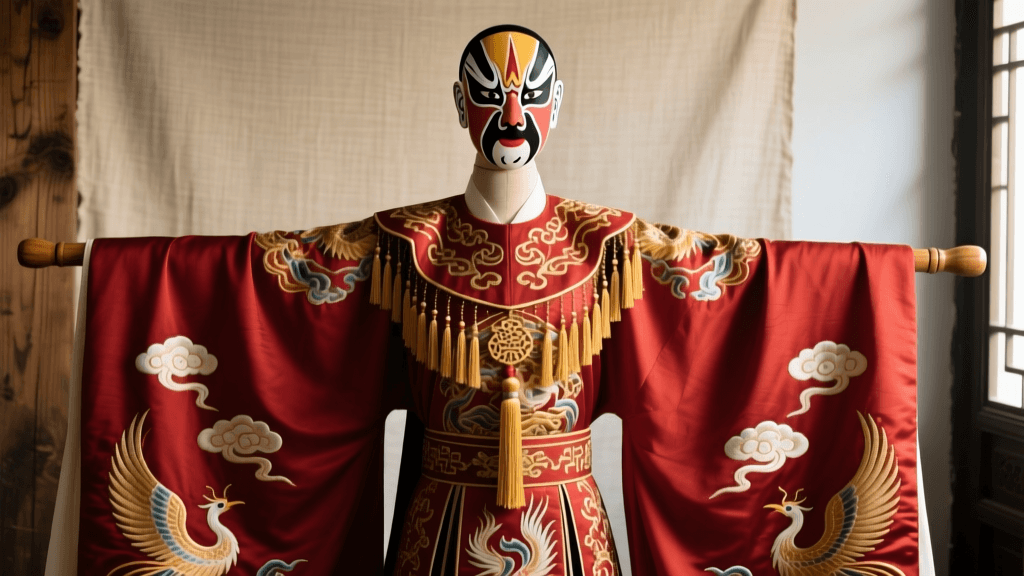
Reserved for emperors, high-ranking officials, and nobility, the Mang is a formal court robe. Despite its name, it features a four-clawed dragon motif (the five-clawed dragon was strictly reserved for the actual Emperor in historical contexts). The Mang is heavily embroidered with metallic threads, sun and moon motifs on the shoulders, and wave patterns at the hem, representing the wearer's dominion over the earth and seas.
The Kao (Armor)
Worn by martial roles (Wusheng and Wudan), the Kao is a spectacular representation of armor. It consists of a front and back panel, shoulder pads, and a belly piece often adorned with a tiger's head. The most striking feature is the four pennants (kaoqi) attached to the back, which amplify the actor's movements during combat sequences and make them appear larger and more imposing. A fully embroidered silk Kao can weigh up to 15 kilograms, requiring immense physical stamina from the performer.
The Xuezi (Scholar's Robe)
The Xuezi is the most common informal garment, worn by scholars, commoners, and officials in casual settings. It features a cross-collar and wide sleeves. The color and embroidery density of a Xuezi immediately denote the wearer's age and economic status; a young scholar might wear a brightly colored, floral-embroidered Xuezi, while an impoverished elder wears a plain, unadorned black one.
Color Symbolism and Character Roles
According to historical analyses found in Encyclopedia Britannica's archives on Beijing Opera, the wardrobe operates on a strict color-coded system. This allows audiences, even those sitting far from the stage, to understand a character's fundamental nature before they speak.
| Color | Symbolic Meaning | Typical Character Archetypes |
|---|---|---|
| Red | Loyalty, bravery, and uprightness | Heroic generals (e.g., Guan Yu), loyal ministers |
| Black | Integrity, impartiality, and roughness | Fierce warriors, impartial judges (e.g., Bao Zheng) |
| White | Treachery, cunning, and suspicion | Villainous officials, treacherous courtiers (e.g., Cao Cao) |
| Yellow | Royalty, divinity, and supreme power | Emperors, empresses, and celestial deities |
| Blue/Green | Rebellion, wildness, and supernatural | Bandit leaders, demons, and forest spirits |
The Magic of Water Sleeves and Headdresses
Shuixiu (Water Sleeves)
Water sleeves are extensions of white silk attached to the cuffs of many garments. They are essential for expressing emotion—trembling sleeves indicate fear, while thrown sleeves convey anger or dismissal. When commissioning a costume, the length of the Shuixiu must be specified based on the role. Standard extensions are 33cm (1 chi) for older or dignified roles, 50cm for standard Dan (female) roles, and up to 70cm for highly expressive, acrobatic performances.
Toumian (Headdresses)
The headdress completes the silhouette. The Fengguan (Phoenix Crown) is worn by noblewomen and brides, traditionally adorned with kingfisher feathers (tian-tsui). Today, ethical and practical modern replicas use dyed goose feathers and silk threads, often weighing over 3 kilograms. Martial characters wear helmets adorned with Lingzi (pheasant feathers), which can extend up to 2 meters in length. Manipulating these feathers to express surprise or anger is a specialized skill requiring years of neck and head conditioning.
Sourcing and Commissioning Costumes
Whether you are outfitting a university theater troupe, preparing for a cultural heritage festival, or building a private collection, sourcing authentic Jingju Fushi requires navigating a spectrum of quality and price. Most professional garments are still hand-embroidered in workshops in Suzhou and Beijing.
| Garment Tier | Material & Craftsmanship | Estimated Cost (USD) | Lead Time | Best Use Case |
|---|---|---|---|---|
| Theatrical Grade | Polyester/Satin, Machine Embroidery | $80 - $250 | 1 - 3 Weeks | Student performances, cosplay, lightweight travel |
| Semi-Professional | Silk-blend, Semi-hand stitched motifs | $400 - $900 | 1 - 2 Months | Regional festivals, indie film, serious amateurs |
| Master Artisan | 100% Mulberry Silk, Su Xiu Hand Embroidery | $1,500 - $5,000+ | 4 - 8 Months | Professional troupes, museum collections, heirlooms |
Crucial Measurements for Custom Tailoring
Opera costumes are not tailored to fit the skin; they are tailored to fit over the 'Cheng' (traditional under-padding) which alters the actor's silhouette. When ordering custom pieces, provide the following:
- Chest & Waist: Measured over the under-padding to ensure the outer robe drapes correctly without pulling at the embroidery.
- Sleeve Length: Measure from the base of the neck, across the shoulder, down to the wrist, and then add the desired Shuixiu (water sleeve) extension length.
- Inseam & Hem: Must account for the thick platform boots (Xuezi) worn by Sheng and Jing roles, which can add 5cm to 15cm in height. The front hem is traditionally cut slightly shorter than the back to prevent tripping during martial arts routines.
Care and Maintenance of Festival Garments
Authentic silk and metallic-threaded garments require meticulous care. The metallic threads (Pan Jin Xiu) are incredibly fragile and will snap or tarnish if exposed to moisture or harsh chemicals.
'Never fold a master-embroidered Mang robe. The metallic threads will crease and eventually break. Always roll the garment around a wide, acid-free cardboard tube, interleaving the folds with unbleached muslin cloth to protect the embroidery from friction.'
- Storage: Store in a cool, dry environment away from direct sunlight, which will fade the vibrant silk dyes (especially the crimson and imperial yellows).
- Cleaning: Never machine wash or dry clean authentic silk opera costumes. Spot clean the inner linings with a damp cloth and mild, pH-neutral detergent. For heavy soiling on master artisan pieces, consult a professional textile conservator.
- Headdresses: Remove all metal pins and store the Fengguan in a custom-fitted, crush-proof box to prevent the delicate wire armatures and feather work from bending.
Conclusion
Peking Opera costumes are masterpieces of wearable art, carrying centuries of cultural symbolism, artisanal techniques, and theatrical innovation. By understanding the distinct roles of the Mang, Kao, and Xuezi, as well as the precise measurements and ethical sourcing practices required, modern performers and festival curators can ensure this vibrant tradition continues to captivate audiences worldwide. Investing in quality craftsmanship not only elevates the visual spectacle of a performance but also supports the intangible heritage of Chinese textile arts.