Peking Opera Costumes: Guide to Mang, Kao, and Pei Robes
The Visual Spectacle of Jingju: Beyond the Stage
Peking Opera, or Jingju, is a mesmerizing synthesis of music, vocal performance, mime, dance, and acrobatics. Yet, before a single note is sung or a sword is drawn, the narrative is established through the Xingtou—the elaborate, highly symbolic wardrobe of the performers. Recognized as an Intangible Cultural Heritage of Humanity by UNESCO, Peking Opera relies on a visual language where every stitch, color, and motif communicates a character's status, temperament, and destiny. Today, these garments are not only confined to the theatre; they are increasingly commissioned for high-level cultural festivals, academic showcases, and heritage revivals.
Unlike Western historical theatre, where costumes attempt to reflect the specific era of the play's setting, traditional Chinese opera costumes operate on a different paradigm. According to Encyclopedia Britannica, the wardrobe is largely stylized and based primarily on Ming Dynasty (1368–1644) dress, regardless of whether the play is set in the Han, Tang, or Qing dynasties. This standardization allows audiences to instantly recognize a character's archetype.
As Asia Society notes, the four main role types in Peking Opera—Sheng (male), Dan (female), Jing (painted face male), and Chou (clown)—each have strict sartorial rules. For collectors, cultural practitioners, and festival organizers looking to commission or wear these garments, understanding the anatomy of the 'Big Three' robes—the Mang, the Kao, and the Pei—is essential.
The Core Wardrobe: Mang, Kao, and Pei
1. The Mang (Python Robe)
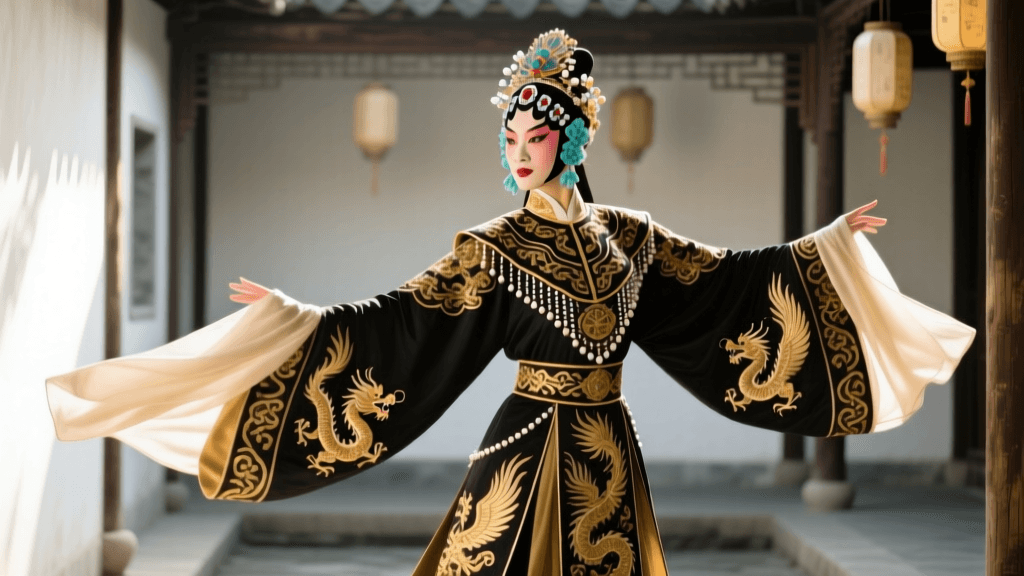
The Mang is the pinnacle of formal court wear in the opera wardrobe, reserved for emperors, high-ranking officials, and nobility. It features a round collar, wide sleeves, and a sweeping hem. The defining characteristic is the embroidery of the 'python' (a dragon-like creature with four claws, as opposed to the five-clawed imperial dragon reserved for the actual Emperor of China). The Mang is heavily structured, often utilizing stiff silk brocades and intricate Suzhou Su embroidery with gold and silver couching threads. Colors are strictly coded: yellow for the emperor, red for high-ranking loyal officials, and black for fierce, upright judges like Bao Zheng.
2. The Kao (Armor)
Worn by generals and martial artists, the Kao is a stylized suit of armor that prioritizes theatrical movement over historical battlefield realism. It consists of a front and back panel, shoulder pads, and embroidered 'scales.' The most striking feature of the Kao is the Kaoqi—four triangular flags attached to the back, representing the general's command over four armies. A fully assembled Kao with flags can weigh between 10 to 15 pounds (4.5 to 6.8 kg), requiring immense core strength from the performer to execute acrobatic flips and martial routines without the flags tangling.
3. The Pei (Informal Robe)
The Pei is the most versatile garment in the Xingtou, serving as the informal, everyday wear for scholars, nobles, and wealthy merchants. It features a cross-collar (wrapping left over right), side slits for ease of movement, and a flowing silhouette. Because it lacks the heavy padding and stiff brocades of the Mang, the Pei is an excellent entry point for modern cultural festivals, allowing for greater mobility and comfort during outdoor Lunar New Year parades or heritage exhibitions.
Actionable Guide: Commissioning Authentic Opera Garments
Acquiring an authentic, hand-embroidered Peking Opera costume is a significant investment of time and capital. Most high-end garments are commissioned from specialized ateliers in Suzhou (famous for silk embroidery) or the Liulichang cultural district in Beijing. Below is a structured guide to help you plan your commission.
| Garment Type | Primary Use / Role | Key Measurement Focus | Estimated Cost (USD) | Lead Time |
|---|---|---|---|---|
| Mang (Python) | Emperors, High Officials | Hem circumference, shoulder width | $3,000 - $12,000 | 4 - 8 Months |
| Kao (Armor) | Generals, Martial Roles | Waist, flag mount width, inseam | $2,500 - $8,000 | 3 - 6 Months |
| Pei (Informal) | Scholars, Nobles at home | Sleeve length, chest, hip drop | $800 - $3,500 | 2 - 4 Months |
| Shuixiu (Water Sleeves) | Expressive movement (Dan/Sheng) | Wrist attachment, silk weight | $150 - $400 | 1 - 2 Months |
Festival Adaptation Tip: If you are commissioning robes for outdoor summer cultural festivals rather than indoor stage performances, request a polyester-silk blend base fabric with machine-assisted embroidery accents. This reduces the garment's cost by up to 60%, cuts the lead time to 4 weeks, and significantly reduces the risk of water stains and heat exhaustion for the wearer.
Mastering the Water Sleeves (Shuixiu)
No Peking Opera costume is complete without Shuixiu, or 'water sleeves.' These are extensions of pure white silk attached to the cuffs of the Mang or Pei. They are used to amplify the actor's emotions, mimicking the ripples of water or the fluttering of clouds.
- Measurements: For amateur performers and festival wearers, a sleeve length of 18 to 22 inches (45-55 cm) is ideal. Professional stage actors often use sleeves up to 24 inches or longer, but this requires years of wrist-strengthening exercises to manipulate without the silk dragging on the floor.
- Attachment: Authentic water sleeves are not permanently sewn. They are attached via small fabric loops and toggle buttons at the inner wrist cuff, allowing them to be removed for washing or when the actor needs to perform martial arts sequences that require bare hands or weapon handling.
- Fabric Weight: Specify '16 momme to 19 momme' pure mulberry silk when ordering. Anything lighter will tangle and lack the dramatic 'snap' required for techniques like Touxiu (throwing the sleeve).
Footwear and Undergarments: The Hidden Architecture
The majestic silhouette of a Peking Opera costume is an illusion created by extensive under-padding and specialized footwear.
For male roles (Sheng and Jing), the Xuezi (thick-soled boots) are mandatory. These boots feature wooden platform soles ranging from 2 to 3.5 inches in height, covered in white cotton and black velvet. The elevated heel alters the actor's center of gravity, forcing a wide, grounded stance that translates to immense authority on stage. When ordering Xuezi for festival wear, ensure you measure your foot width while wearing the thick cotton performance socks (Wazi), as the boots are notoriously narrow and rigid.
Beneath the outer robes, performers wear a Xuezi (an informal inner robe) and padded vests. For the Mang, a stiff, quilted collar pad is worn around the neck to push the heavy collar outward, creating the imposing, broad-shouldered look characteristic of high officials. When dressing for a festival, allow at least 45 to 60 minutes for the full layering process, as the inner ties must be secured tightly to support the weight of the outer embroidery.
'The costume does not merely dress the actor; it is the physical manifestation of the character's soul. To wear the Mang is to carry the weight of the empire; to wear the Kao is to bear the burden of war.'
— Traditional Jingju Wardrobe Proverb
Care, Maintenance, and Storage
Authentic opera garments are masterpieces of textile art and require meticulous care, especially when transported between festival venues.
- Cleaning: Never dry-clean a fully embroidered Mang or Kao, as the harsh chemicals will strip the metallic threads and cause the silk base to pucker. Instead, use a specialized textile vacuum with a mesh screen to gently remove dust. Spot clean silk bases with distilled water and a pH-neutral silk detergent.
- Water Sleeves: These should be removed after every use and hand-washed in cool water. Hang them vertically to dry, and iron them on the lowest silk setting while they are still slightly damp to maintain their crisp, fluid drape.
- Storage: Never hang a heavy Mang or Kao on a standard wire or wooden hanger; the weight of the embroidery will tear the shoulder seams over time. Use wide, heavily padded archival hangers. For long-term storage, fold the garments loosely with acid-free tissue paper stuffed into the sleeves and bodice to prevent hard creases from forming in the metallic threads, and store them in breathable cotton garment bags in a climate-controlled environment.
Conclusion
Whether you are stepping onto a professional stage or participating in a vibrant Lunar New Year heritage parade, wearing Peking Opera costumes is an act of profound cultural preservation. By understanding the distinct roles of the Mang, Kao, and Pei, and by respecting the precise measurements and craftsmanship required to create them, you ensure that the visual poetry of Jingju continues to captivate audiences for generations to come.