Patola Double Ikat vs Banarasi Brocade: 2026 Bridal Guide
The 2026 Renaissance of Heritage Bridal Silks
As we navigate the bridal season of 2026, the South Asian wedding trousseau is experiencing a monumental shift. Modern brides are moving away from mass-produced, synthetic-heavy lehengas and heavily embroidered net fabrics, pivoting instead towards 'quiet luxury' and heritage investment pieces. At the absolute pinnacle of this movement are two of India's most revered textile traditions: the Patola double ikat of Gujarat and the Banarasi brocade of Varanasi. Both represent centuries of mastery, but they offer vastly different aesthetics, drapes, and cultural narratives. For the 2026 bride building an heirloom trousseau, understanding the structural and stylistic differences between these two legendary silks is essential.
The Unmatched Mastery of Patan Patola (Double Ikat)
Originating from the Patan region of Gujarat, authentic Patola is a double ikat textile, meaning both the warp (longitudinal) and weft (transverse) silk threads are resist-dyed before they are even placed on the loom. According to the Victoria and Albert Museum's Asian Collections, the resist-dyeing technique of ikat represents one of the most complex and mathematically demanding textile traditions in human history. The weaver must calculate the exact placement of every dyed thread so that when the warp and weft intersect, they form a flawless, vibrant geometric or figurative pattern.
In 2026, the scarcity of master Patola weavers has elevated these garments to the status of wearable fine art. A single Patan Patola sari can take four to six months to complete, with weavers managing only a few inches of progress per day. The resulting fabric is renowned for its striking colorfastness; because the threads are dyed to their core before weaving, a Patola sari is famously said to retain its vibrancy for over a century, even as the silk itself eventually wears thin.
The Timeless Opulence of Banarasi Brocade
If Patola is a triumph of mathematical precision, Banarasi brocade (often referred to as Kinkhwab) is a masterpiece of sculptural weaving. Hailing from Varanasi, Uttar Pradesh, Banarasi saris are woven on jacquard looms using supplementary weft threads—traditionally pure silver zari coated in gold—to create intricate, raised patterns against a lustrous silk background. The Ministry of Textiles, Government of India has heavily promoted Geographical Indication (GI) tags in recent years to protect authentic Banarasi weaves from power-loom counterfeits, ensuring that 2026 buyers receive genuine handloom heritage.
The 2026 bridal market has seen a massive surge in demand for 'tissue' Banarasi and matte-finish zari. While traditional high-shine gold zari remains popular for grand ceremonies, contemporary brides are increasingly drawn to the subdued elegance of Roopchandi (silver-toned) and antique matte zari, which offers a sophisticated, vintage aesthetic that photographs beautifully under modern LED wedding lighting.
Decoding Motifs: Symbolism in Every Thread
Both textiles rely on deeply symbolic motifs, though their execution differs wildly due to the weaving techniques.
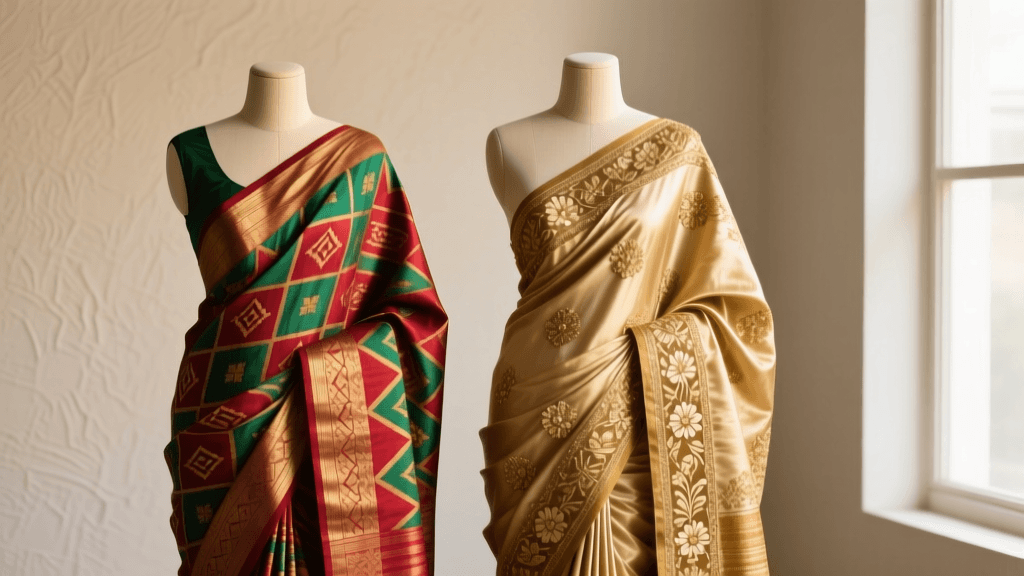
- Patola Motifs: Because double ikat requires precise alignment, Patola motifs are heavily geometric and stylized. The Narikunj (elephant) symbolizes royalty and good luck, while the Popat (parrot) represents love and fidelity. The Chokta (diamond grid) is a classic architectural pattern that provides a striking, modern visual appeal.
- Banarasi Motifs: The jacquard loom allows for fluid, curved, and highly detailed designs. The Kalga (paisley or mango motif) is the most ubiquitous, symbolizing fertility and harvest. Jal (trellis) patterns create a net-like backdrop of flowers, while Shikargah motifs depict intricate hunting scenes with animals and foliage, weaving a literal story into the pallu.
2026 Fabric Comparison Chart: Patola vs. Banarasi
| Feature | Patan Patola (Double Ikat) | Banarasi Brocade (Kinkhwab) |
|---|---|---|
| Weaving Technique | Resist-dyed warp & weft | Jacquard loom with supplementary weft |
| Primary Silk Type | High-twist Patola silk (crisp) | Kattan (raw) or soft spun Mulberry silk |
| Metallic Thread (Zari) | Rarely used; relies on silk dye contrast | Essential; pure silver/gold or tested zari |
| Average Weight | Light to Medium (400g - 600g) | Medium to Heavy (600g - 1.2kg) |
| Drape Quality | Stiff, structured, holds sharp pleats | Fluid, heavy, requires careful pleating |
| 2026 Bridal Price Range | $4,500 - $15,000+ USD | $1,200 - $6,000+ USD |
| Custom Weave Lead Time | 6 to 12 months | 2 to 5 months |
Drape, Weight, and Modern Styling
The structural differences between Patola and Banarasi dictate how they should be styled. Patola silk is spun with a high twist, giving the fabric a slightly crisp, almost paper-like hand feel. This stiffness is a massive advantage for structured drapes like the Gujarati Seedha Pallu or the Rajasthani style, as the pleats will stay razor-sharp throughout a multi-hour ceremony without the need for excessive pinning. In 2026, fashion stylists are also draping Patola saris over structured corset tops and wide-leg palazzo pants for reception wear, utilizing the fabric's architectural stiffness to create avant-garde silhouettes.
Banarasi silk, particularly when woven with soft Kattan yarn, possesses a luxurious, heavy fluidity. It clings to the body and drapes with a regal weight, making it the undisputed queen of the classic Nivi drape or the elaborate Bengali style with its broad, cascading pallu. However, the heavy zari work can make the fabric prone to slipping. For the 2026 bride, wearing a Banarasi sari requires a well-fitted, sturdy cotton or silk petticoat and strategic use of fabric tape to manage the weight of the pallu.
Navigating 2026 Pricing and Authenticity
The global silk market has experienced significant fluctuations, and as of 2026, the cost of premium mulberry silk yarn and pure silver zari has driven up the baseline prices for authentic handlooms. A genuine Patan Patola sari is an elite investment. Due to the extreme scarcity of the Salvi weaver community and the sheer man-hours required, entry-level authentic double ikat saris start around $4,500 USD, with intricate, multi-color masterpiece bridals easily exceeding $15,000 USD.
Banarasi brocades are more accessible but still represent a significant investment. A pure silk Banarasi with real silver zari starts around $1,200 USD, with highly complex Jangla or Shikargah designs reaching $6,000 USD. To combat the influx of power-loom fakes, top Banarasi cooperatives in 2026 have begun embedding washable NFC (Near Field Communication) threads into the sari's pallu. Brides can scan the hem with their smartphones to verify the weaver's name, the loom location, and the GI certification, ensuring absolute authenticity.
For historical context on the evolution of these metallic thread weaves, the Metropolitan Museum of Art's Asian Silk Collection showcases centuries of brocade evolution, highlighting how modern Banarasi techniques are direct descendants of ancient Mughal and Persian textile exchanges.
Archival Care for Heirloom Textiles
Treating these garments as generational heirlooms requires modern, science-backed preservation methods. The outdated practice of storing silks in plastic covers or using naphthalene (mothball) cubes is highly discouraged in 2026, as the off-gassing degrades protein-based silk fibers and tarnishes pure silver zari.
- Cleaning: Avoid traditional chemical dry cleaning, which strips silk of its natural sericin proteins. Seek out specialized heritage textile spas that use liquid silicone or ozone-based cleaning technologies, which are gentle on both the silk and the metallic zari.
- Storage: Wrap the sari in unbleached, acid-free muslin cloth or archival tissue paper. This allows the fabric to breathe while protecting it from ambient humidity and light.
- Pest Control: Instead of chemical mothballs, use sachets of dried neem leaves, cedar blocks, and lavender. Store the wrapped sari in a cedarwood chest, which naturally repels insects and regulates moisture.
- Maintenance: Refold the sari every three to four months along different lines to prevent permanent crease marks and fiber breakage along the fold lines.
Final Thoughts for the 2026 Bride
Choosing between Patola double ikat and Banarasi brocade is ultimately a choice between two different expressions of luxury. Patola offers crisp, geometric brilliance and an unmatched legacy of colorfastness, perfect for the bride who values architectural structure and extreme rarity. Banarasi offers fluid, opulent romance, dripping in metallic motifs and historical grandeur, ideal for the bride seeking a classic, regal silhouette. By understanding the intricate realities of these weaves, the 2026 bride can confidently invest in a textile that will not only define her wedding day but will serve as a cherished family heirloom for the next century.